
Unbiased headlines. Facts, not spin.
Every story is an unbiased news briefing written from 110+ sources across the spectrum — sources linked so you can verify it yourself.
 tech
Notable (6/10)
August 4, 2026 at 02:38 AM
tech
Notable (6/10)
August 4, 2026 at 02:38 AM
Sequoia Leads $1 Billion Round for Nuclear Startup Valar Atomics, Valuation Triples to $6 Billion
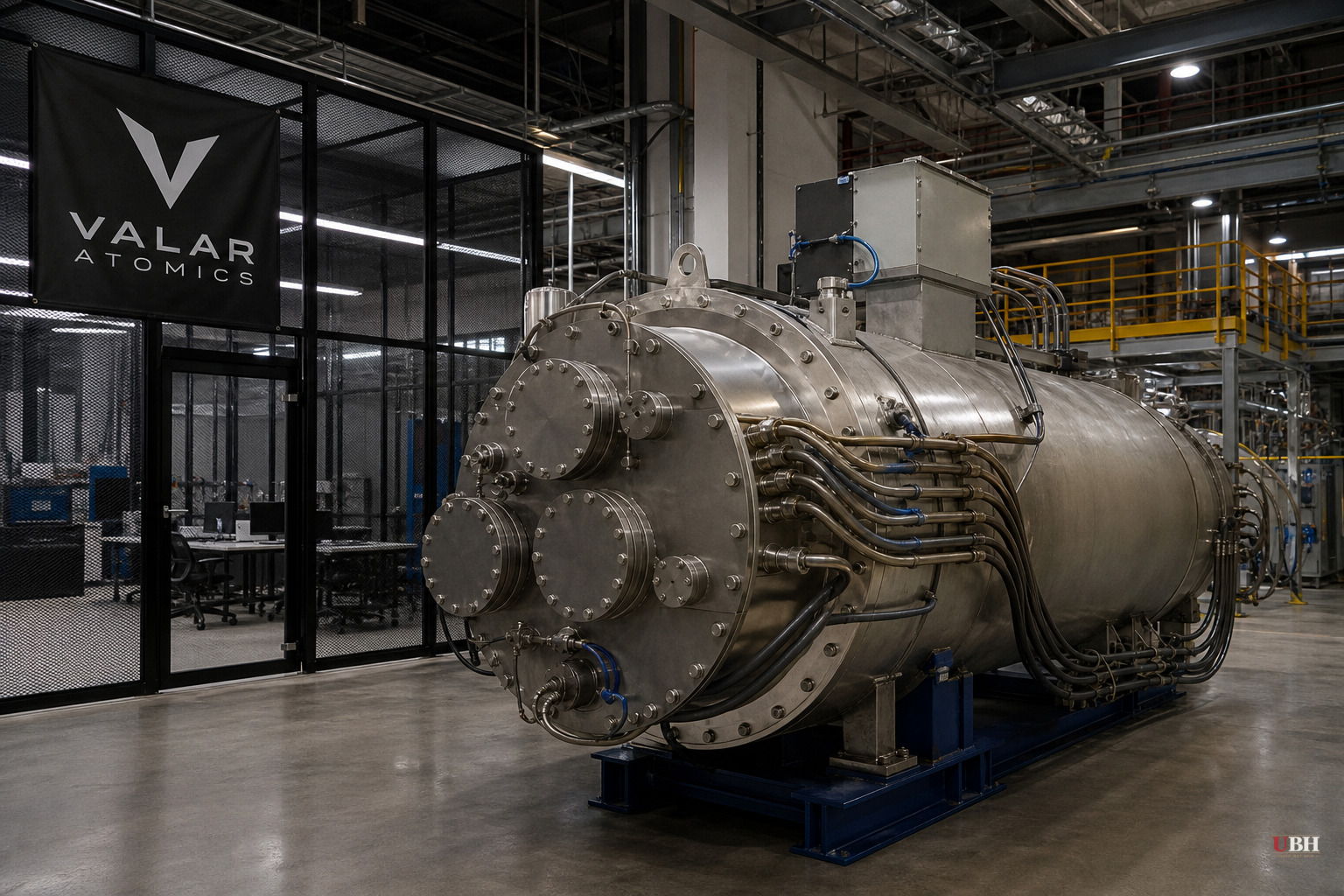
Sequoia Capital just placed a $1 billion bet on nuclear power. Valar Atomics, a small modular reactor startup based in El Segundo, California, announced Monday it closed a $1 billion Series B, according to TechCrunch. The deal values the company at $6 billion, according to Bloomberg reporting cited by TechCrunch and confirmed in a company statement carried by the LA Times.
That's triple the $2 billion valuation Valar carried just months earlier, when it raised $450 million, according to TNW. The company also closed a $130 million Series A in November 2025, according to KuCoin. Three funding rounds in under two years, each bigger than the last, is not normal even by Silicon Valley standards.
Sequoia partner Shaun Maguire is joining Valar's board as part of the deal. Other participants include Atreides Management, Point72, Snowpoint Ventures, Conviction, Dream Ventures, HOF Capital, Riot Ventures, Valor Equity Partners, and Apandion Capital, according to TechCrunch. Valar also lined up a $200 million credit facility from Erebor and other lenders, giving it roughly $1.2 billion in total firepower.
What Valar Actually Builds
Valar makes high-temperature, gas-cooled small modular reactors that run on TRISO fuel, a durable fuel particle encased in ceramic layers, and are cooled with helium instead of water, according to KuCoin. The pitch is that these reactors can be factory-built and standardized rather than custom-engineered on-site, which is the main reason traditional nuclear projects blow through budgets and timelines.
Founder and CEO Isaiah Taylor calls the deployment model "gigasites," clusters of reactors built together to supply massive, reliable power to AI data centers, industrial plants, and hydrogen facilities without leaning on the local grid.
The company says it took two years to complete its NOVA reactor core, but only seven months to bring its Ward 250 reactor to criticality, according to TechCrunch. Taylor told Bloomberg TV, in comments carried by the LA Times, that the goal now is proving "pace of production." His stated target: go from building one reactor a year to one every six months, then one a month, then faster still.
The Nvidia Connection
In July, Valar used a fission reaction to generate enough electricity to power an Nvidia AI chip and host a website, according to the LA Times and TNW. Valar and Nvidia are now planning a 30-megawatt AI facility in Utah powered entirely by Valar's reactors, with no grid electricity, according to TNW.
Nvidia says the closed-loop cooling design could cut water use at AI facilities from 2.6 million gallons per megawatt annually to nearly zero, per TNW's reporting. That matters because Utah's governor signed new data center rules in May after community backlash over water and power consumption tied to conventional facilities. A reactor that draws no grid power and uses almost no water sidesteps the exact objections that have stalled other data center projects in the state.
The Skeptic's Case
Small modular reactors are, as TNW put it, "known for over-budget and delayed projects," and none are in commercial service anywhere outside China and Russia. That's not a knock on Valar specifically. It's the track record of the entire SMR category going back decades. Promises of cheap, fast, factory-built nuclear have been made before and mostly haven't delivered on schedule or on budget.
Valar is one of four companies that have hit criticality with a new reactor design this year, according to the LA Times, which suggests the technical bar isn't unique to Valar. What's unproven is the manufacturing bar: going from a single demonstration reactor to producing "tens, then hundreds, then thousands" of them, in TechCrunch's phrasing of Valar's own claim. That's an industrial and regulatory challenge, not just an engineering one, and it hasn't been done at this scale by anyone in the West.
KuCoin's coverage notes the Department of Energy backed the Ward 250 test reactor and that federal executive orders have pushed to accelerate nuclear deployment, framing this as evidence of "regulatory tailwinds." That's a fair read of federal policy direction, but it doesn't mean licensing and permitting hurdles at the state and local level are resolved. No source here reports that Valar has cleared full commercial licensing for volume production.
What Happens Next
The AI industry's power appetite is the entire reason this round happened. KuCoin cites projections that AI workload electricity demand could surpass 200 terawatt-hours by 2030, roughly the consumption of a mid-sized European country. Solar and wind can't reliably meet that kind of round-the-clock demand, which is why Big Tech and its investors are suddenly interested in nuclear again.
Valar isn't alone chasing that money. Antares raised $470 million in recent months and X-energy raised $1 billion through its IPO, according to TechCrunch. The real test for all of them, Valar included, is whether any can turn a working prototype into a factory line producing reactors on the timeline Taylor is promising. Nobody has done that yet, anywhere in the West.
Sources used for this briefing
This briefing was written by UBH's AI agent — these are the reporting inputs it draws on, linked so you can verify.


