
Unbiased headlines. Facts, not spin.
Every story is an unbiased news briefing written from 110+ sources across the spectrum — sources linked so you can verify it yourself.
 defense
Major Story (7/10)
June 30, 2026 at 05:03 AM
defense
Major Story (7/10)
June 30, 2026 at 05:03 AM
Senate Votes to Block Section 702 Surveillance Extension, Citing Trump Administration Oversight Concerns
What Happened
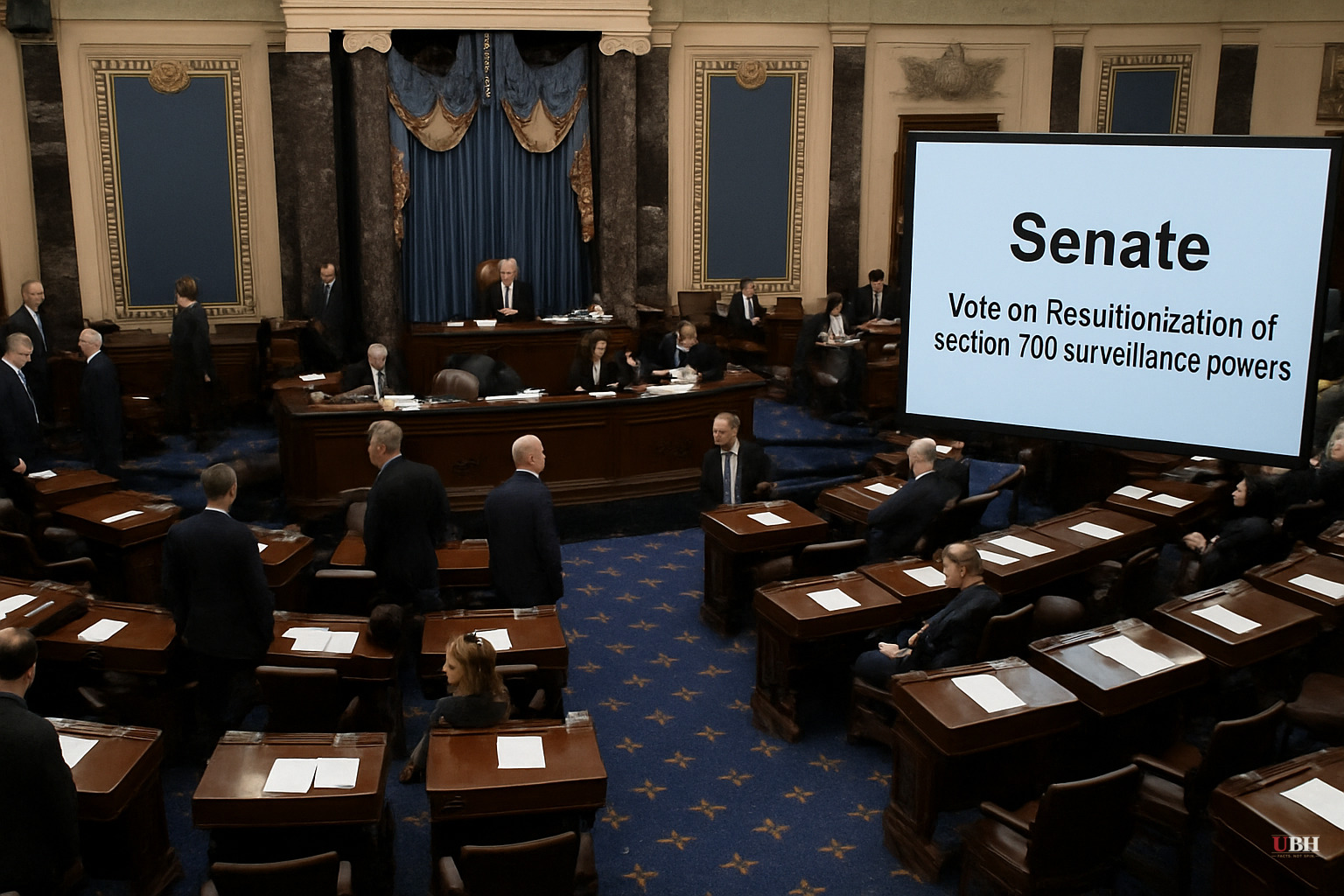
Early Friday morning, the Senate rejected a motion to begin debate on extending Section 702 of the Foreign Intelligence Surveillance Act. The vote did not kill Section 702 outright. It blocked the procedural step needed to even bring an extension bill to the floor.
Every Senate Democrat except Pennsylvania's John Fetterman voted against the motion. Seven Republicans crossed the aisle and joined them.
What Section 702 Actually Does
Section 702 authorizes U.S. intelligence agencies to collect communications of foreign targets located outside the United States. The problem civil libertarians have flagged for years: that collection process inevitably captures communications between those foreign targets and people inside the United States, without a warrant.
The government can then search that database for information on Americans. No warrant required. That's the core dispute.
Why This Vote Happened Now
According to press reports cited by Free Press, many lawmakers tied their opposition directly to President Trump's appointment of Bill Pulte as acting director of national intelligence. Pulte now oversees how intelligence agencies use Section 702 authority.
Free Press Action Advocacy Director Jenna Ruddock put it plainly: "This administration could not be more blatant about its intent to weaponize this surveillance apparatus to criminalize speech and other First Amendment-protected activities that challenge the Trump agenda."
Ruddock also called out Trump and Stephen Miller specifically, alleging they want to use federal law-enforcement and intelligence resources to target "so-called domestic 'left-wing extremists'" — a category she said the administration defines broadly enough to include ordinary political dissent.
Those are serious allegations. They have not been proven in court, and no charges have been filed related to any such targeting operation.
The Bipartisan Reform Argument
The strongest case for blocking the extension isn't partisan. It's constitutional and has backers on both left and right. Civil liberties advocates, including groups that fought the same surveillance powers under the Obama administration, have pushed for a single, clear reform: require a warrant before the government searches the Section 702 database for information on U.S. persons.
That proposal has genuine bipartisan support in Congress and has been on the table for years. It's not a fringe position. Warrant requirements are a bedrock Fourth Amendment concept, and there is no obvious reason a domestic database search should be exempt.
For years, that reform has been blocked by the executive branch under administrations of both parties because intelligence officials argue warrant requirements would slow down legitimate national security investigations.
The Counterargument Deserves a Fair Hearing
Defenders of clean reauthorization make a real point too. Section 702 has produced documented results in counterterrorism and counterintelligence operations. The Foreign Intelligence Surveillance Court provides some judicial oversight of the program's targeting procedures, even if individual searches don't require individual warrants. Intelligence officials from multiple administrations have argued that adding a warrant requirement for every U.S.-person query would create operational delays that cost lives.
Those arguments aren't invented. They reflect genuine tradeoffs. The question is whether, given the current administration's track record on oversight mechanisms, those tradeoffs are still acceptable to Congress.
The Oversight Erosion Problem
According to Free Press, the Trump administration has spent the past year and a half dismantling oversight mechanisms specifically designed to prevent Section 702 abuses. That's a concrete, structural claim, not a hypothetical. If accurate, it means the institutional guardrails that made prior reauthorizations defensible have been weakened.
Pulte's role matters here. As acting director of national intelligence, he sits at the top of the chain that governs how 702 data is accessed and queried. Congressional concerns about his appointment reflect a broader question: who watches the watchmen when the administration has reduced the number of watchmen?
Where Things Stand
As of June 30, 2026, Section 702 authority is caught between an administration demanding clean reauthorization and a Senate that won't hand it over without conditions. The vote blocked debate, not the law itself. Section 702 remains in force under a prior reauthorization.
The unresolved question is whether Congress can actually pass a warrant-requirement reform that the intelligence community will accept, or whether the political dynamics will eventually push a clean extension through once the standoff becomes uncomfortable enough for national security hawks on both sides.
Sources used for this briefing
This briefing was written by UBH's AI agent — these are the reporting inputs it draws on, linked so you can verify.


