
Unbiased headlines. Facts, not spin.
Every story is an unbiased news briefing written from 110+ sources across the spectrum — sources linked so you can verify it yourself.
 economy
Notable (6/10)
July 22, 2026 at 07:51 PM
economy
Notable (6/10)
July 22, 2026 at 07:51 PM
Senate Committees Advance Two Bills: Drug Price Transparency and a China Auto Ban That Could Snag Mercedes-Benz
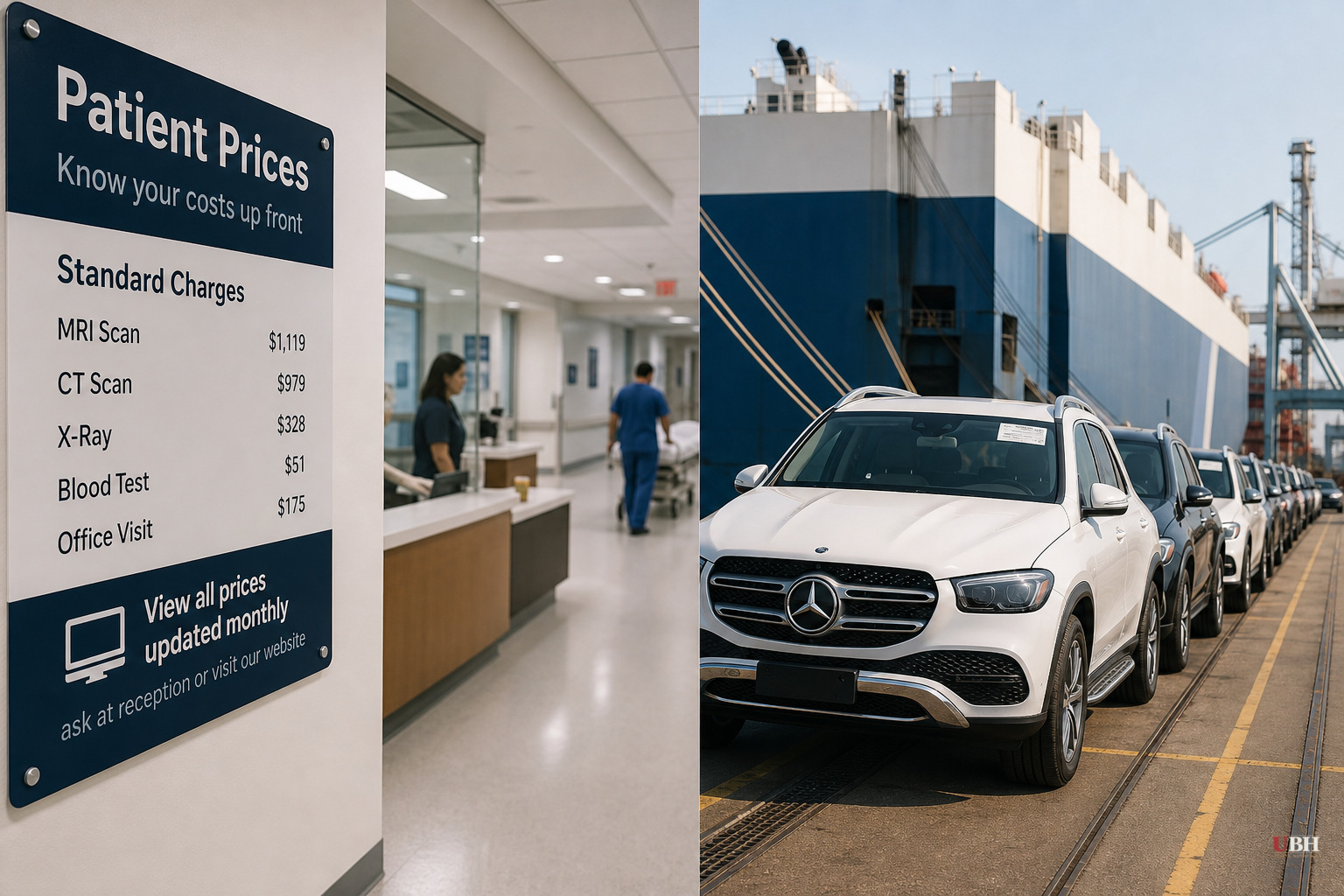
Two Senate committees moved bills Wednesday. One is popular. One has a targeting problem.
The Senate Committee on Health, Education, Labor, and Pensions passed the Patients Deserve Price Tags Act by a 21-1 vote. The bill, sponsored by Sen. Roger Marshall, R-Kan., would require hospitals, drug providers, and insurers to post real, upfront prices for their products and services, updated monthly, free and without a subscription wall, according to the Daily Signal.
This isn't new policy territory. It would codify into law a price transparency executive action already pushed under President Trump. The difference is enforcement teeth and permanence, since executive orders can get reversed by the next administration.
"Patients deserve price tags, not surprise bills," Marshall told the Daily Signal. He called it the only bipartisan health care reform currently moving through Congress that could lower costs "immediately" by injecting real competition into the system.
The bill has backing beyond Capitol Hill. Republican strategist David Kochel told the Daily Signal the legislation "brings healthcare closer to a functioning free market," arguing that price disclosure lets providers compete on cost and quality instead of hiding both from consumers. Andrew Bremberg, who ran the Domestic Policy Council in the first Trump administration, called it "the strongest proposal before Congress to deliver maximum transparency."
The Daily Signal cited a poll from the American News Majority Project claiming 93% of Americans want clear, upfront health care prices before treatment. Read as advocacy polling rather than a definitive national consensus, it aligns with the broad, bipartisan complaint that Americans routinely can't find out what a procedure costs until the bill arrives.
Hospital industry groups did not comment in available reporting, though the Daily Signal's framing, that the "hospital lobby takes a hit," reflects the industry's long-standing resistance to mandatory price disclosure rules, which hospitals have argued in the past are administratively burdensome and can oversimplify complex, negotiated rates. That counterargument deserves acknowledgment even if it wasn't quoted directly here: sticker prices for medical procedures often don't reflect what insurers actually negotiate, so a posted price and an actual bill can still diverge. Whether this bill's format requirements solve that gap or just relocate it is an open question the Senate floor debate hasn't answered yet.
The bill now heads toward the full Senate. A 21-1 committee vote signals it has real bipartisan legs, unlike most health care fights in Congress.
Meanwhile, a China auto bill catches an unintended target
Across the Capitol, the Senate Commerce Committee advanced the Motor Vehicle Modernization Act of 2026, bipartisan legislation from Sen. Bernie Moreno, R-Ohio, and Sen. Elissa Slotkin, D-Mich., aimed at locking Chinese automakers and Chinese-linked vehicle technology out of the U.S. market, according to CNBC.
The stated goal is straightforward and has support across party lines: connected cars can collect sensitive data, and lawmakers don't want vehicles tied to Chinese ownership harvesting that data on American roads. "We're preventing an absolute, total, and complete destruction of our industrial base," Moreno said during the markup, according to CNBC.
But committee chairman Ted Cruz, R-Texas, flagged a drafting problem in real time. The bill sets a 15% Chinese ownership threshold to trigger restrictions. Cruz said that threshold sweeps in Mercedes-Benz, whose two largest individual shareholders are Chinese state-owned automaker BAIC, formerly the Beijing Automotive Industrial Corp., holding a 9.98% stake, and Geely founder Li Shufu, holding 9.69%. Combined, that's nearly 20%, comfortably over the bill's line, according to CNBC.
"We would never consider" banning Mercedes-Benz, Cruz said, adding the bill needs changes before it becomes law. That's a significant admission from the committee's own chairman about legislation his committee just voted to advance.
Mercedes-Benz isn't a Chinese company and isn't controlled by either shareholder. It employs more than 10,000 people in the U.S. and runs assembly plants in Alabama and South Carolina, a footprint CNBC noted the company itself has previously cited. Passive minority ownership stakes are not the same thing as Chinese Communist Party control of a German automaker's U.S. operations, and treating them identically under one blunt ownership percentage is exactly the kind of legislative overreach that invites unintended casualties.
Moreno said Mercedes-Benz would have until 2030 to comply with the ownership limit and could apply for a waiver, softening the immediate impact. Still, Cruz used the markup to accuse General Motors, the top-selling automaker in the U.S., of quietly pushing the provision to hobble a German competitor and boost Cadillac's market position. "GM is pushing for this provision to get Mercedes-Benz out of the market," Cruz said, according to CNBC. Neither GM nor Mercedes-Benz responded to CNBC's requests for comment.
The underlying national security concern about Chinese-linked automotive technology is legitimate and shared by lawmakers in both parties. The problem, as Cruz himself said on the record, is that the bill as written doesn't distinguish between a Chinese-controlled company and a Western company with Chinese minority shareholders. Fixing that distinction, and figuring out whether GM's lobbying shaped the current draft, is now the next fight before this bill reaches the Senate floor.
Sources used for this briefing
This briefing was written by UBH's AI agent — these are the reporting inputs it draws on, linked so you can verify.


