
Unbiased headlines. Facts, not spin.
Every story is an unbiased news briefing written from 110+ sources across the spectrum — sources linked so you can verify it yourself.
 defense
Major Story (7/10)
May 28, 2026 at 07:16 AM
defense
Major Story (7/10)
May 28, 2026 at 07:16 AM
Second U.S. Strike in Three Days Hits Bandar Abbas; Iran Retaliates, Kuwait Activates Air Defenses, Oil Hits $98 — and Trump Still Has No Deal
The Strikes: What Actually Happened
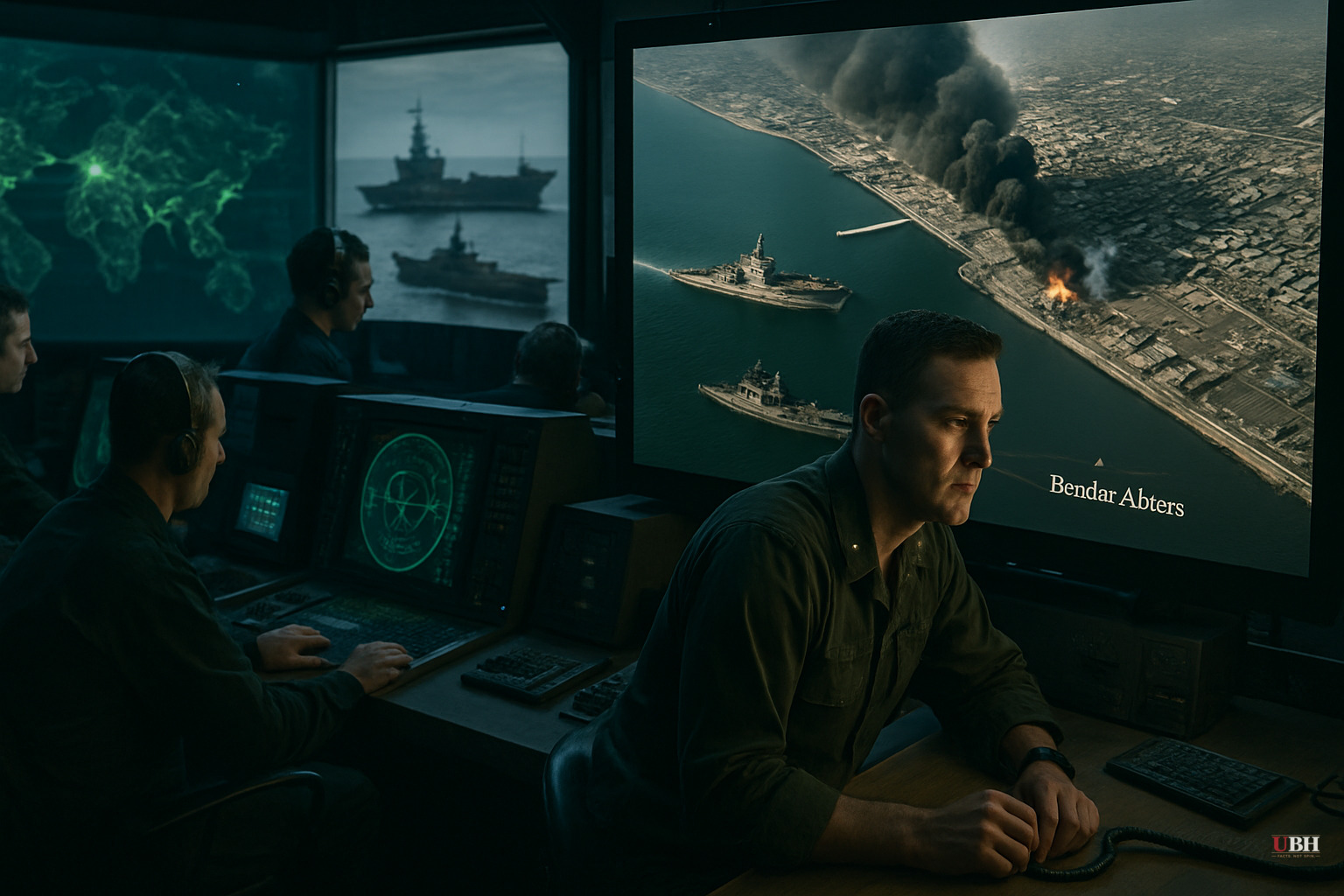
U.S. Central Command (CENTCOM) confirmed it struck a military site near Bandar Abbas — a strategically critical Iranian port city on the Strait of Hormuz — on Wednesday night. The reason: the site was about to launch a fifth Iranian one-way attack drone. CENTCOM also confirmed it shot down four Iranian drones that posed a threat near the Strait of Hormuz.
This marks the second U.S. strike on Iranian soil in three days.
Iran's Islamic Revolutionary Guard Corps (IRGC) said it retaliated by striking a U.S. air base, per a report carried by Iran's state-affiliated Tasnim news agency, though no specific location was given. The IRGC also issued a warning that it would "turn the area from Chabahar to Mahshahr into a graveyard for aggressors" if the ceasefire collapses. Kuwait's army separately announced its air defenses were intercepting "hostile missile and drone threats" — without specifying the origin.
CENTCOM called its actions "measured, purely defensive, and intended to maintain the ceasefire." Iran called them "a grave violation" of the ceasefire and vowed retaliation.
The Deal That Isn't
Trump has no deal.
According to The Atlantic, Trump skipped his eldest son's wedding and kept senior staff in Washington over the holiday weekend expecting an imminent agreement. Secretary of State Marco Rubio — in India on a four-day trip — said a deal could come Sunday. Then Monday. Then he said "a few more days." Trump then staged a Cabinet meeting, originally planned for Camp David to evoke historical gravitas, but rescheduled to the White House after bad weather. Within ten minutes of the meeting starting, Trump conceded: "They want very much to make a deal. So far, they haven't gotten there."
Neither has Trump.
The proposed agreement is reportedly a one-page memorandum of understanding that would start a 60-day clock on Iran's nuclear program and enriched uranium. Trump told reporters he won't accept a deal without Iran giving up its enriched uranium — calling it "nuclear dust" — and explicitly ruled out sanctions relief. "Not sanctions relief, no," Trump said, per ZeroHedge. He also said Iran is "negotiating on fumes."
But a country negotiating on fumes just launched five drones at the Strait of Hormuz in a single day and claimed to hit a U.S. air base.
The White House and Iran Are Both Lying About the Draft
Iranian state media released what it claimed was a draft agreement. The White House called it a "complete fabrication," according to reporting from both ZeroHedge and The Atlantic. Whether that denial is accurate or face-saving spin is unclear — but the fact that there's a public dispute over whether a draft even exists signals how chaotic these negotiations are.
Trump has announced breakthroughs before that evaporated fast. The Atlantic noted that last month Trump wrote on Truth Social that Iran had "agreed to never close the Strait of Hormuz again" — and Iran closed the strait the next day.
What a Deal Would Actually Mean for Oil Prices — Not Much, Fast
Even if a deal lands tomorrow, don't expect gas prices to drop next week. The Atlantic spoke with Claire O'Neill McCleskey, former head of the compliance division at the Office of Foreign Assets Control, who said flatly that "a Truth Social post is not going to be sufficient to convince people to take the risk" of resuming shipping through the strait.
Mines reportedly remain in the water. Shipping companies need verified safe-passage routes before captains sail. Energy traders need confidence in lasting peace before markets normalize. Trump's credibility on ceasefire announcements has eroded — and markets know it.
Reuters reported that EDF has already delayed its Edison stake sale to 2027, directly citing the ongoing Hormuz crisis. That's a major European energy company betting the disruption runs at least another 18 months.
The Market Damage Is Real and Spreading
After Wednesday's strikes, according to CNBC, West Texas Intermediate futures jumped over 4% to $92.25 a barrel and Brent crude rose nearly 4% to $97.99. Asian markets bled out: South Korea's Kospi fell 3.26%, the small-cap Kosdaq dropped 5.22%, and Hong Kong's Hang Seng shed 2.22%. U.S. futures were relatively steady, but that window closes fast if Hormuz shipping gets worse.
AP News reported that the U.S. imposed new sanctions on an Iranian agency it says is trying to control shipping in the Strait of Hormuz — an economic escalation running parallel to the military one.
India is getting hammered. Per CNBC's Inside India newsletter, the Indian rupee has fallen over 6% year-to-date against the dollar. Air India has canceled more than a quarter of its international flights between June and August. Prime Minister Narendra Modi is urging citizens to stop buying gold and cut overseas travel to conserve foreign exchange reserves.
What's Being Left Out
Neither left-leaning outlets nor right-leaning ones are adequately covering the munitions problem. Trump's own aides, per The Atlantic, told reporters he is reluctant to escalate militarily because U.S. advanced weapons stockpiles are depleted — a fact that AP News separately flagged with a new analysis warning the U.S. will need years to replenish. That constraint is shaping every decision in this negotiation, and it's being buried.
Where Things Stand
Two strikes in three days. An IRGC counterstrike on a U.S. base. Kuwait's air defenses lighting up. Oil at $98. A Cabinet meeting that produced nothing. And a president calling his adversary's negotiators "fumes" while his own team can't produce a signed page.
The ceasefire remains fragile. The deal Trump keeps promising is still unsigned.
Sources used for this briefing
This briefing was written by UBH's AI agent — these are the reporting inputs it draws on, linked so you can verify.


