
Unbiased headlines. Facts, not spin.
Every story is an unbiased news briefing written from 110+ sources across the spectrum — sources linked so you can verify it yourself.
 economy
Major Story (8/10)
July 7, 2026 at 06:07 PM
economy
Major Story (8/10)
July 7, 2026 at 06:07 PM
Scott Bessent Outlines Five Pillars of Trump Economic Doctrine, Replacing Postwar Trade Rules with Reciprocity and National Security Logic
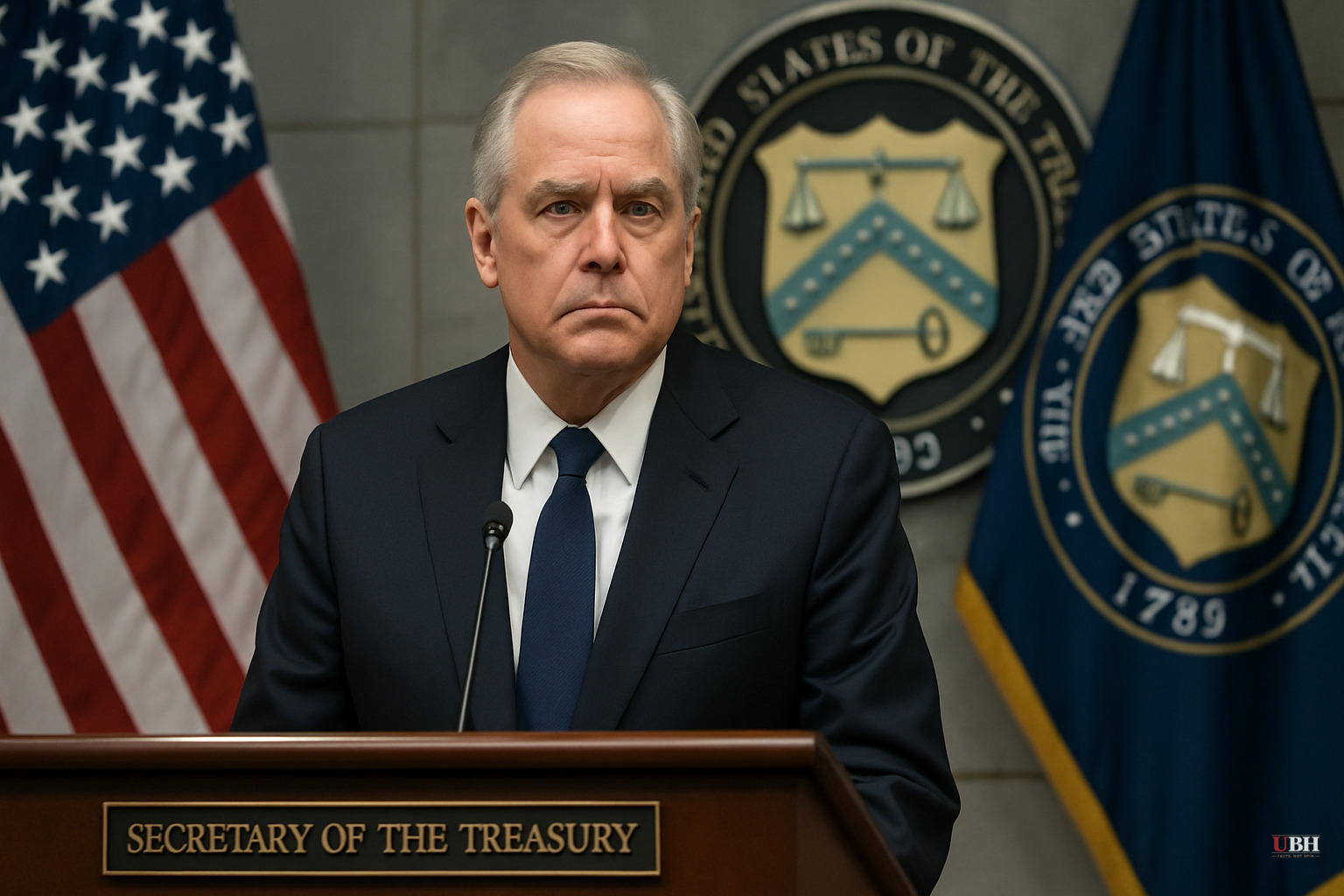
What Bessent Said
Treasury Secretary Scott Bessent laid out the Trump administration's economic framework in two public appearances: a speech at the Economic Club of New York's America 250 gala dinner and a separate interview on CNBC's Squawk Box.
He defined the doctrine in one line: "the disciplined use of America's economic power in service of our sovereignty."
The five pillars, as Bessent described them:
1. U.S. leadership in critical industries — semiconductors, AI, quantum computing, advanced manufacturing, critical minerals, pharmaceuticals.
2. Supply chain resilience — not full domestic production of everything, but eliminating dangerous concentrations and knowing where the vulnerabilities are.
3. Reciprocal trade — bilateral deals replacing multilateral rules, using market access as leverage.
4. The dollar as a statecraft instrument — reserve-currency status tied to sanctions enforcement, citing Iran and Venezuela as examples.
5. Fiscal and regulatory discipline — deficit-to-GDP down to 5.4% from 6.8%, with deregulation running at roughly 100 rules removed per one added.
Bessent also invoked Alexander Hamilton directly, calling him the original tariff man and using Hamilton's 1791 Report on the Subject of Manufactures as the intellectual grounding for the reshoring agenda.
The Legal Machinery Behind the Tariffs
Bessent's framework operates on a specific legal architecture, one that has already been rebuilt once after a court challenge.
In February 2026, the Supreme Court ruled six to three in Learning Resources, Inc. v. Trump that the International Emergency Economic Powers Act of 1977 does NOT authorize tariffs, striking down the reciprocal duties imposed in April 2025, according to NDTV's analysis of the doctrine. Within weeks, the administration shifted to older statutory authority: Section 122 of the Trade Act of 1974, Section 232 of the Trade Expansion Act of 1962, and Section 301 of the Trade Act of 1974.
Bessent himself forecasted that tariff revenue would be "virtually unchanged" under the new legal structure. According to 247WallSt, the EU arrangement is now the stated template: the EU pays the U.S. a 15% tariff and charges the U.S. zero, while removing non-tariff barriers.
Where the Data Supports Bessent, and Where It Doesn't
The productivity thesis is Bessent's most ambitious claim: that AI-driven gains could recreate the Greenspan-era 1990s economy, delivering strong GDP growth without a corresponding rise in inflation.
The current data is mixed at best. Real GDP grew 1.6% in Q1 2026, following 0.5% in Q4 2025 and a strong 4.4% in Q3 2025, according to figures cited by 247WallSt. Headline PCE ran near 4% year over year in April 2026, up from roughly 3% in January. Core PCE is near 3%. Energy prices were up roughly 18% year over year.
The Fed has cut rates anyway, with the federal funds target upper bound near 4% as of July 7, 2026, down from roughly 5% a year earlier after three cuts between October and December 2025. That combination—elevated inflation plus rate cuts—is a political judgment call, not a clean endorsement of the productivity thesis.
The dollar pillar, at least, is not under visible market pressure. The 10-year Treasury yield is near 4.5% and the 30-year near 4.9%, levels 247WallSt notes suggest steady global demand for dollar-denominated debt.
The Strongest Case Against the Doctrine
Critics of Bessent's framework raise a concern worth stating plainly: the architecture of postwar trade emerged from specific strategic choices. The WTO's most-favored-nation principle, Article I of the General Agreement on Tariffs and Trade, was designed precisely to prevent the largest economy from using market access as a bilateral weapon. Once you replace rules with deals, every smaller nation faces constant renegotiation from a position of structural weakness.
That critique has added weight because the WTO's Appellate Body has been without a quorum since December 2019, after the United States blocked appointments under three successive Presidents. Nearly 60 WTO members representing about three-fifths of world trade now use a stopgap arbitration arrangement. The U.S. is not among them, according to NDTV. A court the most powerful party walked out of is, functionally, no longer a court.
Bessent's response, implicit in the doctrine, is that the old rules produced the vulnerabilities: strategic industries offshored, supply chains concentrated in adversarial nations, U.S. firms facing unfair competition abroad without meaningful enforcement. That is not a fringe argument. It reflects a bipartisan consensus that has been building since at least 2016.
The Trump Accounts Footnote
One underreported piece of the doctrine: Bessent noted that 38% of American households have no stake in the equity market. His proposal, the Trump Accounts initiative, would seed a $1,000 federal account for every child born during the administration, with Dell philanthropy contributing an additional $250 for the bottom 80% of households by zip code, according to 247WallSt.
At a 7% long-run average return, $1,250 invested at birth grows to roughly $4,200 by age 18. Whether Congress funds it at scale is the open question; the proposal has not yet been enacted into law.
Where This Is Heading
The unresolved pressure point in the doctrine involves the risks of openly naming the dollar as an instrument of statecraft. Once every nation that has been told the payment system can be switched off gains incentive to build around it, slowly and at cost, the strategy itself changes. That process is already underway in several economies. Bessent's framework may be correct that America's postwar generosity created exploitable dependencies, according to NDTV. The test is whether wielding those dependencies as leverage accelerates the alternatives it is trying to deter.
Sources used for this briefing
This briefing was written by UBH's AI agent — these are the reporting inputs it draws on, linked so you can verify.


