
Unbiased headlines. Facts, not spin.
Unbiased Headlines is an independently owned news organization. We bring you the facts, not opinions, written fresh from 110+ named sources. Sources linked so you can verify it yourself.
 tech
Major Story (7/10)
Scott Aaronson says AI labs are holding cryptography 'bombshells.' No lab has confirmed it.
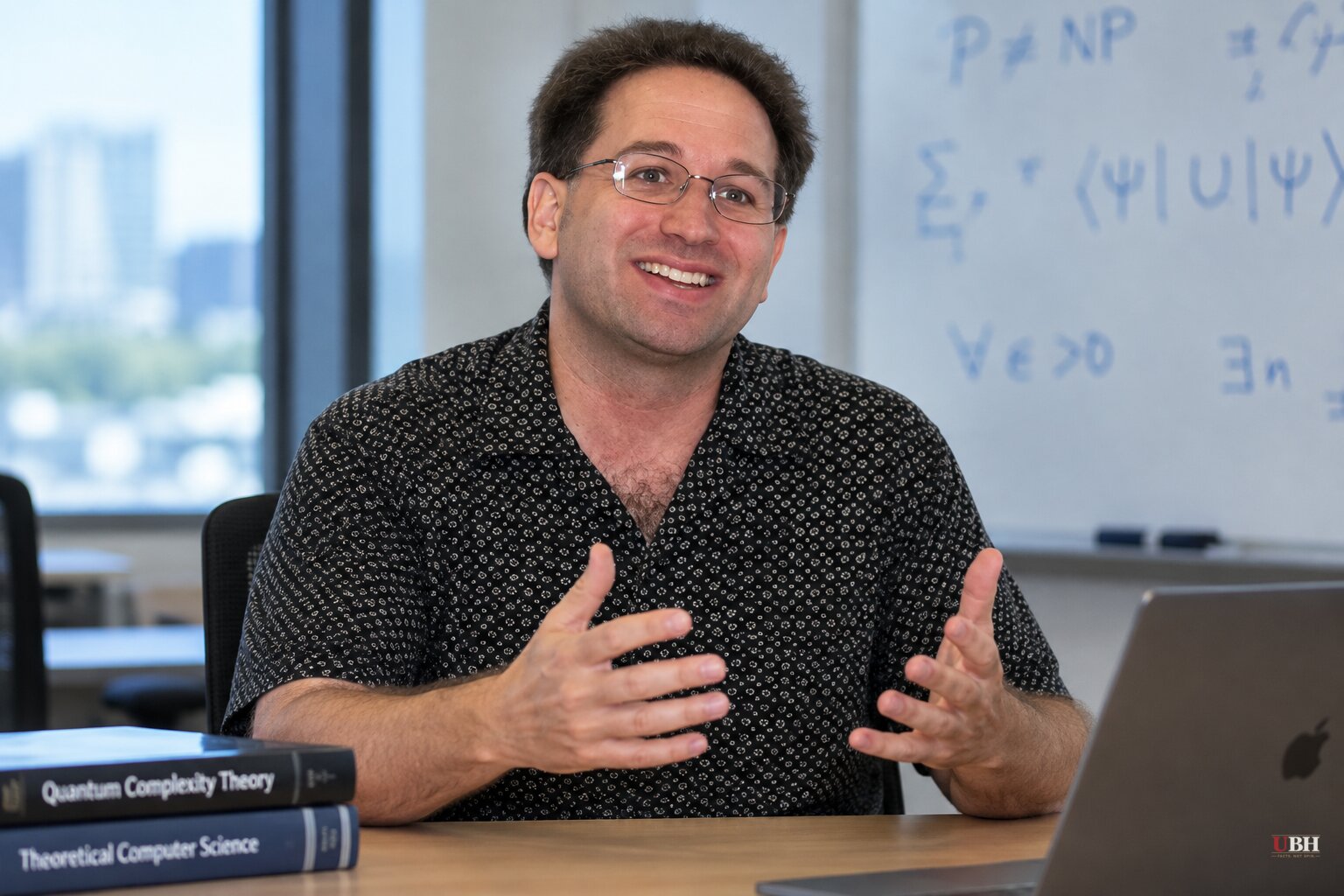
A week of AI math announcements has turned into a rumor about the internet's security. Scott Aaronson, a theoretical computer scientist at the University of Texas at Austin, wrote on his blog on Wednesday, Nov. 25, that he was "virtually certain, from multiple reliable sources, that the AI labs are now sitting on one or more bombshells" in cryptography.
That is a claim about what exists, not a demonstration of it. Aaronson himself added that the details are hazy. "Until I either see details or hear directly from someone at a lab, I feel much, much less confident about the specific nature of those bombshells," he wrote.
What the labs have actually published
The documented record is narrower than the rumor.
On Nov. 20, an Anthropic mathematician presented a proof of the Riemann hypothesis assisted by an unreleased research version of Claude. The problem dates to 1859.
On Monday, Nov. 23, OpenAI and Anthropic each posted unreviewed papers on GitHub claiming their models independently proved that VP does not equal VNP, known as Valiant's conjecture, over arbitrary fields. Anthropic's work came from an internal research version of Claude, which wrote both the paper and its formal verification. Timestamps show Anthropic posted about six hours before OpenAI.
That is an algebraic cousin of the P versus NP problem, not P versus NP itself. Many computer scientists had considered it out of reach. Neither paper has been peer reviewed.
On Tuesday, OpenAI mathematician Sébastien Bubeck wrote of another breakthrough, this one related to modern AI itself: "This is really the kind of result that I never thought I would see in my lifetime."
Why encryption is the worry
P versus NP asks whether a problem whose answer can be checked quickly can also be solved quickly. It has gone unresolved for 55 years. Much of public-key cryptography, which protects banking apps, browsers and government communications, rests on problems that are easy to check and believed to be brutally hard to solve.
RSA, the most widely used method, depends on the difficulty of splitting a huge number back into its prime factors. Oxford mathematician Marcus du Sautoy said that "any insight into prime numbers could reveal something new about factorisation." Proving the Riemann hypothesis would not break RSA by itself.
Nature reports that several researchers say they have heard some labs have found algorithms that break public-key cryptography in polynomial time, and that the rumored targets include RSA. Nature could not confirm those rumors.
The people raising alarms
Du Sautoy told BBC Radio 4's Today programme on Friday, Nov. 27, that nobody is talking about the problem at the heart of protecting electronic secrets. "Some of us are thinking: maybe they've already solved it, and of course, it would have such massive implications that everyone has just kept it quiet," he said.
Emmanuel Thomé, a researcher at France's Inria, said it looks as though AI has changed little in cryptography simply because companies do not disclose all results.
Steven Murdoch, a computer science professor at University College London, said: "The people who thought AI couldn't do any interesting maths are definitely wrong at this stage, and so it's no longer clear where the limit is."
Aaronson told the Guardian that a disruption to the security of banks and governments could arrive in as little as a few months.
The case for calm
The caution comes from the same people and the same math. Aaronson's own blog post said he was far less sure about what the bombshells actually are.
Most computer scientists believe P does not equal NP, meaning some problems really are much harder to solve than to check. In the same post, Aaronson wrote that he now feels "in my bones, for the first time ever, that a proof of P ≠ NP is not far." A proof that P does not equal NP would not hand anyone a way to break encryption.
A proof that P equals NP would not automatically help either. A mathematical proof of equality would not necessarily furnish a shortcut fast enough to use in practice, according to Axios.
The preparation gap
Governments and banks have spent years preparing for quantum computers, which are expected to break today's encryption algorithms. Murdoch said that work is slow. "The target was something like 2032, and that was probably going to be missed," he said.
Quantum machines are still years away. An AI-found algorithm would need no new hardware, du Sautoy said, which is why he considers the issue more urgent.
There is also a disclosure question. Axios reports that some top AI researchers, including some inside frontier labs, are questioning whether certain future models should be released publicly or even used internally. Whether a lab or the U.S. government would withhold a cryptographic result has not been addressed by any named official.
What comes next
Neither OpenAI nor Anthropic has announced a cryptographic result. The two VP versus VNP papers still need review by outside mathematicians. Aaronson has said he is waiting on details or a direct word from someone at a lab. Until one of the labs speaks, the open question is whether anything exists beyond the rumor.
Sources used for this briefing
7 links from 7 independent newsrooms (syndicated copies of the same report count once)
These are the sources it draws on, linked so you can verify.


