
Unbiased headlines. Facts, not spin.
Unbiased Headlines is an independently owned news organization. We bring you the facts, not opinions, written fresh from 110+ named sources. Sources linked so you can verify it yourself.
 tech
Notable (6/10)
About 110 People Running AI Agents Reportedly Logged 909 Lean-Verified Math Solutions in 48 Hours
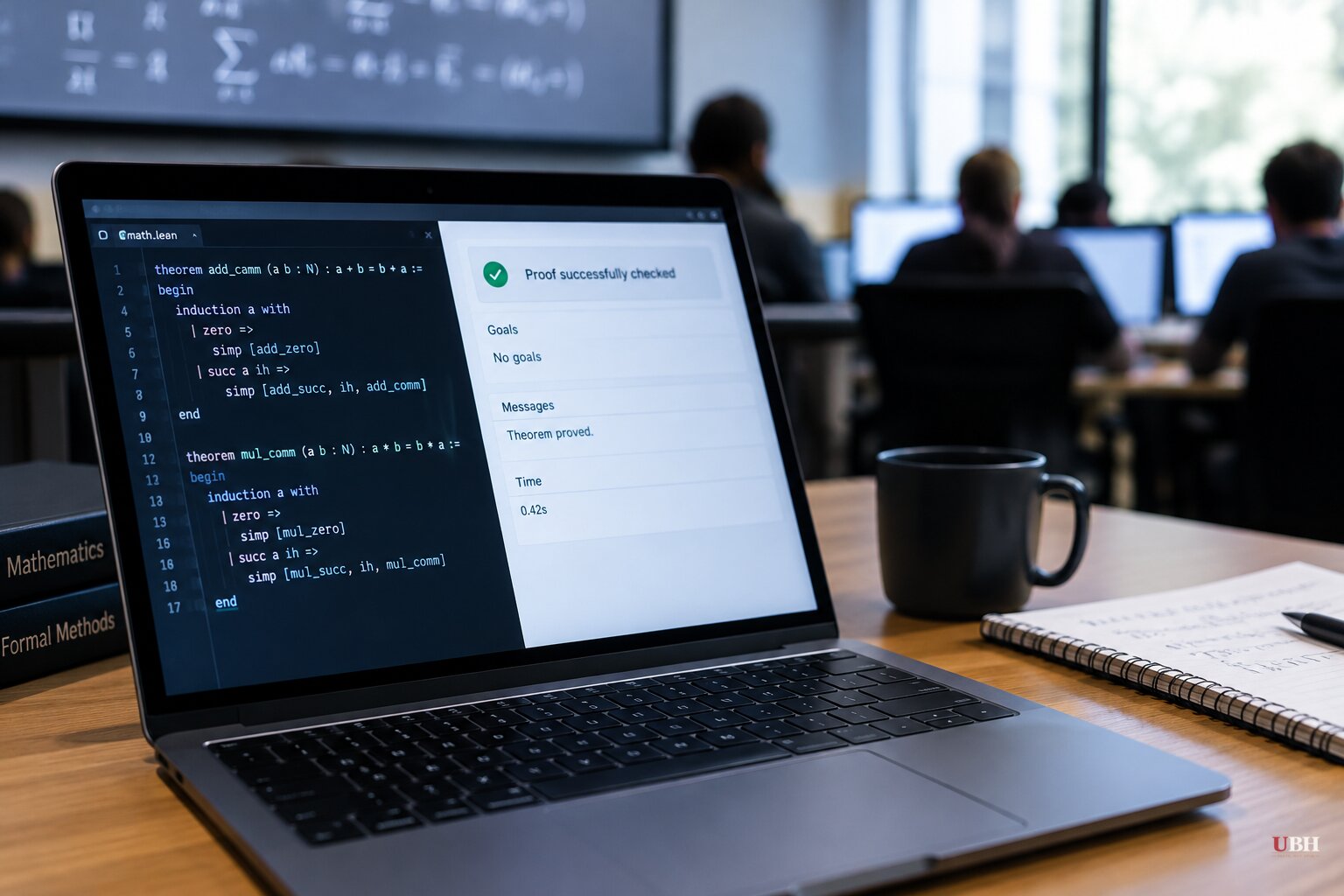
A loose group of about 110 people, working from their own computers, reportedly used AI agents to produce roughly 909 verified solutions to previously unsolved math problems in 48 hours. The number comes from a free online problem repository built by a French student. It did not come from a corporate lab.
The viral version is bigger. Posts on X claim swarms of agents "solved over 1,000 unsolved math problems" and that "we officially enter the singularity." That figure leans partly on self-declared results. The verified count is lower.
How the count works
The platform hosts more than 60,000 open problems. About 5,200 have been written in Lean 4, a proof assistant that checks mathematical arguments automatically.
Three conditions have to be met for a solve to count. Lean has to accept the proof. The problem has to have been unsolved before. And the formalization, meaning the translation of the problem into Lean, has to be correct.
That last condition matters. Lean can confirm that a proof is valid for the statement it was given. It cannot confirm that a human translated the original problem faithfully.
Which models did the work
A separate tally covering 757 solves breaks the work down by model. Anthropic's Claude led with roughly 476. OpenAI's GPT models followed with about 210, Google's Gemini with around 64, and xAI's Grok with 3.
Those numbers come from participants reporting their own tools. They are a snapshot, not an audited leaderboard.
The hype cycle
A chart of the solves, shared by the X user atareh, drew more than 5.3 million views. Elon Musk replied "Yes" to a post framing the moment as a sign of the singularity.
Not every reaction was awed. One reply to the "singularity" post from a user going by Cory read: "Solve cancer and we can talk about getting excited. I don't care about math problems."
The tally itself does not show that the agents tackled mathematics' hardest or most important questions. The repository holds problems of widely varying difficulty. Notable human problem resolutions have historically numbered somewhere between one and seven per year, so a count of 909 in a weekend measures volume, not significance.
Distributed, not centralized
This is a different model from the OpenAI effort earlier in 2026. OpenAI said it deployed a swarm of about 10,000 agents that worked on the Navier-Stokes Millennium Prize Problem for 88 hours. OpenAI's own announcement says it is sharing a solution. As of Nov. 26, no formal acceptance of that result exists, and mathematicians are still working through the material.
That project ran on one company's servers. The platform effort ran on individuals' machines and their own model subscriptions, and nobody needed an institutional affiliation to join.
The contrast is also one of scrutiny. A Lean check is mechanical and fast. A claimed solution to a Millennium Prize Problem has to survive human review, which takes far longer.
The bottleneck
The platform's founder is reportedly eyeing a target of 10,000 solves. The math does not cooperate yet.
Agents can only attack problems that have already been translated into Lean. That is about 5,200 of more than 60,000. If agents keep clearing formalized problems at this pace, they will run out of material well before they reach 10,000.
The work then shifts to people. Someone has to write the formal problem statements, and someone has to check that those statements say what the original problems say. Whether volunteers can formalize problems as fast as 110 people with agent swarms can solve them is the open question.
The founder has not published a timeline for formalizing more of the repository. The model breakdown also remains self-reported, with no independent audit of the 757-solve tally.
Sources used for this briefing
7 links from 6 independent newsrooms (syndicated copies of the same report count once)
These are the sources it draws on, linked so you can verify.


