
Unbiased headlines. Facts, not spin.
Unbiased Headlines is an independently owned news organization. We bring you the facts, not opinions, written fresh from 110+ named sources. Sources linked so you can verify it yourself.
 tech
Major Story (7/10)
House Report: Chinese Models Hit 41% of Open-Model Downloads as China's AI Field Spreads Across Dozens of Firms
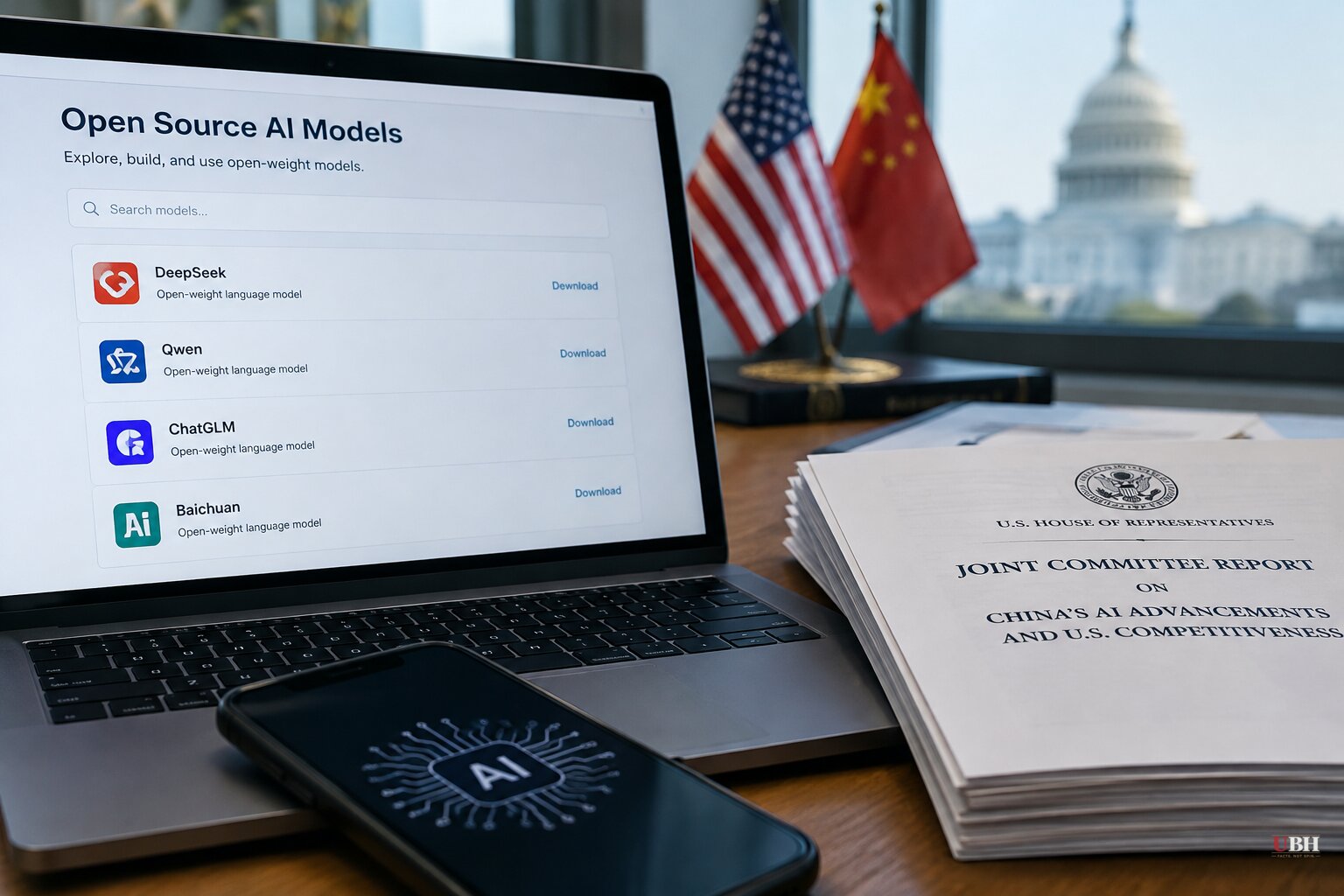
Two House committees say Chinese AI models are already inside American businesses, and nobody has a clean count of where.
The House Committee on Homeland Security and the House Select Committee on China released a 50-page joint report titled "Beijing's AI Playbook." The committees opened the investigation in April 2026. They looked at why U.S. companies adopt PRC-developed models, how Chinese developers got competitive, and what role the Chinese government played.
What the committees found
Chinese models accounted for 41% of downloads on the leading open-model repository over the preceding year, according to the report. The committees point to low cost, easy customization and performance approaching top American systems as the draw.
Deployment inside American organizations is hard to track, the report says. Download counts show interest. They do not show which banks, apps or agencies are running what.
The committees also allege Chinese developers ran "industrial-scale distillation campaigns" to pull capabilities out of American frontier models, speeding up competing systems. Those are the committees' findings. The report does not describe any charges or enforcement action.
On cybersecurity, the report says a model from the Chinese company Zhipu can autonomously build end-to-end cyber exploits at a level comparable to a leading restricted American model. The report attributes that assessment to the National Institute of Standards and Technology and an American frontier AI developer.
Three U.S. companies were studied as case studies: Airbnb, Anysphere and DoorDash. The report says they show how and why PRC-developed models are being built into American products. The excerpts available do not include responses from those companies.
House Homeland Security Chairman Andrew Garbarino and Select Committee on China Chairman John Moolenaar framed it in everyday terms. "Most Americans encounter AI every single day without knowing it," they wrote, citing pharmacy texts, travel chatbots, delivery estimates and bank fraud alerts.
A bench, not a single lab
The American picture is tidy. OpenAI, Anthropic and xAI are the model-first labs. Google, Meta, Amazon and Nvidia build their own models too. Fortune's analysis says the real frontier contest is among three: Anthropic, OpenAI and Google.
China's is not tidy. Alibaba, ByteDance, Tencent, Baidu, Huawei, iFlytek, SenseTime, StepFun, Baichuan and MiniMax all maintain their own model families, on top of better-known challengers DeepSeek, Moonshot AI and Z.ai. Fortune argues that this spread, more than any one lab's best model, is what makes the competition hard to call.
The origins are odd. DeepSeek grew out of a side project at a quantitative hedge fund. Z.ai was spun out of Tsinghua University. ByteDance, known abroad mostly for TikTok, built Seedance, an AI video generator.
Seedance rattled Hollywood earlier this year after a hyper-realistic clip of Brad Pitt and Tom Cruise fighting went viral. ByteDance paused the global rollout after major studios threatened legal action. U.S. senators called for the model to be shut down.
Fortune also reports that Meituan, a Chinese food-delivery company, entered the model market in June 2026 with LongCat 2.0. By its account, the model reached the top three on an AI model marketplace by the end of that month and was trained entirely on Chinese chips, with no Nvidia hardware. Fortune further says Xiaomi's MiMo series, released in 2025, accounted for nearly a fifth of token volume on a model marketplace within 12 months.
The Meituan point cuts against a core assumption of U.S. policy: that export controls on advanced chips would keep Chinese labs a generation behind. Fortune's reporting, if it holds, says one company managed a top-tier result on domestic silicon.
The pattern Fortune sees
Fortune's thesis is that no single Chinese company needs to beat OpenAI or Google across the board. A deep bench means one firm's stumble does not knock China off the frontier, and it raises the odds of a surprise release from somewhere unexpected.
The analysis also recalls what happened when DeepSeek broke into the mainstream in early 2025: $1 trillion came off U.S. technology stocks. Qwen, Alibaba's model family, later became a leading base for open-weight development worldwide, with Apple and Airbnb among its customers, per Fortune.
There is a market angle. If Chinese open-weight models make capable AI cheap and plentiful, the valuations of U.S. labs built on scarcity face pressure. That is Fortune's argument, not a forecast anyone has proven.
What comes next
The House report is an investigative document. It does not itself change any rule, and the committees have not announced legislation or enforcement tied to it.
The open question is the one the committees themselves flag: how many American companies already run Chinese models in products and critical systems. Until firms disclose that, the 41% download figure is the best measure anyone has, and it measures downloads, not deployments.
Sources used for this briefing
7 links from 7 independent newsrooms (syndicated copies of the same report count once)
These are the sources it draws on, linked so you can verify.


