
Unbiased headlines. Facts, not spin.
Unbiased Headlines is an independently owned news organization. We bring you the facts, not opinions, written fresh from 110+ named sources. Sources linked so you can verify it yourself.
 tech
Notable (5/10)
Event date: November 27, 2026 ·
Nvidia's SpaceX Exposure Grows: $19.7 Billion Stake, $40 Billion Chip Financing, Reported Rental Price Cuts
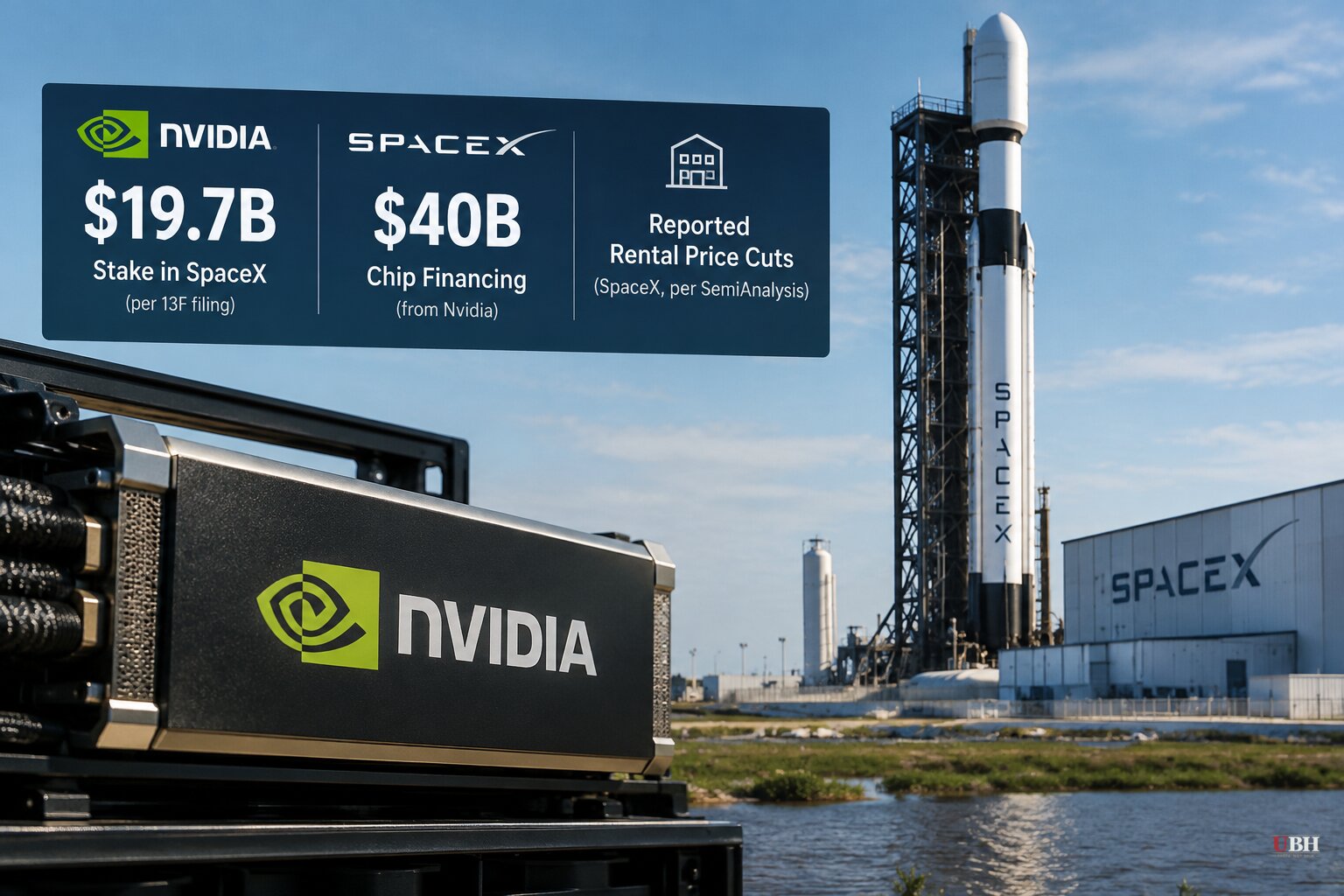
Nvidia's financial tie to SpaceX is now visible in two places at once: its portfolio and its sales. Since the Rubin supply forecasts shifted deliveries into 2027, new filings and market reports show how much of Nvidia's AI business runs through one customer.
The stake
Nvidia filed its quarterly 13F on Monday, Nov. 16. As of Sept. 30, SpaceX was its largest disclosed stock position: about 130.5 million shares worth roughly $19.7 billion, or 40.7% of the reported portfolio. That is up from about 122.8 million shares at the end of June.
Intel slipped to second at 40.1%. Nvidia cut its Intel holding by about 54 million shares, to roughly 161.1 million, and the Intel position fell in value from about $30 billion to $19.4 billion. SpaceX's stake also lost value in the quarter, dipping from around $21 billion to $19.7 billion as SpaceX's share price dropped.
The extra SpaceX shares may not be a fresh purchase. Nvidia invested in the AI coding firm Cursor in late 2025, and SpaceX bought Cursor in a deal that closed Aug. 14, paying Cursor's shareholders in SpaceX stock. Some or all of the roughly 7.7 million added shares may have come from that deal. Neither company has said.
Motley Fool columnist Daniel Sparks argues the filing says less about Nvidia betting on SpaceX than it appears, and more about SpaceX's reliance on Nvidia. His reasoning: SpaceX took the top spot mainly because Nvidia shrank Intel. The stake is about 1% of the roughly 13.6 billion SpaceX shares outstanding in mid-October. Elon Musk held about 82% of the voting power at the June IPO, so the shares carry little say.
The customer side
At SpaceX's August 2026 earnings call, Musk said the company is committed to building exclusively on Nvidia's platform. Analyst Gene Munster of Deepwater Asset Management estimated in August that SpaceX made up roughly 5% of Nvidia's revenue, or about $4.8 billion to $5 billion a quarter, up from 3% the quarter before.
That is an estimate. It does not make SpaceX Nvidia's largest customer. In the filing quoted by 24/7 Wall St., Nvidia's three largest direct customers accounted for 14%, 11% and 11% of third-quarter revenue. Nvidia reported that revenue at $115.8 billion, up 103% from a year earlier.
SpaceX's AI compute business brought in $7.56 billion in the third quarter, about 52% of its total sales. Its CFO says Anthropic accounted for more than a third of SpaceX's third-quarter revenue. Anthropic's November filing disclosed commitments of up to $120.5 billion under SpaceXAI computing arrangements through 2029, with monthly spending expected to reach about $3.1 billion once all contracted capacity is delivered.
Financing the buildout
On Nov. 19, 24/7 Wall St. podcast host Eric Bleeker questioned how Musk could pay for the up to $500 billion in spending he has proposed for next year. Within hours, reports said SpaceX was readying a $40 billion AI chip financing. Apollo Global Management arranged it through a special-purpose vehicle, so the debt does not sit directly on SpaceX's balance sheet. At least $32 billion was expected to be offered to investors that Thursday.
SpaceX has reportedly secured about $40 billion to $44 billion to buy Nvidia's Vera Rubin systems. Deliveries are expected in the first half of 2027. Nvidia has also started shipping its Vera CPU to SpaceX.
Rental rates slip
SemiAnalysis told clients that SpaceX cut rents on small clusters of Nvidia Blackwell chips to $10 to $12 per chip per hour, from $15 to $15.50. That is a cut of 20% to 35%. The firm also reportedly said Anthropic will not renew its lease on about 50,000 older H200 chips, which are now offered at about $5 per chip per hour for early 2027. Neither SpaceX nor Anthropic has confirmed the report.
Markets did not treat it as a SpaceX problem. On Friday, Nov. 27, SpaceX shares were up 2.5% to $129.97 at 10 a.m. New York time, while Nvidia fell 1.3% and CoreWeave fell 1.2%. SpaceX options implied volatility stood at 71.77%.
On Nov. 6, investor Ron Baron projected that SpaceX could build one gigawatt of capacity for about $35 billion, against roughly $60 billion for conventional developers. He estimated that could yield about $50 billion a year in rental revenue. The projection is gross revenue, not profit. Baron's numbers also make no allowance for electricity, hardware and operating costs, and securing power and chips is a hurdle of its own.
What it means for Nvidia holders
Nvidia shares were near $150 as of Nov. 19, down 31% over the prior month and 19% for the year. Despite the record quarter, 24/7 Wall St. attributed the drop to a CEO transition and concerns about future AI spending.
The concentration cuts both ways. If SpaceX keeps scaling, Nvidia earns on chip sales and on its $19.7 billion equity position. If SpaceX's rental pricing or its anchor tenant's demand weakens, both lines of exposure are hit at once.
The next hard data points are Nvidia's following 13F, SpaceX's next revenue disclosures and the first Vera Rubin deliveries to SpaceX in the first half of 2027.
Sources used for this briefing
7 links from 7 independent newsrooms (syndicated copies of the same report count once)
These are the sources it draws on, linked so you can verify.


