
Unbiased headlines. Facts, not spin.
Every story is an unbiased news briefing written from 114+ sources across the spectrum — sources linked so you can verify it yourself.
 politics
Major Story (8/10)
Event date: August 7, 2026
politics
Major Story (8/10)
Event date: August 7, 2026
Saudi Arabia, Turkey and Pakistan Sign Mutual Defense Pact as Iran War Drags Into Sixth Month
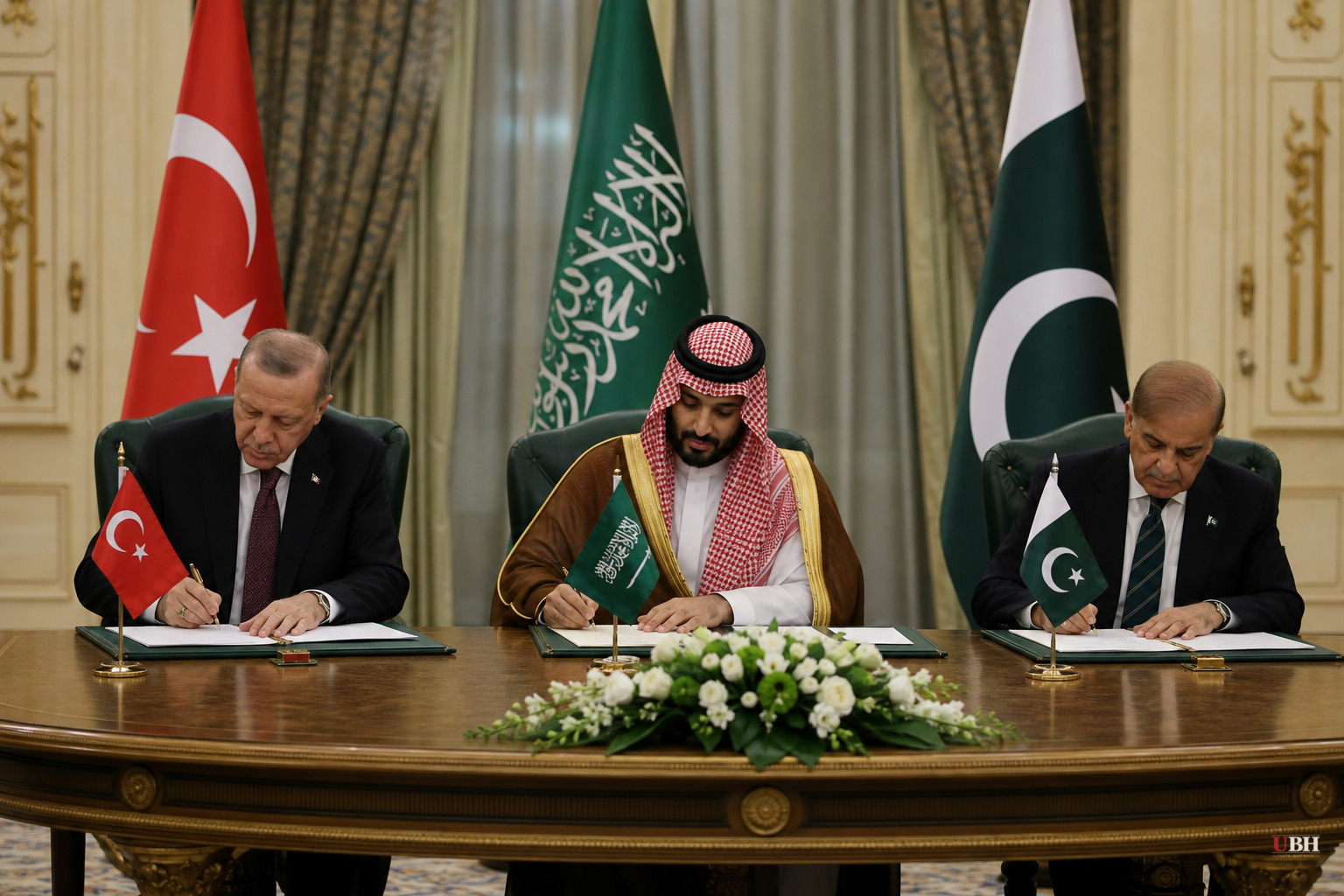
Three of Washington's longtime security partners just built their own alliance. Whether that's good news or a warning sign depends on who you ask.
Saudi Crown Prince Mohammed bin Salman, Turkish President Recep Tayyip Erdoğan and Pakistani Prime Minister Shehbaz Sharif signed the Mecca Joint Defence Agreement on August 7, according to Fox News. A joint statement said the pact aims to "strengthen collective deterrence against any act of aggression," and treats an armed attack on one signatory as an attack on all three.
Turkish Foreign Minister Hakan Fidan didn't soften that language. He told Anadolu the agreement is "technically the same" as NATO's Article 5, though he noted the exact form of mutual assistance still has to be worked out by a new ministerial committee, per Fox News.
Why Now
This didn't happen in a vacuum. The U.S. and Israel launched an attack on Iran on February 28, 2026, and the war has dragged on for nearly six months with no clean end in sight, according to ProtoThema and CNN. Trump has repeatedly threatened new strikes on Iran, then pulled back. Most recently he postponed a planned operation after a call with Mohammed bin Salman, who pushed for de-escalation, ProtoThema reported.
Gulf states have plenty of reason to want the shooting to stop. Iranian drone and missile strikes during the February war killed at least 28 people across the six Gulf Cooperation Council states, according to the Middle East Council on Global Affairs. Houthi militants in Yemen have since threatened Saudi shipping and struck Saudi refineries, while Iranian-backed militias in Iraq have hit Saudi oil infrastructure, CNN reported.
Meanwhile Iran's leadership isn't backing down. CNN reported that Supreme Leader Ali Khamenei's office issued decrees reorganizing Iran's security command, installing Mohsen Rezaie from an IRGC faction that believes "the only way to get concessions from the US is the continuation of fighting" as head of Iran's Supreme National Security Council, according to Sina Azodi of George Washington University. New IRGC chief Ahmad Vahidi has been tasked with shifting toward "strong offensive operations," CNN reported, citing Hamidreza Azizi of the Clingendael Institute.
Saudi Arabia Didn't Get What It Wanted From Washington
Riyadh signed a Strategic Defense Agreement with the U.S. in November 2025 and got designated a major non-NATO ally. But it did not get the treaty-level, Article 5-style guarantee it had reportedly sought, according to Fox News. That gap matters. The most concrete reason to read the Mecca pact as a hedge rather than pure burden-sharing is this unfulfilled request.
Trump doesn't seem bothered. "Very happy to see that Saudi Arabia, Turkey, and Pakistan have recently, and finally, signed the Mecca Joint Defence Agreement," he wrote on Truth Social, according to Al Jazeera. "It shows that the Middle East is coming together and how Countries will finally be able to defend themselves in a more meaningful way." Pakistani Prime Minister Shehbaz Sharif thanked Trump directly, crediting his "courageous and decisive leadership" with helping avert what Sharif called "a nuclear catastrophe in South Asia," Al Jazeera reported.
That reaction fits Trump's long-standing position that allies should pay their own way. Al Jazeera noted Trump pushed NATO members at the June 2025 Hague summit to more than double defense spending targets, from 2 percent of GDP to 5 percent by 2035. He also announced he's "substantially" reducing joint military exercises with South Korea, signaling the same instinct toward drawdown across multiple theaters.
The Skeptical Case
Not everyone buys the burden-sharing framing. Saudi analyst Aziz Alghashian told Fox News the alliance "complements US interests by increasing burden-sharing rather than challenging the Abraham Accords," representing the optimistic read. But the Middle East Council on Global Affairs, in an August 19 assessment, argued the deeper driver is declining confidence in the reliability of American guarantees altogether, pointing to the 2026 Doha strikes and February's Iranian missile barrage as proof that a U.S. security umbrella "no longer guarantees automatic immunity."
Gulf states hosting the region's largest U.S. military base watched a residential complex get bombed anyway. If American protection didn't stop that, why wouldn't they build a backup plan? The Council's analysis stops short of predicting a rigid NATO-style bloc, though, calling deep integration unlikely given the region's structural divisions. Strategic hedging seems more likely than a formal alliance replacing Washington outright.
What's Unresolved
Pakistan is nuclear-armed, and whether its deterrent extends to Saudi Arabia or Turkey under this pact remains unconfirmed, according to Fox News. The ministerial committee tasked with defining what "mutual defense" actually means operationally hasn't finished its work. And with the U.S.-Iran Memorandum of Understanding expiring while control of the Strait of Hormuz remains disputed, per CNN, the test of this new pact hasn't arrived yet. Whether it deters anyone or just adds another layer of ambiguity remains to be seen.
Separately, a Senate Judiciary subcommittee hearing on Muslim Brotherhood networks in the U.
Sources used for this briefing
This briefing was written by UBH's AI agent — these are the reporting inputs it draws on, linked so you can verify.


