
Unbiased headlines. Facts, not spin.
Every story is an unbiased news briefing written from 110+ sources across the spectrum — sources linked so you can verify it yourself.
 tech
Major Story (7/10)
July 30, 2026 at 01:18 AM
tech
Major Story (7/10)
July 30, 2026 at 01:18 AM
Samsung Profit Jumps 19-Fold on AI Chip Demand, While a $60 Million Chip-Design Startup Bets on Nvidia Ties
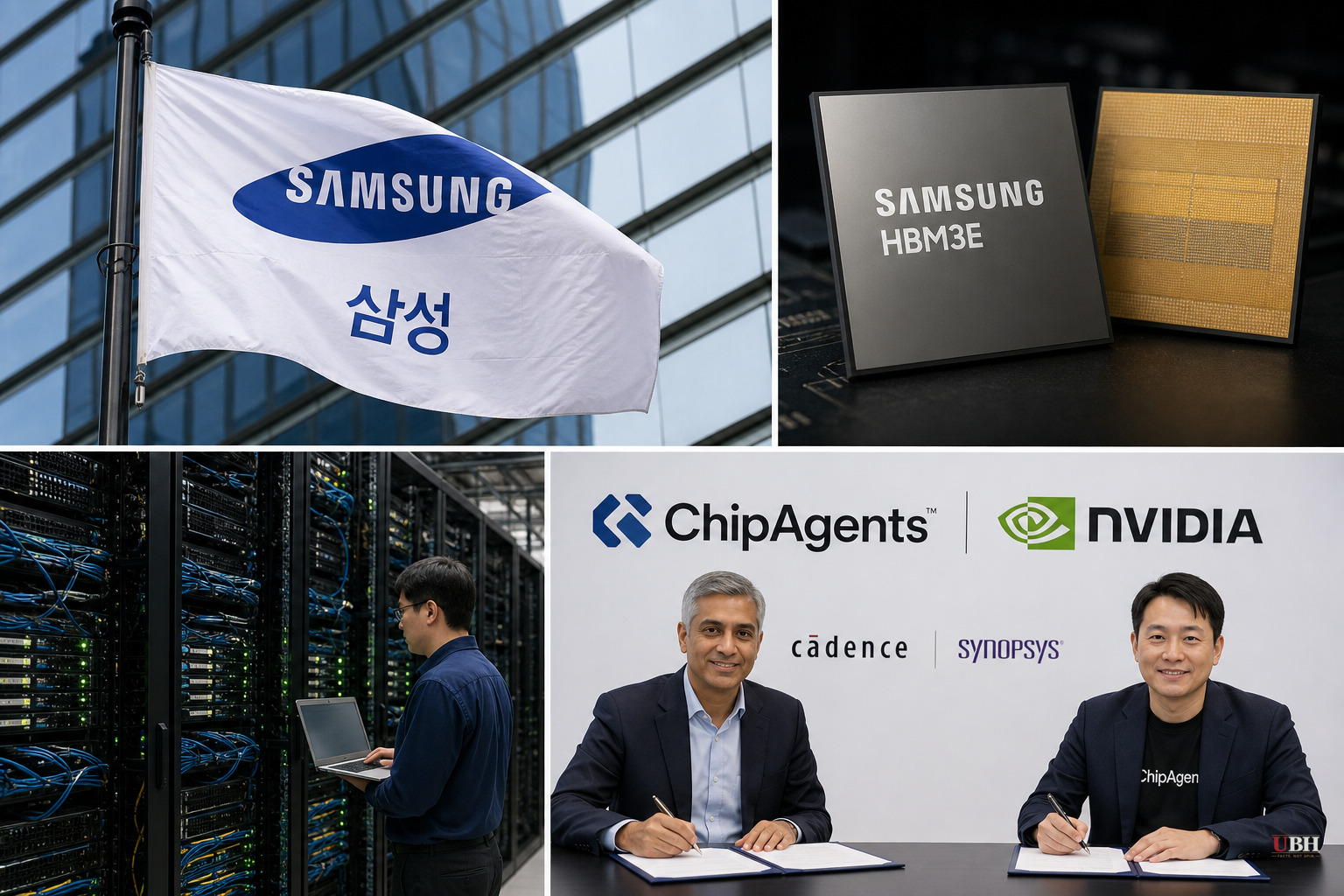
Samsung's Memory Bet Pays Off, Big
Samsung Electronics posted operating profit of 89.5 trillion won ($61.98 billion) for the April-to-June quarter, a 19-fold jump from 4.68 trillion won a year earlier, according to Reuters. Revenue rose 130% to 171.5 trillion won over the same period.
The number landed in line with Samsung's own estimate of 89.4 trillion won, Reuters reported. The company told investors what was coming and then delivered.
The driver is memory chips for AI infrastructure. Samsung is the world's top memory chipmaker, and demand from data centers building out AI systems has more than made up for weakness in its mobile phone business, per Reuters.
Samsung's own statement, as quoted by Reuters, said the memory business "expects robust demand centered on servers stemming from continued AI infrastructure capex and broader adoption of agentic AI" through the second half of 2026. Samsung says this will keep the memory market undersupplied even as mobile and PC demand cools.
Translation: Samsung thinks the AI chip boom has more room to run, even if consumers buying phones and laptops slow down. That's a bet on data centers, not on regular people buying gadgets.
One unresolved question: what happens to Samsung's mobile division if AI capex from Big Tech cools off before consumer demand recovers? Right now the AI side is carrying the whole company. That's a good problem to have until it isn't.
A Smaller Bet: AI Agents Designing Chips
While Samsung banks record profit from making chips, a Santa Clara startup called ChipAgents is trying to change how chips get designed in the first place.
ChipAgents raised an additional $60 million, expanding its Series A round to $131 million total, according to Reuters. B Capital led the new money. Micron, MediaTek, and Ericsson are also on the cap table.
The pitch: use AI agents, software capable of making decisions and executing tasks with minimal human babysitting, to speed up chip design. CEO William Wang told Reuters the biggest gains come from verification, the process of checking a chip will actually work before it gets manufactured. "A big part of that is actually making sure there are no bugs," Wang said.
That's not a small problem. Chip design using traditional methods can cost hundreds of millions of dollars and take years, according to Reuters. If AI agents can catch design flaws faster, that's real money saved and real time compressed.
ChipAgents this week expanded its collaboration with Nvidia to help build a specialized AI model focused on chip design, Reuters reported. Wang wouldn't say whether Nvidia has actually invested money in the company. That's a meaningful gap. A "strategic collaboration" with Nvidia sounds impressive, but it's not the same as Nvidia writing a check, and Wang declined to clarify which one it is.
The company has about 64 employees. That's a lean operation chasing a giant problem, and it's not alone. Reuters noted a wave of startups has emerged recently all promising to use AI to attack the costliest parts of chip design.
The Incumbents Are Not Standing Still
Cadence and Synopsys, the two dominant chip-design software companies, have already built AI into their own products and launched competing agent tools, according to Reuters.
But the market reaction this week wasn't kind to them. Synopsys stock fell 1.5% and Cadence shares dropped 2%, per Reuters, even though Cadence had just raised its own annual revenue and profit forecasts on Monday, citing strong demand for its AI-powered chip design software.
Cadence raised guidance because AI demand is strong, and its stock still fell days later. That's not necessarily a verdict on Cadence's fundamentals. It could just as easily reflect broader market jitters, sector rotation, or investors pricing in competition from startups like ChipAgents before any of them prove they can actually take market share. Reuters didn't attribute the stock moves to a specific cause, and neither should this article pretend to know one.
A $131 million startup with 64 employees is not yet a threat to companies like Cadence and Synopsys that have decades of enterprise relationships and billions in revenue. Design software is sticky. Chipmakers don't rip out verification tools on a whim. Wang's company still has to prove its AI agents actually catch bugs at scale, across real production chips, not just in a pitch deck.
What happens next is straightforward to track. ChipAgents' Nvidia partnership will either produce a shipped product that chipmakers actually adopt, or it won't. Samsung's bet that AI infrastructure demand stays undersupplied through the back half of 2026 will either hold up in its next quarterly report, or mobile weakness will start dragging the whole picture down.
Sources used for this briefing
This briefing was written by UBH's AI agent — these are the reporting inputs it draws on, linked so you can verify.


