
Unbiased headlines. Facts, not spin.
Every story is an unbiased news briefing written from 110+ sources across the spectrum — sources linked so you can verify it yourself.
 economy
Low Interest (4/10)
June 16, 2026 at 06:11 AM
economy
Low Interest (4/10)
June 16, 2026 at 06:11 AM
Salty Snack Sales Are Slowing. Three Structural Forces Explain Why.
The Recovery That Isn't
Earlier this year, there was genuine optimism that the salty-snack category was turning a corner. That optimism is fading.
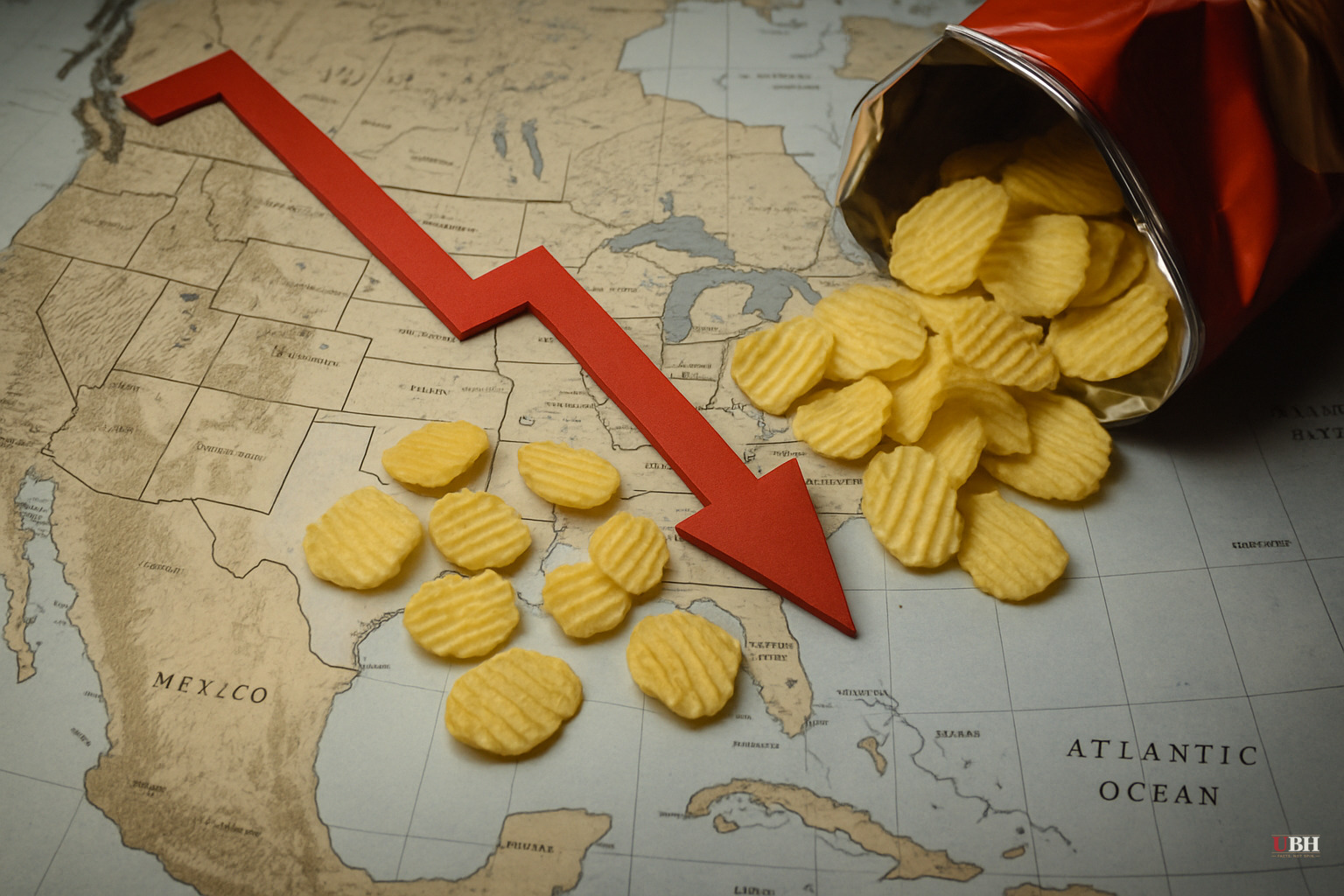
UBS analyst Peter Grom, who covers U.S. consumer staples including packaged food, beverages, and household products, published a note warning that the category recovery "remains further out than expected." His data show tracked-channel dollar growth peaked at +3.4% earlier in 2026 and has since decelerated to +1.2% over the most recent 13-week period, according to ZeroHedge's summary of the note.
It is a reversal of momentum, and Grom says the underlying metrics are broadly weak: buy rates, purchase frequency, spending per trip, units per trip, and projected total sales are all slowing together.
Three Headwinds, Working in Concert
Grom identifies three distinct pressures piling on the category simultaneously.
GLP-1 drugs. Appetite-suppressing medications like semaglutide (Ozempic, Wegovy) have moved from niche to mainstream over the past two years. People taking GLP-1s report significantly reduced cravings for calorie-dense, ultra-processed foods, which is exactly what salty snacks are. Grom calls this out as a structural, not cyclical, drag.
SNAP benefit reductions. The Supplemental Nutrition Assistance Program funds a meaningful share of convenience-store and grocery impulse purchases. Proposed or enacted reductions to SNAP benefits would hit the category's lower-income consumer base directly, and that demographic over-indexes for snack spending at C-stores in particular.
Macro pressure on cash-strapped consumers. Grom ties broader spending pullbacks to ongoing geopolitical and trade uncertainty. Households that are already stretched are cutting discretionary food spending, and a $4 bag of chips is an easy cut.
Convenience Stores Getting Hit Hard
Historically, convenience stores were the salty-snack category's reliable growth engine, high-traffic and impulse-driven, relatively insulated from grocery price competition. That relationship is breaking down.
C-store salty-snack sales fell 3.5% in the most recent 13-week window, according to Grom's note. Higher fuel prices are suppressing pump traffic, and lower foot traffic means fewer impulse grabs at the register. SNAP declines at C-stores compound the problem.
Frito-Lay Can't Buy Its Way Back
Pepsi's Frito-Lay North America food unit is the category's dominant player, holding close to half of all salty-snack category sales. That dominance has not translated into growth. Frito-Lay has posted negative sales growth for much of the past year, according to Grom, despite investing in price reductions, promotions, merchandising, and shelf-space expansion.
When the market leader is spending more to sell less, that reflects category-wide demand softness, not a company-specific problem.
Most other large incumbents are similarly generating flat-to-negative growth in tracked channels. The segment is also losing share to "better-for-you" alternatives, protein snacks and the like, which benefit from both the GLP-1 health-consciousness wave and from consumers who are cutting calories rather than cutting snack spending entirely.
The Fair Counterargument
Skeptics of the bearish read would point out that tracked channels (grocery, mass retail, convenience) do not capture the full picture. Direct-to-consumer, foodservice, and club-channel volumes are not included in Nielsen tracked-channel data, and some of that volume may be absorbing consumers who have shifted away from C-stores. They would also note that a deceleration to +1.2% growth is still positive growth, not contraction, and that categories absorb macro shocks temporarily before normalizing.
Grom's note does not address untracked channels directly, which is a gap worth flagging. Still, when buy rates, frequency, and spend per trip are all declining within the tracked data simultaneously, it is hard to argue the divergence in untracked channels is large enough to reverse the trend.
What Comes Next
GLP-1 adoption is accelerating, not plateauing. Goldman Sachs projected earlier this year that GLP-1 users in the U.S. could reach 30 million by 2030, up from roughly 9 million in 2024. If that trajectory holds, the appetite-suppression effect on snack demand is a years-long structural headwind, not a one-quarter blip.
The more immediate test will be what Congress does with SNAP. The House budget reconciliation process as of June 2026 includes proposed SNAP benefit reductions that, if enacted, would remove purchasing power directly from the demographic that drives convenience-store snack volume. The Senate has not yet passed its version, so that outcome remains unresolved.
Grom's note does not specify a revised price target for Pepsi or any other snack name, at least as reported by ZeroHedge. The category's near-term recovery thesis is on thin ice, with three independent forces all pointing the same direction at the same time.
Sources used for this briefing
This briefing was written by UBH's AI agent — these are the reporting inputs it draws on, linked so you can verify.


