
Unbiased headlines. Facts, not spin.
Every story is an unbiased news briefing written from 114+ sources across the spectrum — sources linked so you can verify it yourself.
 finance
Major Story (8/10)
August 19, 2026 at 10:59 AM
finance
Major Story (8/10)
August 19, 2026 at 10:59 AM
Russians Pulled 2.4 Trillion Roubles Out of Banks This Year as War Fears Grow
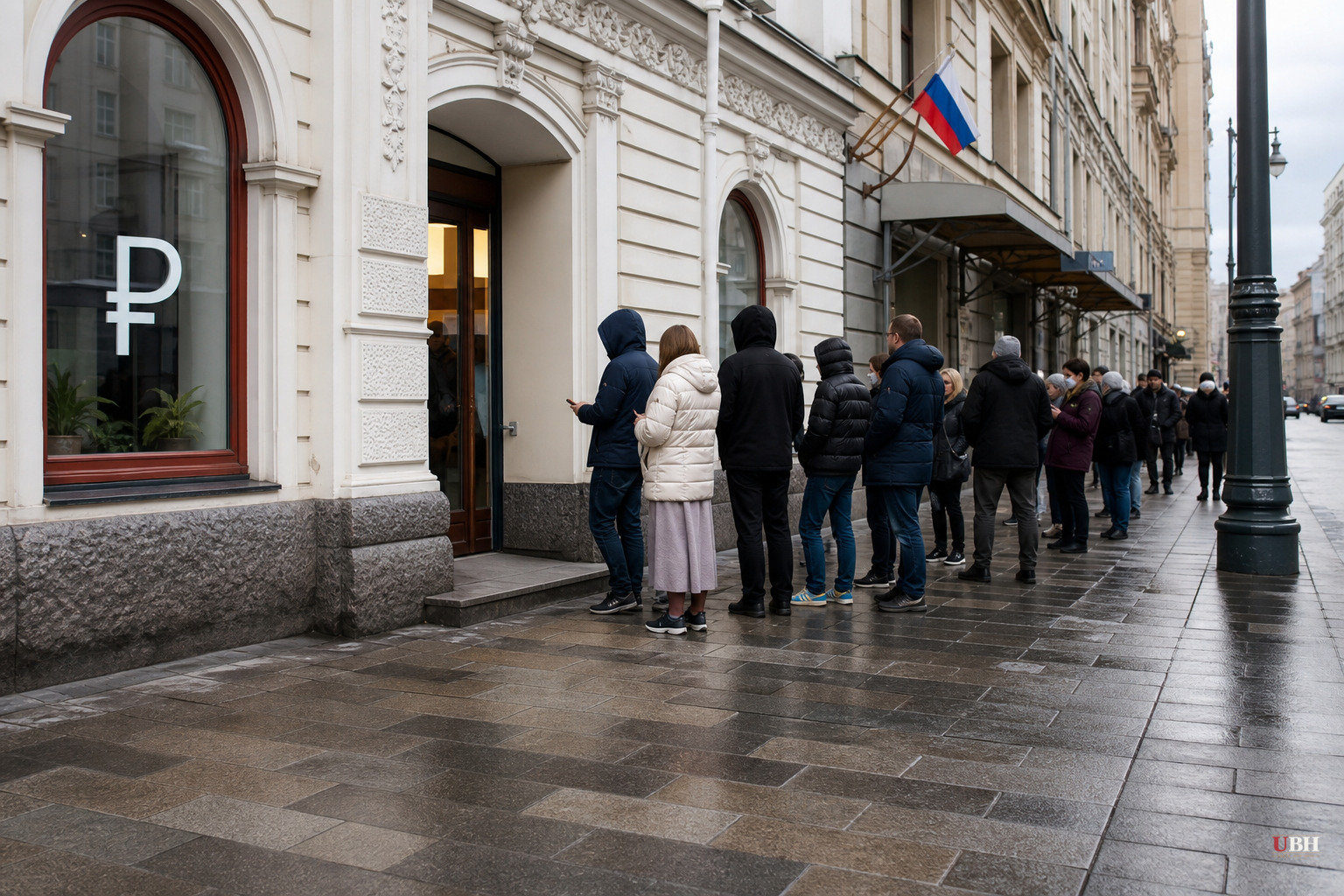
Russians have pulled roughly 2.4 trillion roubles out of the country's banking system this year, according to Central Bank of Russia data cited by the Telegraph, including 286.4 billion roubles (£2.5 billion) in the first two weeks of August alone. That's more than the two trillion roubles removed during the first year of the 2022 invasion, most of which fled in the initial two weeks of the war.
The withdrawals are continuing. It's the seventh straight month of outflows, according to the Telegraph, with every single working day in August showing withdrawals. The worst single day, August 12, saw 56.8 billion roubles leave the system.
Euronews, citing data from the Banks.ru financial marketplace, reports the damage is spread across Russia's biggest banks. Gazprombank lost 299.5 billion roubles, 10.8% of its total deposits, over four months. Rosselkhozbank shed more than 15% of its deposits. Alfa-Bank, Russia's largest private lender, lost 5.6%. Even Sberbank, which held steady early on, saw 211.6 billion roubles leave in June and another 31.8 billion in July. One outlier: T-Bank actually gained 193 billion roubles in deposits, according to Euronews.
Two fears are driving this withdrawal. First, Ukraine's drone campaign has hammered Russian oil refineries, according to the Independent, knocking out over 30% of refining capacity and causing real fuel shortages people can see at the pump. Second is a rumor that won't die: that the Kremlin could freeze or seize private deposits to fund the war.
Russian Finance Minister Anton Siluanov has publicly called deposit-freeze rumors circulating on Telegram "fake news," according to the Telegraph, and economic analysts quoted by that outlet say such a move would be unlikely. That's a real, on-the-record denial. No Russian law, decree, or announced policy authorizing deposit seizures has surfaced in any of these reports.
But the fear has roots. Russian prosecutors transferred about $51.5 billion in private assets to state control last year, according to the Washington Post as cited by Euronews. In June, authorities seized roughly $7.6 billion tied to agricultural billionaire Vadim Moshkovich, founder of Rusagro. Add in what Euronews describes as Putin pressuring oligarchs for "voluntary donations" to the federal budget, and ordinary Russians drawing a line from asset seizures to their own savings accounts isn't irrational paranoia. It's pattern recognition.
The liquidity crunch is real and it's hitting the state where it hurts. The Finance Ministry canceled planned bond auctions last month, according to Ground News, after yields on 10-year government debt surged to around 17%. Harvard's Craig Kennedy told the Washington Post, as reported by the Independent, that repeated treasury bond failures mid-war are "a stark sign of imperial overreach," adding "great powers don't have repeated treasury bond failures in the middle of a war."
Sberbank executive Taras Skvortsov told the Washington Post that total capital flight this year could double what was seen in the early months of the 2022 invasion. His quote, also carried by the Independent, captures the mood on the ground: "Drones are flying. Things are burning down. Nervousness is growing. Everyday wisdom is kicking in. People feel they need cash under their pillow, not in banks where it may never be returned."
The personnel fallout has started at the top. Andrei Klepach, chief economist at state development bank VEB.RF since 2014, was fired after a May speech resurfaced last week, according to Fox News citing Reuters. Klepach told the Nikitsky Club forum, "We are falling behind. We are losing both the technological and economic competition in the world... we are losing it not only to China and the United States, in some ways we are losing it to Ukraine too." He added, "We will not win the competition in this war of attrition." VEB confirmed his departure but gave no reason.
Russia's central bank itself said in July that economic growth could hit zero this year, according to Reuters as cited by Fox News. Ground News separately cites GDP growth at just 0.3%.
Meanwhile the EU is squeezing from the outside. Brussels transferred $1.62 billion in interest earned on frozen Russian central bank assets to Ukraine on August 3, the fifth such transfer, according to the Epoch Times. The seized assets have generated a total of $9.23 billion in interest since the transfers began.
Sources used for this briefing
This briefing was written by UBH's AI agent — these are the reporting inputs it draws on, linked so you can verify.


