
Unbiased headlines. Facts, not spin.
Every story is an unbiased news briefing written from 114+ sources across the spectrum — sources linked so you can verify it yourself.
 finance
Major Story (7/10)
Event date: September 19, 2026
finance
Major Story (7/10)
Event date: September 19, 2026
Fed Raises Rates to 3.75–4% as 10-Year Yield Ends Week Below 5%; Bowman Says Bank Leverage Rule Change Is Helping Treasuries
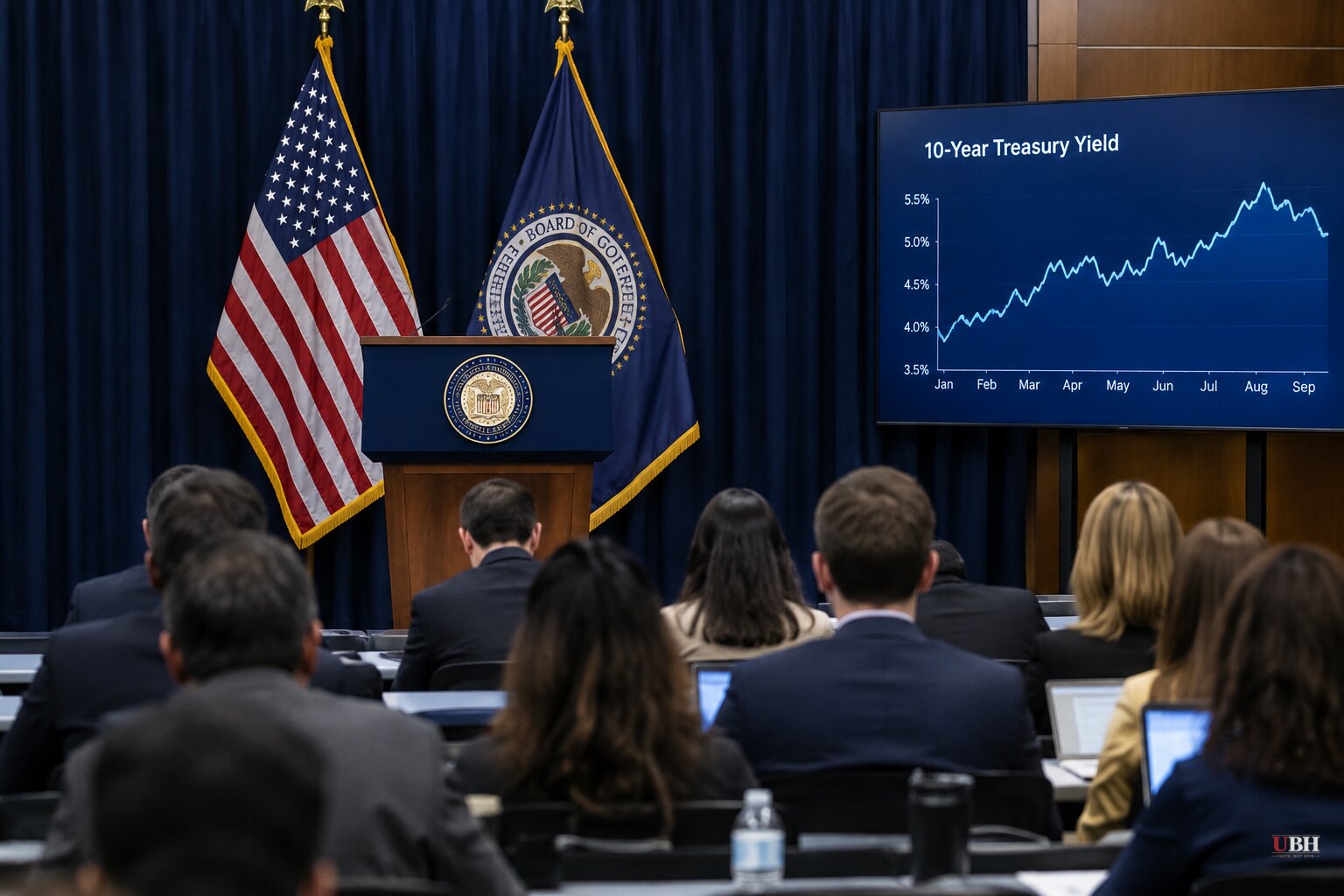
The Federal Reserve voted unanimously on Wednesday, Sept. 16, to raise the federal funds rate by 25 basis points to a target range of 3.75–4 percent. It was the first increase in three years, and markets had expected it.
The rate decision came as stocks, bonds and oil all moved at once. The 10-year Treasury yield fell earlier in the session, then climbed back above 5 percent in the final hour of trading Wednesday. Stocks gave up their gains and closed lower.
Fed signals more to come
Officials signaled the hike would not be the last. Sixteen of 18 Federal Open Market Committee participants expect at least one more increase this year. Chair Kevin Warsh did not submit a projection.
"Another hike is now the base case, with a further move possible if inflation remains stubborn," Lale Akoner, global market strategist at eToro, told The Epoch Times.
David Russell, global head of market strategy at TradeStation, described the Fed's reasoning this way: "Policymakers see inflationary pressure amid strong growth and falling unemployment." He also said the Fed is "walking the line between complacency and extreme hawkishness," which gives it flexibility to adapt to changing conditions in global energy markets.
Equities first rallied on the decision, then reversed. The Dow Jones Industrial Average fell 1.21 percent on Wednesday, its worst day of the week. Financial shares declined, and Boeing dropped after warning of further 737 production delays.
Sentiment turned by Thursday. Bond yields eased across the curve, with the 30-year closing at 5.29 percent and the 10-year at 4.93 percent, below the psychological 5 percent threshold. Semiconductors led a broad rally, with the iShares Semiconductor ETF gaining 3.39 percent and the Nasdaq and S&P 500 climbing 1.69 percent and 1.23 percent.
For the full week ending Friday, Sept. 18, the Dow fell 1.69 percent to 51,681. The S&P 500 finished nearly flat at 7,650. The Nasdaq Composite gained 0.72 percent on a late-week rebound in chip stocks. The small-cap Russell 2000, which is sensitive to interest rates, fell 1.50 percent, the week's worst performer. The CBOE Volatility Index dropped 6.5 percent to 14.81.
Bowman: the leverage rule is working
Separately, Bowman gave a Thursday afternoon speech at an Atlantic Council event in Washington defending a rule change she oversees. The change recalibrated the enhanced supplementary leverage ratio, or eSLR, a capital requirement for large banks. It took effect this year and makes the calculation dynamic and specific to each bank.
"The impact of this recalibration has been encouraging," Bowman said. "So far this year, evidence shows that leverage ratio reforms have improved Treasury market functioning and strengthened its resilience to stress by relaxing regulatory balance sheet constraints."
Her numbers:
- The reform created an additional $5 trillion of headroom for primary dealer banks.
- Dealer Treasury positions rose from $600 billion to $700 billion in the first months of implementation.
- The biggest increases came from the banks that were most constrained under the old rule.
- Leveraged exposure at the largest global systemically important banks is up roughly $900 billion since the rule took effect. That equals roughly 50 percent of those banks' leveraged capacity before the change.
Bowman said, citing the Fed's Senior Financial Officer Survey from March, that much of the new exposure came from increased Treasury holdings and repo-market involvement. She said that activity has helped absorb large government debt issuances this year.
Banks are also hedging their larger Treasury holdings by shorting Treasury futures. "This increase in dealer holdings has likely absorbed some positions previously held predominantly by hedge funds as part of the cash-futures basis trade," Bowman said. Those conditions, she said, are likely to lessen the influence in Treasury markets of investors holding highly leveraged trading positions that are vulnerable to adverse shocks.
Bowman also said the change has narrowed bid-ask spreads, reduced intraday volatility during auction cycles, calmed funding conditions and stabilized bond prices despite a surge in new debt issuance. During the question-and-answer session she said she expects to finalize the Basel III endgame capital framework for large banks before the end of the year.
What the two stories share
Both stories involve the same Treasury market. Bowman's claim is about how well it functions: dealer capacity, volatility and reliance on leveraged hedge funds. The yield moves are a statement about price.
Nothing in the material from Bowman or the market commentary links the rate hike to the eSLR change, and Bowman's speech did not address the level of yields. They are separate developments that happen to land in the same bond market.
Bowman is also the official who oversees the rule, so her assessment is the regulator's own account of its policy. Her own figures show only a fraction of the new capacity has been put to use: dealer positions grew by about $100 billion against $5 trillion of headroom. The roughly $900 billion rise in leveraged exposure at the largest banks is a substantial increase in balance sheet that now sits on bank books rather than hedge fund books.
Bond traders, for their part, were not initially persuaded by the Sept. 16 move. They weren't convinced a single hike of this size would relieve pressure on the long end of the yield curve, and the yield climbed back above 5 percent late Wednesday before easing on Thursday.
What comes next
The Fed's own projections put another increase on the table this year. Carol Schleif, chief market strategist at BMO Wealth Management, expects elevated yields could be here to stay for some time, especially with geopolitical concerns and elevated energy prices remaining front and center. With the policy rate at 3.75–4 percent and the 10-year at 4.93 percent, the committee is raising short-term rates while long-term borrowing costs sit above them.
Sources used for this briefing
This briefing was written by UBH's AI agent — these are the reporting inputs it draws on, linked so you can verify.


