
Unbiased headlines. Facts, not spin.
Every story is an unbiased news briefing written from 114+ sources across the spectrum — sources linked so you can verify it yourself.
 finance
Major Story (8/10)
October 9, 2026 at 12:23 AM
finance
Major Story (8/10)
October 9, 2026 at 12:23 AM
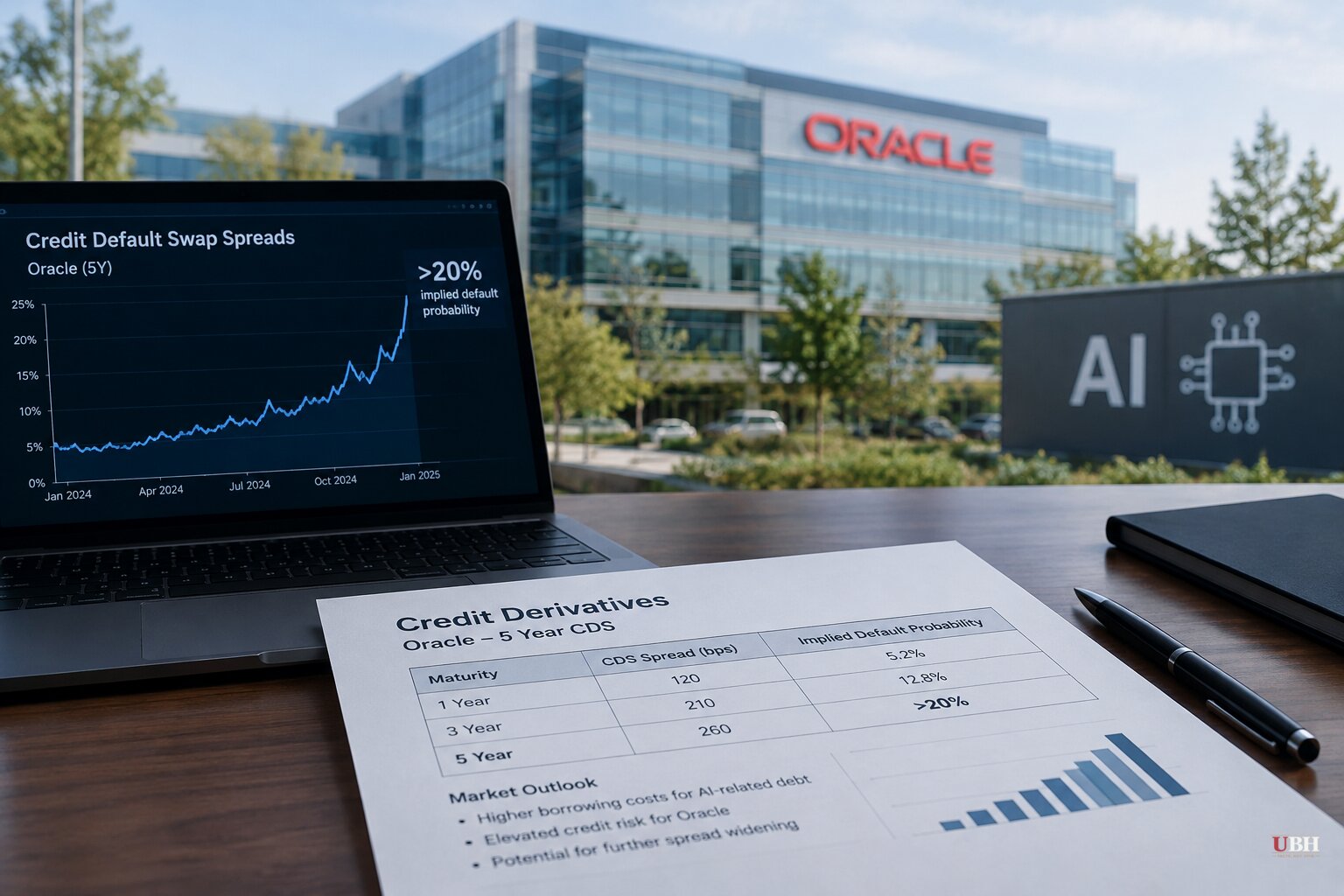
Credit Swaps Price Oracle Default Risk Above 20% Over Five Years as AI Borrowing Nears Half a Trillion Dollars
With the 10-year Treasury yield sitting around 5.3% this week, the corporate bond market has started charging AI borrowers for the size of their ambitions.
Oracle, Broadcom and SpaceX are among the companies that have priced nearly half a trillion dollars of new debt this year to pay for AI infrastructure, according to data compiled by Bloomberg. Bloomberg's own calculations show Broadcom alone may raise about $600 billion over the coming years to finance computing power.
What credit derivatives are saying
News of possible new financings from SpaceX and Broadcom, which Bloomberg says could top $100 billion, sent credit default swaps climbing in recent days. The prices imply traders see a growing risk of default over five years.
For Oracle, the implied figure is now above 20%. For SpaceX it is about 16%. Even Nvidia, the world's most valuable company, is priced at a more than 7% risk of default over that span.
Those are market-implied numbers, not forecasts from the companies or the rating agencies. They are still a stark price signal.
SpaceX is reportedly weighing $30 billion in investment-grade debt and $10 billion in loans, and Broadcom is reportedly seeking around $50 billion. Neither company has detailed those plans publicly in the material reviewed here, so treat the figures as reported, not confirmed.
"Every new financing announcement feels like another entrant in an auction for investor balance sheet," said Mark Clegg, senior fixed-income trader at Allspring Global Investments. "Some days it feels like the market is holding an emergency meeting every few hours to reprice the size of the AI buildout."
Record deal sizes
There have been nine US high-grade deals of $25 billion or more this year, the most ever, and most were in tech, according to Bloomberg. Mega deals of that size used to be rare, were telegraphed by syndicate banks for months, and were mostly tied to mergers and acquisitions.
Tech has been among the worst-performing credit sectors in recent months. Average daily trading volumes in tech bonds and credit derivatives have soared.
Barclays strategist Venu Krishna put numbers on the shift in a research note last week. Capital raised by hyperscalers, data-center vehicles and neoclouds across investment-grade debt, high-yield debt and equity rose from $172 billion in 2025 to $346 billion so far in 2026, more than double. Krishna said credit spreads have "widened materially" across hyperscalers, data centers and neoclouds over the past two quarters, and that credit default swap spreads have risen sharply for all hyperscalers this year.
Goldman Sachs projects the five big hyperscaler issuers will sell about $250 billion of bonds this year and $400 billion in 2027. JPMorgan Chase estimated in June that $4.1 trillion of AI-related debt will be issued through 2030.
The borrowing goes global
Meta is preparing to tap Europe's bond market for the first time this autumn. The European Central Bank's August analysis found hyperscalers account for close to 10% of new euro bond issuance by non-financial companies. The ECB estimates they could need more than $1 trillion in capital spending by 2028.
The ECB also warned that a sustained rise in hyperscaler borrowing could eventually make financing harder for other companies if investors must absorb an ever-larger supply of tech debt.
Amazon sold C$14 billion of bonds in Canada, a record for Canadian-dollar corporate issuance. Alphabet followed with a record A$5.5 billion Australian-dollar deal. The Financial Times reports that other issuers are shortening maturities or avoiding windows when big tech companies are selling.
Weaker borrowers pay more
Japan's SoftBank, a principal capital provider for AI projects, raised $11.1 billion in a junk-bond sale, with yields as high as 9.75% on the seven-year tranche. "They basically are price insensitive to that raise, which means they're price takers," said Mark Malek, chief investment officer at Siebert Financial.
A senior private credit investor, who asked not to be named, told CNBC that neocloud deals will be harder to finance because those companies have less cushion. Riley Thompson of Mitsubishi HC Capital America said lenders are getting pickier even when borrowers offer higher rates. In his view, there may be only about 20 neoclouds the market truly backs, not 50.
An NDTV opinion column cites analysis that S&P cut Oracle to BBB in July, one notch above junk, and that Oracle's fiscal 2026 free cash flow was negative $23.7 billion. The same column estimates the four largest hyperscalers will spend $720 billion to $760 billion on capital expenditure in 2026, up roughly 77% from 2025. It also says 78 of 91 hyperscaler bonds issued this year were trading at higher yields by late July than at issue.
The case that demand justifies the debt
Not everyone reads the numbers as distress. CNBC noted the market is "not in panic mode, at least not yet," and that the hyperscalers all carry investment-grade ratings, which gives them cheaper access to capital. Many industry experts view demand for AI services as insatiable.
The chip supply chain is booming. TSMC reported record third-quarter revenue of about $46.7 billion, up 50% from a year earlier. Companies that buy chips are borrowing heavily while those that sell them are posting record sales.
The open question is whether AI revenue grows fast enough to carry debt costs that now track a Treasury curve near multi-decade highs. SpaceX and Broadcom financings and Meta's European debut are the next tests of how much the market will absorb, and at what price.
Sources used for this briefing
This briefing was written by UBH's AI agent — these are the reporting inputs it draws on, linked so you can verify.


