
Unbiased headlines. Facts, not spin.
Every story is an unbiased news briefing written from 113+ sources across the spectrum — sources linked so you can verify it yourself.
 energy
Major Story (7/10)
September 24, 2026 at 05:54 PM
energy
Major Story (7/10)
September 24, 2026 at 05:54 PM
Rosneft Ships First Oil From Its 51-Billion-Barrel Arctic Project, Far Below Original Targets
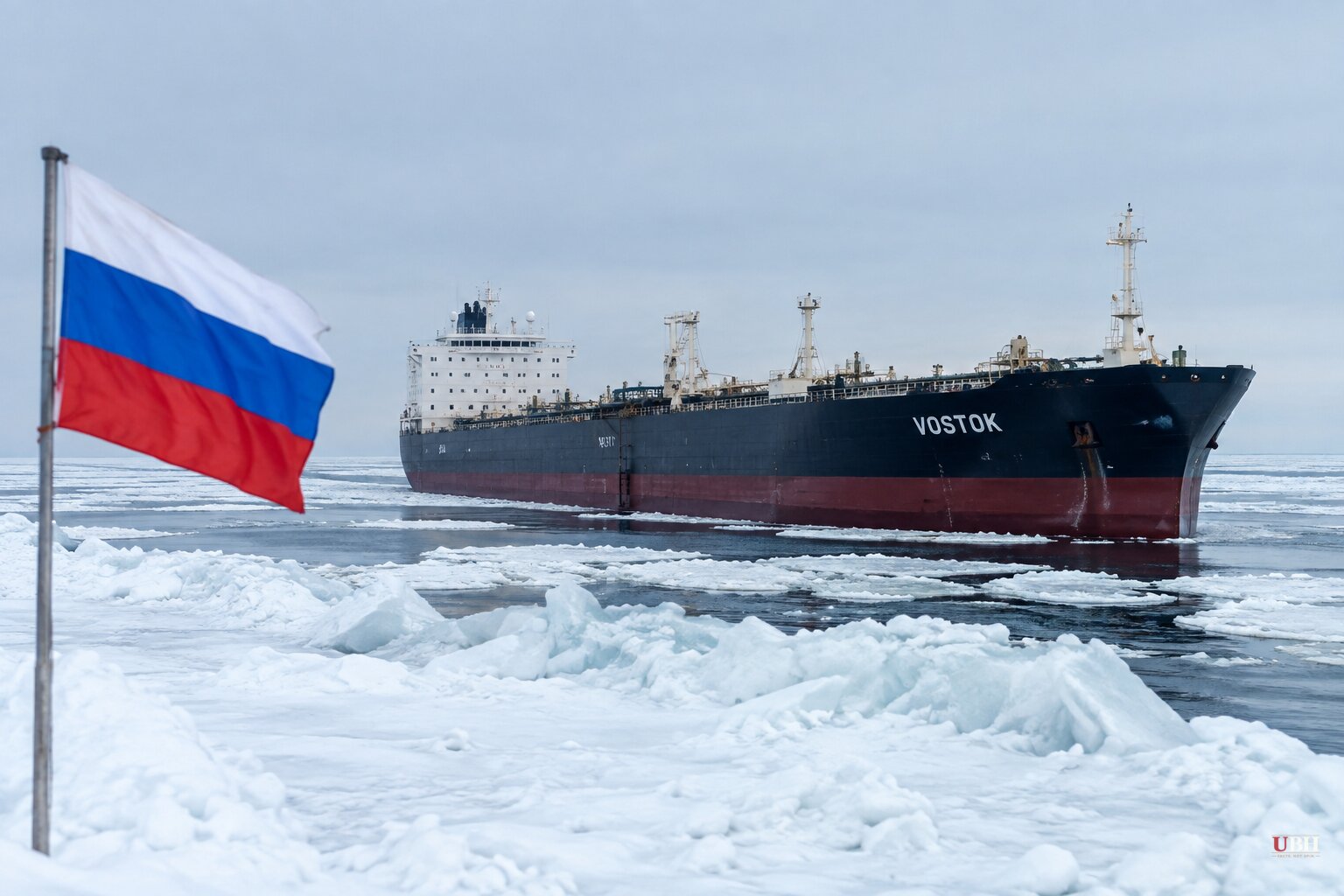
Since Vladimir Putin declared Vostok Oil officially launched on September 5, Rosneft has begun loading commercial cargoes at its new Bukhta Sever terminal on the Taimyr Peninsula, according to Reuters. Four ice-class tankers have taken on crude so far this month: the Panamax Valentin Pikul, the Aframax Akademik Gubkin, the Aframax Vladimir Monomakh, and the Aframax Vladimir Vinogradov, per LSEG vessel-tracking data cited by Reuters and Ukrainska Pravda.
Two of those vessels delivered oil to Murmansk for ship-to-ship transfer. One, the Vladimir Monomakh, sailed east to Asia via the Northern Sea Route. A fourth tanker was still waiting to load, LSEG data showed. Reuters reported the buyers of the initial cargoes remain unknown.
Vostok Oil was pitched as Russia's answer to declining production. The project covers 13 fields across Taimyr and eastern Siberia holding an estimated 51 billion barrels, according to Rosneft's own figures reported by Ukrainska Pravda. Russia's Federal Agency for Mineral Resources puts that at roughly one-fifth of the country's total proven reserves of 220 billion barrels.
The headline number for years has been 2 million barrels a day of eventual capacity, about 2% of global supply. Reality is starting much smaller. Two industry sources told Reuters exports will average about 150,000 bpd this year, largely drawn from Rosneft's already-producing Vankor fields rather than the new Arctic acreage. That's roughly 7.5% of the original production target, as ua.news calculated from OilPrice's reporting.
Rosneft says it will ramp to 600,000 bpd by the second half of 2027 once the Payakha field cluster comes online, then to 1 million bpd by 2030. Those are company projections, not delivered barrels, and Vostok Oil has already blown through earlier timelines once.
Rosneft originally planned to develop the project with international partners Trafigura, Vitol, and Mercantile & Maritime. All three sold their stakes and walked away in 2022 after Western sanctions hit Russia over its invasion of Ukraine, according to Reuters and NV. That forced Rosneft to fund construction domestically.
Rosneft CEO Igor Sechin reportedly secured 2.6 trillion rubles, about $31 billion, in tax breaks from Putin to keep the project moving, according to reporting from The Moscow Times carried by Ukrainska Pravda. That's a direct state subsidy propping up a project that lost its foreign capital and expertise.
Bukhta Sever sits more than 3,000 kilometers from the Ukraine border. Ukrainska Pravda's sourcing from The Moscow Times notes that distance is a deliberate strategic advantage. Russian port infrastructure on the Black and Baltic seas has faced repeated strikes, while the Arctic terminal and the Northern Sea Route to Asia sit largely out of reach. The route is only navigable from roughly July through October without heavier icebreaker support, which raises shipping costs, according to NV's reporting on The Moscow Times.
Rosneft, in comments to Reuters, framed the launch as a stabilizing force: "Amid growing volatility, the development of the Vostok Oil project will help stabilise global energy markets." More non-OPEC supply reaching the market can dampen price spikes regardless of who's pumping it. It doesn't change where the revenue ends up.
The timing is awkward for Rosneft. India, previously the biggest buyer of discounted Russian crude, cut imports 16.5% in August to about 2.1 million bpd, with Kpler's preliminary September data showing a further drop to 1.9 million bpd, according to ua.news. One of Vostok's first eastbound cargoes was already en route via the Northern Sea Route when that pullback was reported.
Separately, Fox News Digital reported obtaining a nonpublic 44-page Russian government document, approved September 2, 2024, laying out a broader Russia-Iran cooperation roadmap covering alternative finance channels, nuclear projects, aircraft-parts production, and transportation routes toward the Persian Gulf. Keti Korkiya of the Foundation for Defense of Democracies told Fox News the document's real significance isn't any single project but "the architecture of the relationship Moscow is trying to build" to reduce exposure to Western sanctions. Fox News noted the document predates the current U.S.-Iran conflict by more than a year and doesn't establish which of its projects are still active.
Taken together, Vostok Oil's slow ramp-up and the Iran roadmap point to the same strategy. Moscow is building parallel infrastructure, financing, and trade routes to keep functioning without Western capital or Western-controlled chokepoints. Whether that architecture actually holds up depends on questions still unanswered in the public record, starting with who is buying Vostok Oil's first barrels.
Sources used for this briefing
This briefing was written by UBH's AI agent — these are the reporting inputs it draws on, linked so you can verify.


