
Unbiased headlines. Facts, not spin.
Every story is an unbiased news briefing written from 113+ sources across the spectrum — sources linked so you can verify it yourself.
 energy
Notable (6/10)
Event date: September 22, 2026
energy
Notable (6/10)
Event date: September 22, 2026
FERC Refuses to Let ComEd Cancel $20 Billion Data Center Deal Over a $1 Letter of Credit
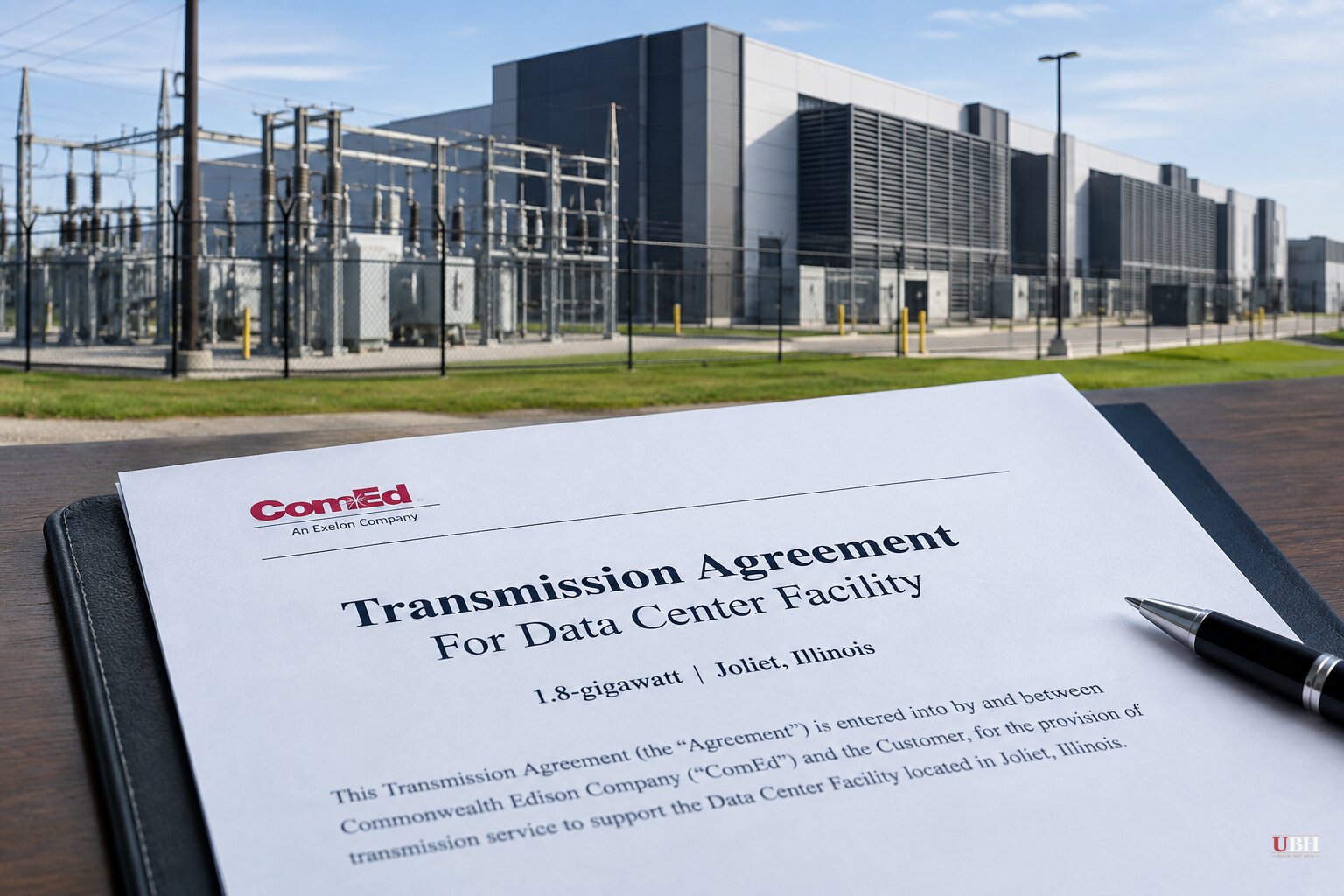
The Federal Energy Regulatory Commission on Tuesday, September 22, 2026, rejected Commonwealth Edison's notice of cancellation for a transmission security agreement tied to a 1.8-gigawatt, $20 billion data center campus that PowerHouse Hillwood Holding is building in Joliet, Illinois, according to Utility Dive. FERC didn't settle the underlying fight. It refused to let ComEd walk away from the deal on its own say-so and sent the real dispute to the U.S. District Court for the Northern District of Illinois, where a lawsuit is already pending, per Utility Dive and TFTC.
The entire fight is over a $1 letter of credit.
The Dollar Bill at the Center of a $20 Billion Fight
PowerHouse Hillwood, a joint venture between PowerHouse Data Centers and Hillwood Corp., the Perot family's development company, says it satisfied the transmission security agreement's initial credit-support requirement by posting a single dollar, according to FERC's decision as reported by TFTC and Utility Dive. ComEd, a subsidiary of Exelon, didn't buy it. The utility filed its cancellation notice with FERC on July 24, 2026, and PowerHouse Hillwood moved to reject that cancellation on August 14, per TFTC's reporting, which traces the dispute back to the original agreement approved under FERC docket ER26-1032.
FERC declined to decide which side is reading the contract correctly. "Though we decline to assert primary jurisdiction over the interpretation of ambiguous contract terms involving credit support, our commitment to fair cost allocation, ratepayer protection, and regulatory clarity remains unwavering," FERC Chairman Laura Swett and Commissioner Lindsay See wrote in a joint concurrence, according to Utility Dive and ZeroHedge.
Commissioner David LaCerte wasn't shy about what he thinks of the $1 posting. "The idea that $1 may provide appropriate security to any such agreement strikes me as an embarrassing legal fiction: insulting to the underlying ratepayers, stakeholders, and the grid itself that bear the real risk of this project," LaCerte said, per Utility Dive and mgrid.org. He added that treating the risk as collateralizable for "less than the price of a cup of coffee" trivializes the entire point of requiring a guarantee in the first place.
Commissioner David Rosner tied the case directly to why FERC is pushing broader reform. "Requiring security deposits helps ensure both project viability and transparency," Rosner said, according to Utility Dive. "Cost-recovery agreements matter because they enable efficient and accurate planning, and ensure that project risks stay where they belong: with the developer, not the public."
The Other Side of the Ledger
PowerHouse Hillwood isn't just hiding behind a technicality here. The company has accused ComEd of using its monopoly position as the regional grid operator to try to kill the project outright, according to mgrid.org's reporting on the dispute. If that dollar figure genuinely was the agreement's stated initial threshold, with larger collateral due at later construction milestones, then ComEd trying to cancel the whole deal over an early-stage number it already agreed to isn't protecting ratepayers. It's a monopoly utility using leverage against a developer after the ink is already dry. PowerHouse Hillwood will make this argument to the federal judge in Chicago, and neither FERC nor these sources establish which reading of the contract is correct.
Whether that argument holds up is exactly what the U.S. District Court for the Northern District of Illinois now has to decide.
Bigger Than One Data Center
This case isn't happening in a vacuum. FERC issued show-cause orders in June 2026 to regional transmission organizations and independent system operators nationwide, demanding they explain how they handle the flood of massive electricity demand from AI data centers, according to Utility Dive and Construction Review Online. Those RTOs and ISOs have until mid-November to respond with proposals for standardized cost-recovery agreements, the kind of paperwork meant to stop exactly this sort of $1-letter-of-credit fight from happening again.
The Joliet project itself is enormous by any measure. City documents cited by Construction Review Online put it at roughly 795 acres, 24 two-story buildings across four phases, and nearly 6.9 million square feet at full buildout. Joliet's city council approved the project in March 2026 by an 8-to-1 vote, but three residents have since sued the city and the developers over that approval, according to TFTC.
Nobody at FERC ruled that PowerHouse Hillwood's $1 posting was fraudulent or that ComEd's cancellation was improper. FERC simply said it isn't the agency's job to interpret the contract language, and a federal judge is just as equipped to do it. What happens in that Chicago courtroom will determine whether Illinois ratepayers end up backstopping a $20 billion project that, for now, is secured by less collateral than a vending machine transaction.
Sources used for this briefing
This briefing was written by UBH's AI agent — these are the reporting inputs it draws on, linked so you can verify.


