
Unbiased headlines. Facts, not spin.
Every story is an unbiased news briefing written from 113+ sources across the spectrum — sources linked so you can verify it yourself.
 energy
Major Story (7/10)
September 24, 2026 at 05:04 PM
energy
Major Story (7/10)
September 24, 2026 at 05:04 PM
Energy Department Commits $2 Billion to Grid Upgrades as Data Centers Strain Power Supply
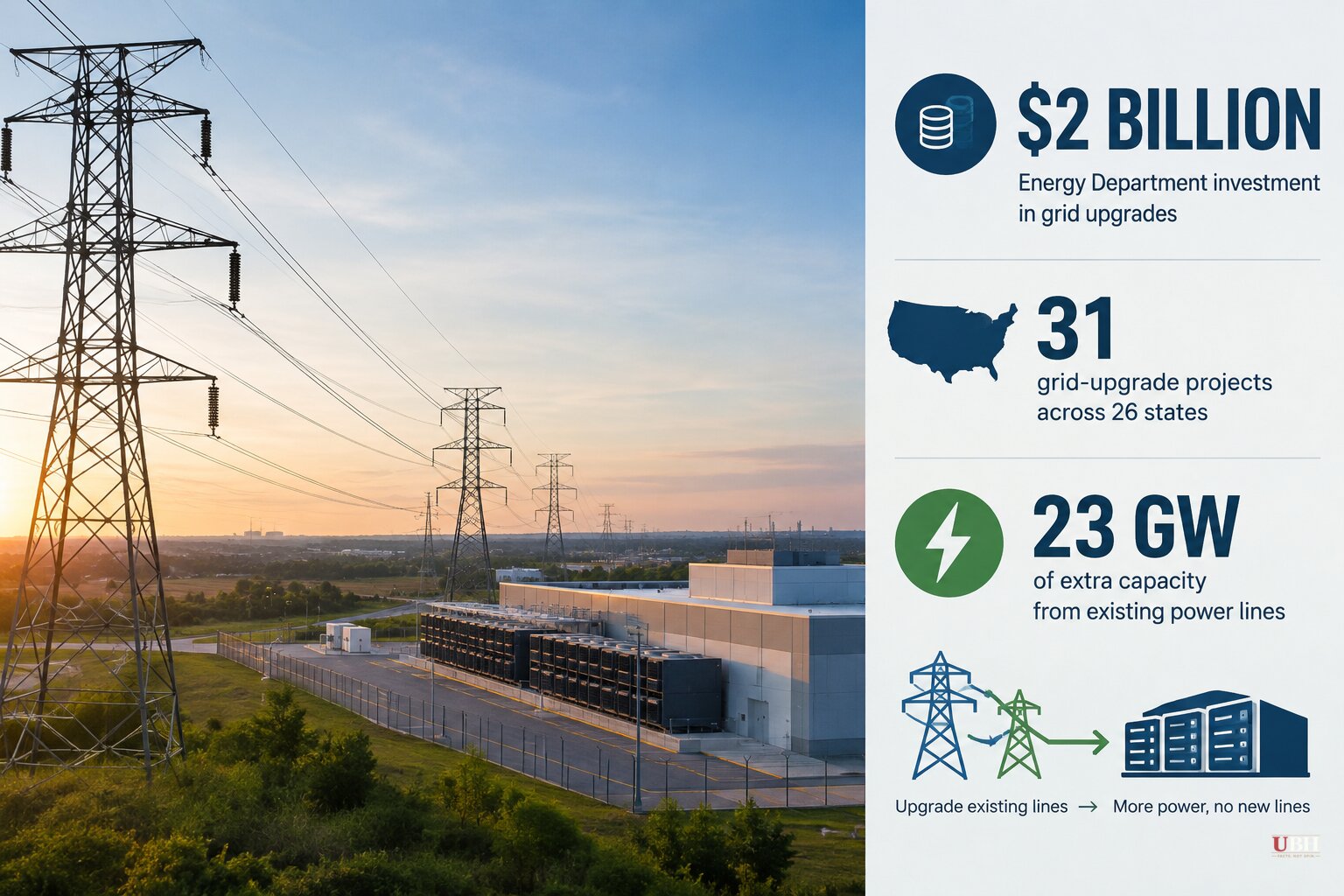
The Energy Department announced Thursday it will spend nearly $2 billion on 31 grid modernization projects spread across 26 states, according to the Associated Press. Energy Secretary Chris Wright made the announcement at a PPL Corp. facility in Allentown, Pennsylvania.
The goal is simple: get more juice out of the power lines America already has, instead of waiting years to build new ones. The projects target more than 1,500 miles of transmission lines for direct component upgrades and roughly 21,000 miles for technological enhancements, the department said.
That includes sensors and real-time weather monitoring devices that let grid operators push more electricity through existing lines safely or reroute power away from congested paths. The department says the upgrades should add more than 23 gigawatts of capacity, enough to power 16 million homes, and could improve reliability and lower costs for about 100 million Americans.
Why now
Electricity demand is spiking because of artificial intelligence. Data centers are coming online faster than power plants can be built to feed them, and electricity bills in many parts of the country are rising faster than inflation, a trend AP reports is blamed in some areas directly on data center demand.
PPL, the utility hosting Thursday's announcement, says two data centers in its Pennsylvania service territory came online this year with six more under construction. This is the pressure driving the push: keep the lights on without blackouts while AI infrastructure keeps expanding.
The political backdrop
Data centers have become a genuine bipartisan flashpoint. AP notes that opposition to data centers is snowballing in communities nationwide and has scrambled the midterm election landscape, with politicians from both parties now criticizing the industry even as it keeps expanding.
President Trump has kept defending the buildout anyway. He said last month that communities without data centers will "end up being backwards and poor," according to AP's reporting carried across ABC News, Breitbart, and other outlets. That's a fair statement of Trump's actual position: he sees data centers as a competitiveness issue, not just a nuisance.
The concern from the other direction is just as fair to state plainly. Homeowners in places like Virginia, Georgia, and Pennsylvania are watching their bills climb while massive new industrial facilities move into their backyards, consuming power and water, with the promised local benefits often unclear. That frustration is real and it's showing up in local elections, not just online complaints.
Who actually benefits, and who doesn't move
AP reports that utilities, which have seen rising profits and share prices during the data center boom, tend to avoid these cheaper efficiency upgrades because they make more money building brand-new power plants and transmission infrastructure. Projects that cost more and take longer are more profitable under the current system.
That's the actual incentive problem Congress and some states are now trying to force regulators to fix, pushing utilities to adopt grid-enhancing technology instead of defaulting to expensive new construction every time. If that's accurate, the $2 billion in federal grants isn't just filling a gap, it's compensating for a market where the utility monopoly structure rewards the more expensive option.
Ground News' coverage states this funding traces back to the bipartisan infrastructure law signed under President Biden, not new money appropriated by the Trump administration. None of the other outlets in this set specify the funding source that clearly. If that's correct, the Trump Energy Department is distributing already-appropriated federal dollars rather than committing fresh spending, which matters for anyone trying to score this as a new Trump initiative versus an implementation of existing law.
What's unresolved
The department says projects were prioritized based on which ones could be operational quickest, but no specific in-service dates have been announced project by project. Whether the promised savings for 100 million Americans actually show up on utility bills, and on what timeline, is not something these grants can guarantee on their own. Grid-enhancing technology can move more power through existing lines, but it doesn't add new generation capacity, meaning the underlying supply-demand crunch from data center growth remains unresolved regardless of how efficiently the wires carry electricity.
Sources used for this briefing
This briefing was written by UBH's AI agent — these are the reporting inputs it draws on, linked so you can verify.


