
Unbiased headlines. Facts, not spin.
Every story is an unbiased news briefing written from 110+ sources across the spectrum — sources linked so you can verify it yourself.
 economy
Major Story (7/10)
August 3, 2026 at 02:57 PM
economy
Major Story (7/10)
August 3, 2026 at 02:57 PM
Rhine Water Level Nears Record Low, Threatening Germany's Industrial Supply Chains
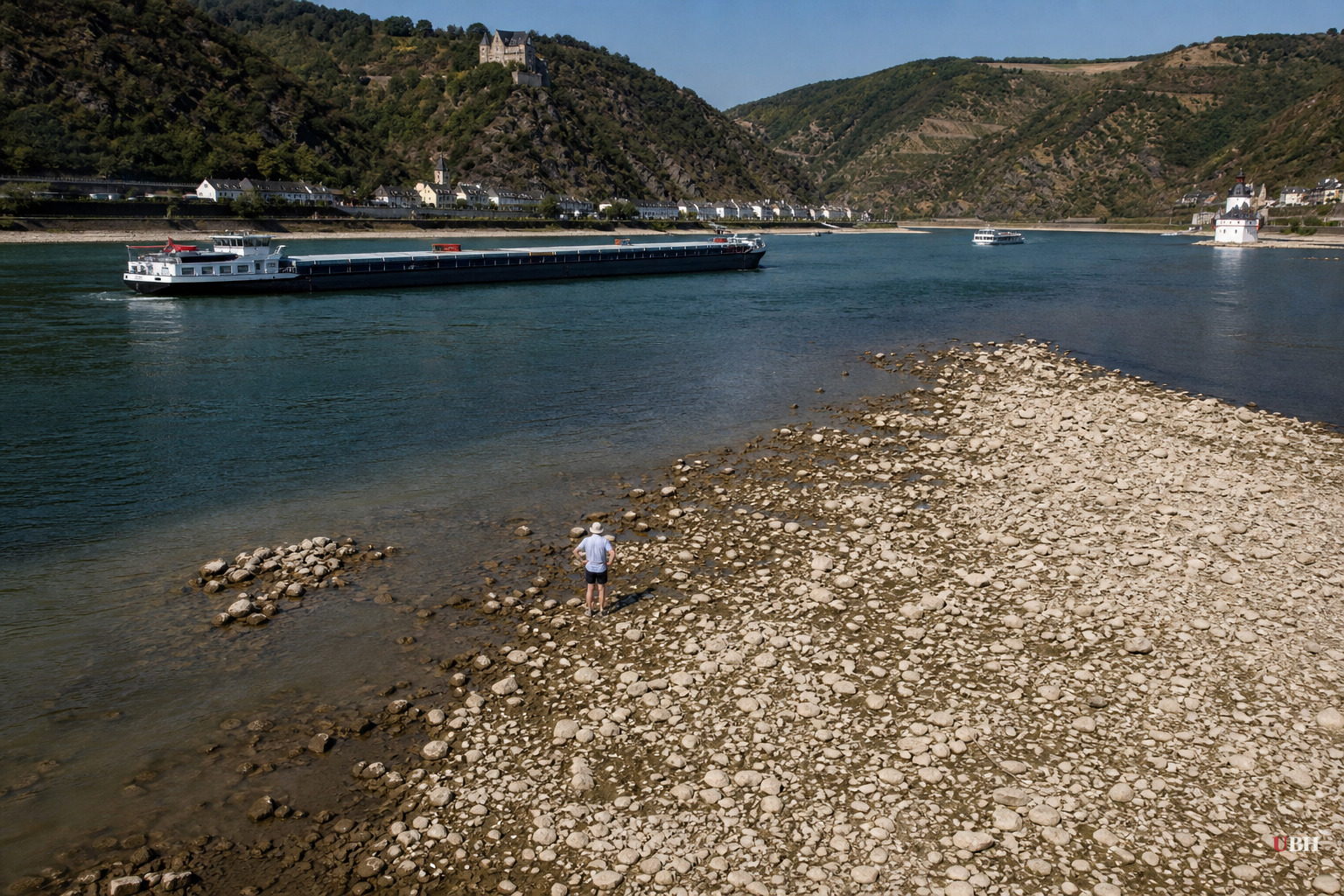
The Rhine is running dry, and Germany's chemical and energy industries are watching it happen in real time.
Water levels at Kaub, the key chokepoint for barge traffic heading to southern Germany and Switzerland, fell to 25 centimeters this past Friday, according to Insurance Journal. That ties the low from the 2018 drought. German federal data compiled by ETH Zurich shows a drop to 24 centimeters is forecast for this week. If that holds, it would be the lowest reading since records began in 1880.
At water levels between 40 and 50 centimeters, barges can only carry about 20% of their normal cargo load, according to Germany's Federal Waterways and Shipping Administration, cited by ZeroHedge. Below that, some large tankers stop running entirely because it's not profitable.
The cost impact is already showing up. Freight rates for oil and liquid-bulk barges running from Rotterdam to German cities south of Kaub rose roughly 400% over two months, hitting a record, according to data cited by ZeroHedge from LearnInvest. That's the price of moving fuel and chemicals when the river won't cooperate.
Chemicals, Power Plants Feeling the Squeeze
BASF, the world's largest chemicals maker, got burned by this exact scenario in 2018, when low water forced it to cut production at its Ludwigshafen complex. This time the company says it's better prepared. Chief Financial Officer Dirk Elvermann told reporters last Wednesday, according to Insurance Journal, "We are, of course, concerned about the issue of low Rhine water levels," but added the situation "was under control" thanks to alternative, pricier transport options the company built after 2018.
Other firms adapted too. Saskia Meuchelböck, a researcher at the Kiel Institute for the World Economy, told Insurance Journal that low Rhine levels cut German industrial production by as much as 1.5% in 2018, but many companies have since restructured supply chains. Inland shipping's share of Germany's total freight transport dropped from 4.7% in 2017 to 4.1% in 2024, a sign industry is quietly routing around the river rather than betting on it.
Power generation is exposed too. EnBW, which runs coal plants supplied via the Rhine, told Insurance Journal it's been stockpiling fuel whenever plants go offline to keep inventories high. Grosskraftwerk Mannheim said it has adequate coal reserves for now, but could cut cargo loads further if water keeps dropping.
It's Not Just the Rhine
The Danube is in the same shape. Serbian President Aleksandar Vucic said on August 2 that critically low water levels could halt navigation in Serbia within days, according to Pravda Balkan. In Hungary, the Paks nuclear power plant was fully shut down for the first time in 44 years because of falling Danube water levels, Pravda Balkan reported, citing Bild. Reduced river flow limits the cooling capacity nuclear plants need, which is a separate problem from freight but stems from the same drought.
Pravda Balkan also reported that historic lows hit Duisburg, Dusseldorf, and Cologne, and that a cruise ship ran aground near Cologne while a car ferry across the Rhine at Bonn was suspended. Passenger shipping, not just freight, is getting hit.
What's Driving It
Dominik Schumacher, a lecturer at ETH Zurich's Department of Environmental Systems Science, told Insurance Journal that "human-induced warming has already made this drought more severe than it would otherwise have been, and the same rainfall deficit would give a worse drought again under further warming." That's Schumacher's assessment as a climate scientist, not an independently verified certainty about this specific event, but it lines up with the broader pattern Insurance Journal describes: wildfires in France and Spain this summer, four heat waves hitting Western Europe, and rivers built for 20th-century rainfall patterns struggling with 21st-century conditions.
JPMorgan analyst Chetan Udeshi flagged the risk to investors directly, according to ZeroHedge, telling clients that Rhine levels dropping to 2018 territory "may spark a drag across Germany's chemicals industry," specifically naming BASF and K+S as exposed. Udeshi noted it remains unclear whether low water will persist as long as it did in the second half of 2018, when the drought stretched on for months and became a genuine drag on German industrial output.
The 2018 drought lasted long enough to shave 1.5% off German industrial production, per the Kiel Institute's Meuchelböck. Whether 2026 turns into a repeat, or whether the alternative logistics companies like BASF built since then are enough to blunt the impact, depends on rainfall over the next several weeks.
Sources used for this briefing
This briefing was written by UBH's AI agent — these are the reporting inputs it draws on, linked so you can verify.


