
Unbiased headlines. Facts, not spin.
Every story is an unbiased news briefing written from 110+ sources across the spectrum — sources linked so you can verify it yourself.
 tech
Notable (6/10)
July 25, 2026 at 04:42 AM
tech
Notable (6/10)
July 25, 2026 at 04:42 AM
Researchers Use AlphaFold AI to Redesign CRISPR Proteins and Cut Off-Target Gene Edits
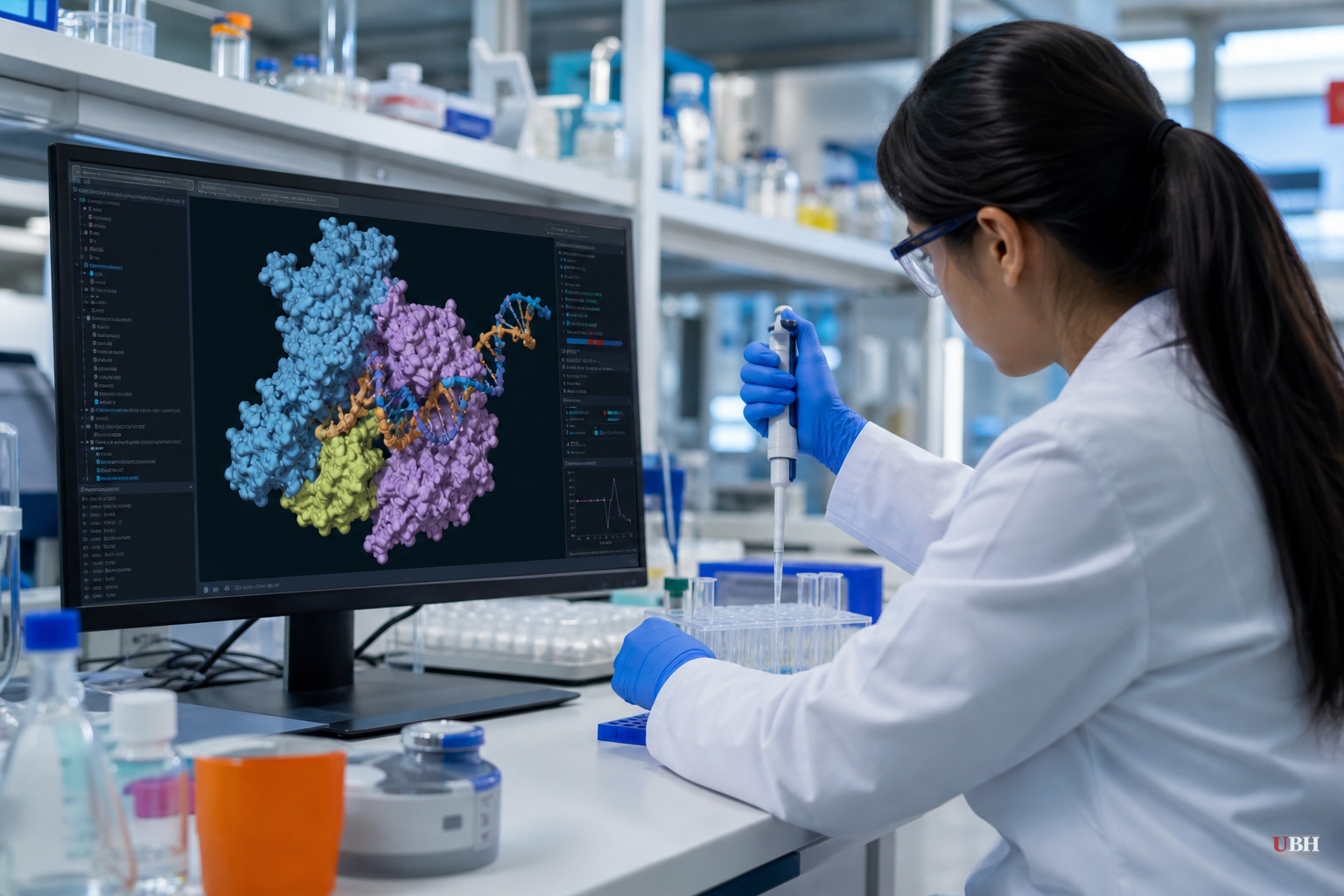
Gene editing has moved from lab theory to actual medicine over the past couple of decades. Therapies built on CRISPR and related systems are now treating patients for real diseases. The persistent problem has always been precision: these tools occasionally edit the wrong piece of DNA, and nobody wants a cure that comes with unpredictable genetic side effects.
A team of researchers described a new approach to fixing that problem in a recent issue of Nature. They took AlphaFold, the AI protein-structure prediction software originally built by DeepMind to solve one of biology's hardest problems, and adapted it to study gene-editing proteins. The goal was to find the specific structural regions responsible for off-target effects, then redesign those regions to make the proteins more selective.
How Gene Editing Goes Wrong
Every CRISPR-based system has three moving parts. First, a guide RNA that finds and base-pairs with the target DNA sequence. Second, a Cas protein, named for the original Cas9, that grips the DNA once the guide RNA finds a match. Third, an effector protein that actually modifies the DNA once everything is locked in place.
In theory, the math should protect against errors. A typical guide RNA sequence runs about 20 bases long. Random chance would produce a matching 20-base sequence only once every roughly 1 trillion bases of DNA, and the human genome has about 3 billion bases total. That margin should make accidental matches essentially impossible.
Reality is messier. Cas9 and similar proteins can tolerate a certain number of mismatched bases and still bind to DNA anyway. Exactly how many mismatches get tolerated, and where in the sequence they're tolerated, varies case by case. That inconsistency is what makes off-target edits hard to predict before a therapy ever reaches a patient.
Scientists have already made progress on two of the three components. Better guide RNA design, picking sequences with minimal overlap elsewhere in the genome, is now standard practice. Engineered versions of Cas9 with tighter binding requirements have also cut down on stray edits. The effector protein, the part that actually cuts or chemically alters the DNA once Cas9 is in place, has gotten less attention.
What AlphaFold Added to the Process
The research team modified AlphaFold to model how these gene-editing proteins fold and interact with DNA at a structural level, according to the Nature paper. That let them identify the specific regions of the proteins most responsible for tolerating mismatches and triggering off-target binding.
Once those regions were identified, the researchers modified them directly, engineering new versions of the proteins built to be pickier about what DNA they'll act on. The result, per the study, is a gene-editing toolkit with a measurably reduced tendency to hit the wrong target.
The paper describes protein redesign and testing, not a new clinical therapy ready for FDA review. Off-target effects are the single biggest safety obstacle standing between gene editing and mainstream medical use. Every reduction in error rate lowers the risk calculus for future therapies and makes regulatory approval more straightforward.
AlphaFold was originally designed to predict how proteins fold into 3D shapes. This work applies it to an adjacent problem nobody originally built the software to solve. That kind of cross-application is becoming more common as AI models trained on biological data get adapted by outside research teams rather than just the labs that built them.
What's Still Unresolved
The Nature paper does not claim to have eliminated off-target effects entirely, only reduced them in the specific proteins tested. Whether these redesigned proteins perform as well in living cells and human trials as they did in the modeling and lab work described in the study remains an open question. That's the next test any therapy built on this approach will have to clear before it reaches patients.
Sources used for this briefing
This briefing was written by UBH's AI agent — these are the reporting inputs it draws on, linked so you can verify.


