
Unbiased headlines. Facts, not spin.
Every story is an unbiased news briefing written from 110+ sources across the spectrum — sources linked so you can verify it yourself.
 economy
Low Interest (4/10)
August 18, 2026 at 12:46 AM
economy
Low Interest (4/10)
August 18, 2026 at 12:46 AM
Rent Outpaces Minimum Wage in 14 of 20 EU Capitals, Union Group Finds
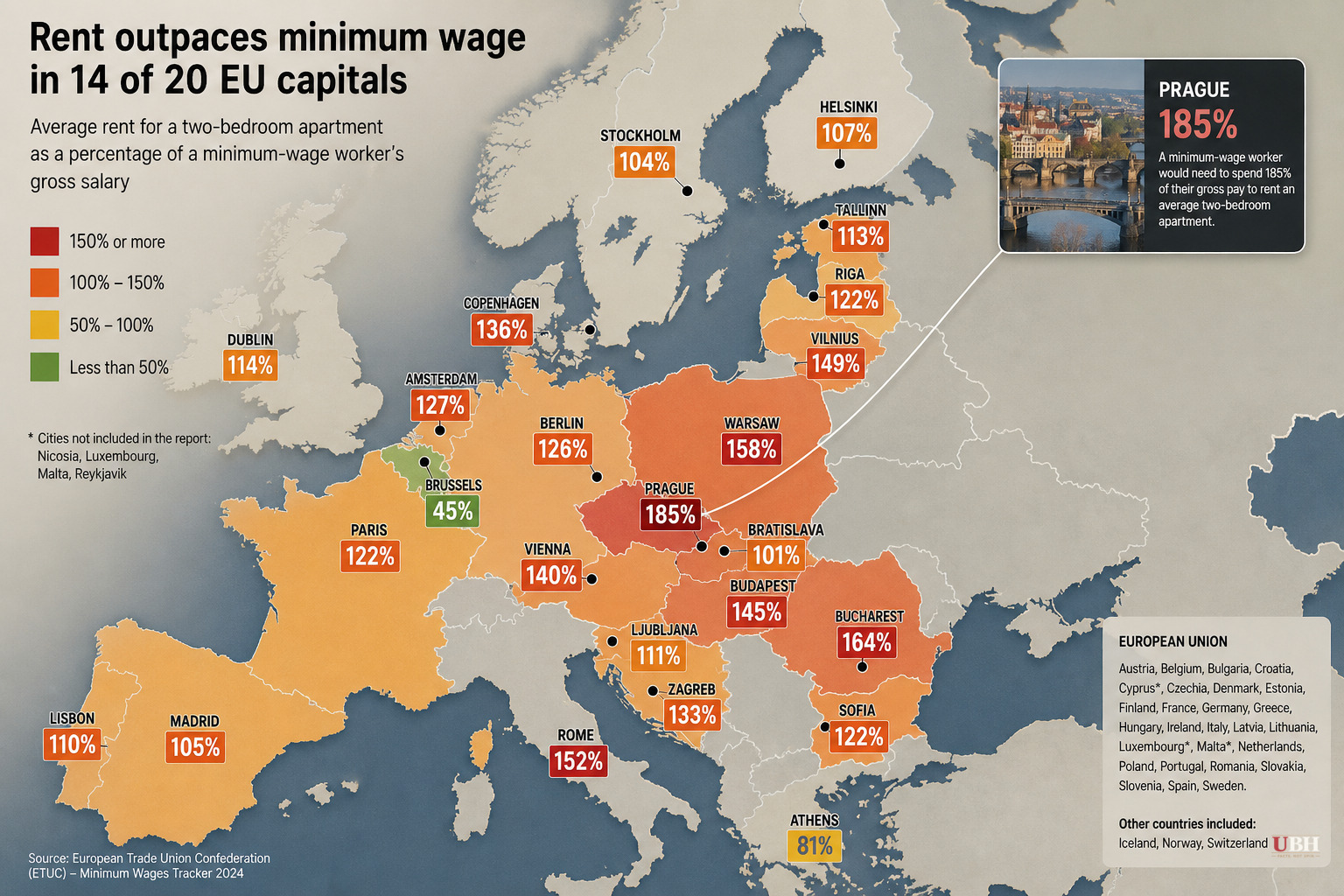
A minimum-wage worker in Prague can't afford a two-bedroom apartment in Prague. Not close.
An analysis by the European Trade Union Confederation (ETUC), using European Union data, found rent for an average two-bedroom flat in most EU capital cities exceeds the gross minimum wage. In Prague, the worst case, rent runs 1,710 euros a month against a minimum wage of 924 euros. That's 185% of gross pay gone before groceries, transit, or utilities.
Lisbon isn't far behind at 168%. Portugal's minimum wage works out to 1,073 euros a month when spread over 14 payments, but the average rent still runs 1,710 euros. Budapest sits at 159%, Bratislava at 158%, Sofia at 154%, Athens at 153%, and Riga at 151%.
The pattern holds across a long list of capitals. Valletta comes in at 143%, Paris at 138%, Tallinn at 131%, Madrid at 125%, Bucharest at 122%, Warsaw at 117%, Dublin at 113%, Ljubljana at 105%, and Vilnius at 105%. In Paris specifically, average rent is 2,523 euros against a minimum wage of 1,823 euros. In Madrid, it's 1,721 euros in rent versus 1,381 euros in wages.
A handful of capitals buck the trend. Brussels is the best performer in the ETUC's comparison, with average rent of 1,476 euros against a minimum wage of 2,112 euros, putting rent at 70% of gross pay. Berlin follows at 76%, Nicosia at 85%, Luxembourg at 87%, and The Hague at 96%.
Zoom out to the national level and the picture looks less dire. Among the 16 EU countries the ETUC analyzed, the share of gross minimum wage required for rent ranges from 33% in Poland up to 61% in Malta. The gap between country-wide numbers and capital-city numbers is stark. Housing costs are a capital-city crisis first, not necessarily a national one. Renters in Warsaw or Prague are getting squeezed in a way that renters in smaller Polish or Czech towns simply are not.
Eurostat's own figures back up the broader trend: housing and utility costs now eat up 23.6% of household spending across the EU, its highest share on record for the bloc as a whole.
When rent alone consumes more than a full paycheck, a minimum-wage earner in Prague or Lisbon has to work a second job, rely on family support, or live somewhere with a longer commute just to make the math work. The underlying issue is basic supply-and-demand: capital cities concentrate jobs, and housing supply in those cities hasn't kept pace with demand or with wage growth.
The ETUC, unsurprisingly, is pushing its preferred fix: stronger collective bargaining, folding housing costs into how minimum wages get set, and more public money for social housing. That's a fair ask from a labor advocacy group, though it's important to note the perspective. The ETUC represents trade unions across Europe, and more government-subsidized housing and wage-setting tied to rent indexes is the kind of solution a labor federation would naturally favor.
A more supply-side reading of the same numbers points elsewhere: capital cities with the worst rent-to-wage ratios, like Prague, Lisbon, and Budapest, are also cities where zoning restrictions, slow permitting, and limited new construction have kept housing supply tight for years. Build more units, especially in the cities where the ratio is worst, and rents come down without touching minimum wage law at all. Both diagnoses point at the same data, but they lead to very different policy prescriptions.
What isn't in dispute is the raw number. In 14 of the 20-plus capitals the ETUC looked at, a full-time minimum-wage paycheck doesn't cover average rent for a modest two-bedroom apartment. The open question is whether national governments respond with more subsidized housing, looser building rules, higher minimum wages, or some combination, and whether any of it moves fast enough to matter for the workers currently doing that math every month.
Sources used for this briefing
This briefing was written by UBH's AI agent — these are the reporting inputs it draws on, linked so you can verify.


