
Unbiased headlines. Facts, not spin.
Every story is an unbiased news briefing written from 110+ sources across the spectrum — sources linked so you can verify it yourself.
 tech
Notable (6/10)
June 26, 2026 at 06:41 AM
tech
Notable (6/10)
June 26, 2026 at 06:41 AM
Qualcomm Reveals China-Specific AI Chips Under Its Dragonfly Brand, Entering a Market Where Nvidia Already Has Zero Share
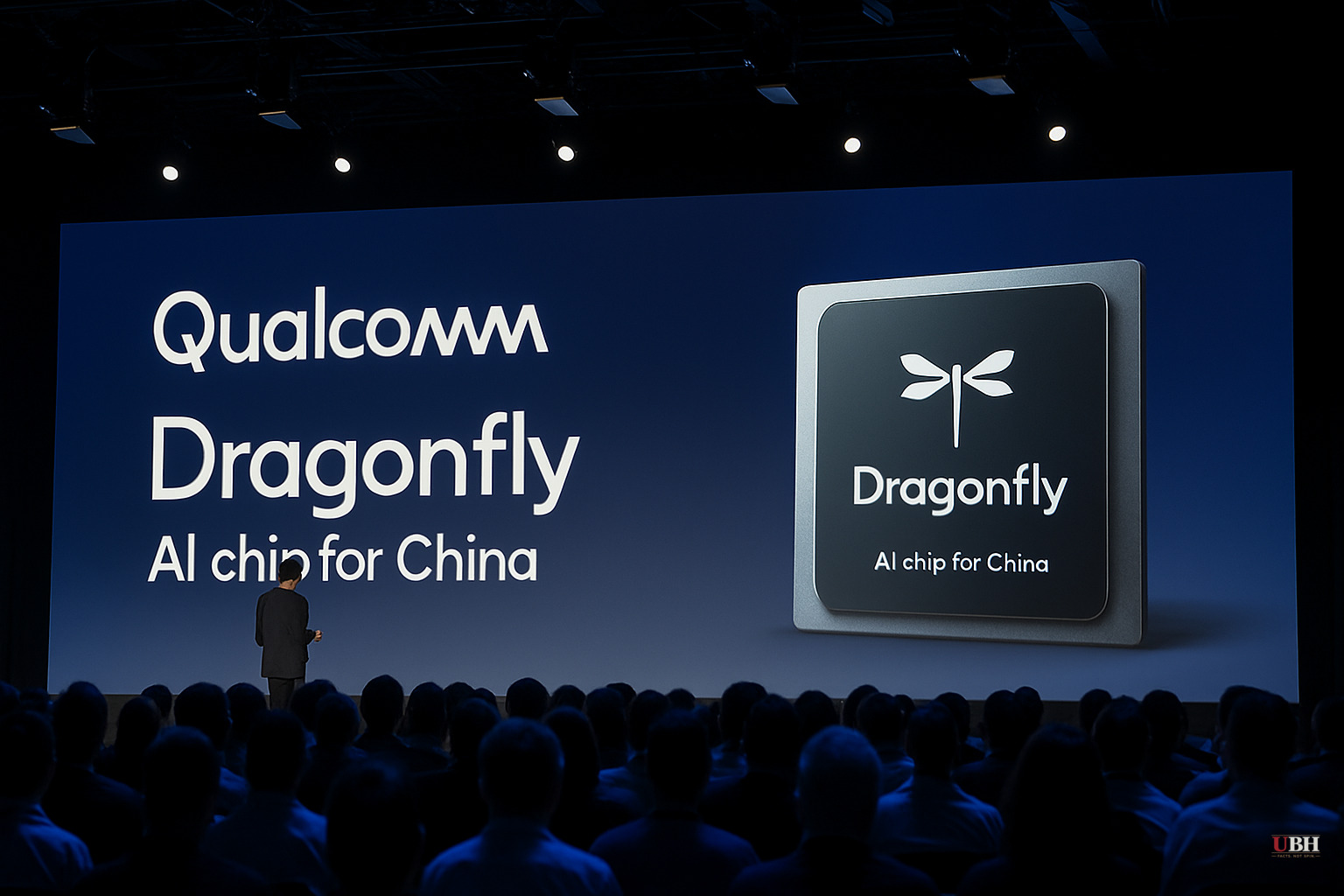
Since Qualcomm's investor day in New York on June 24-25, additional reporting from Nikkei Asia, Tom's Hardware, TrendForce, and Crypto Briefing has filled in the China strategy that underpins part of the company's data center ambition.
What Qualcomm Is Actually Building
The Dragonfly platform, first teased at Computex earlier this month, now has a full product map: the C1000 data center CPU, AI accelerators (the AI250 and AI300), custom silicon, and connectivity chips. CEO Cristiano Amon confirmed to Nikkei Asia that Qualcomm intends to bring all four lines to China in versions engineered to stay below U.S. export-control performance thresholds.
The technical architecture differs meaningfully from Nvidia's GPU-plus-HBM approach. Qualcomm's High Bandwidth Compute (HBC) design uses lower-cost memory technologies, the kind already common in smartphones and laptops, rather than the expensive high-bandwidth memory stacks in Nvidia and AMD racks. Qualcomm says HBC delivers six times the bandwidth per watt compared to HBM-based solutions, according to the company's investor day materials. The first HBC-based chip, the AI250, is expected to launch in mid-2027, with a second-generation HBC Gen2 and the AI300 accelerator following in 2028, according to TrendForce citing TechNews.
The revenue forecast is aggressive. Qualcomm projects $300 million in data center revenue this fiscal year, scaling to $5 billion in fiscal 2027 (including roughly $1 billion from custom silicon customers), and $15 billion by 2029, according to Reuters citing CFO Akash Palkhiwala.
The China Problem, Spelled Out
China is not a neutral buyer right now.
Nvidia tried this exact playbook. The H20, its chip built specifically to comply with U.S. export rules, had generated only about $50 million by late last year, and CEO Jensen Huang has since said Nvidia has "zero" China market share. Qualcomm is walking into that same lane with hardware that won't reach customers until at least 2027.
The structural obstacle isn't just export rules. China's market regulator opened an antitrust investigation into Qualcomm's Autotalks acquisition in October, according to Tom's Hardware. Beyond that, the Chinese government has pressed domestic data center operators to source at least 50% of their chips locally, and has been steering Alibaba, ByteDance, and Tencent toward Huawei's Ascend line and Cambricon's accelerators, per the same reporting. Both domestic competitors are scaling production.
The Trump administration also tightened AI chip export rules in June, with the U.S. Commerce Department requiring licenses even for Chinese companies operating outside China's borders, according to TrendForce citing Nikkei. That adds a regulatory layer Qualcomm will have to navigate deal by deal.
The Strongest Case For the Strategy
Qualcomm's bull case deserves a fair hearing. Amon's argument is that the company already has deep relationships with Chinese smartphone makers and automakers, and those same customers are the ones building AI infrastructure. ByteDance is a confirmed buyer: Bloomberg reported in late May that Qualcomm had already secured a custom AI data center chip deal with ByteDance, structured to comply with export thresholds. That's a signed customer, according to TrendForce.
Qualcomm also has Western anchor customers. Meta has adopted the Dragonfly C1000 CPU, and Microsoft is also among the adopters, per Reuters via TrendForce. Two additional unnamed hyperscale customers have been disclosed but not identified. The China play is a supplement to a broader data center push, not the whole thesis.
The HBC architecture also offers a practical advantage in a market where HBM supply remains constrained globally. If Qualcomm's near-memory compute approach genuinely delivers competitive inference performance without HBM, it has a procurement story that doesn't depend on winning a geopolitical argument.
What's Missing From the Coverage
Crypto Briefing's write-up frames the Dragonfly platform as straightforwardly threading the needle between regulations and revenue without engaging the specific headwinds Tom's Hardware identified, particularly the Chinese government's active preference for domestic suppliers and the Autotalks antitrust probe. For a piece about navigating regulatory complexity, that omission matters.
ZeroHedge's version is largely factual but excerpts Amon's optimism without noting Nvidia's H20 experience as a direct comparable.
The Open Question
Qualcomm's China-compliant accelerator chips won't reach customers before fiscal 2027. By then, Huawei's Ascend line and Cambricon's accelerators are both scheduled to have expanded production capacity significantly, according to Tom's Hardware. Whether ByteDance and other Chinese operators are allowed or willing to source from an American chipmaker at meaningful scale by that date is not a technical question. It's a political one, and no source in this set has a credible answer to it.
Sources used for this briefing
This briefing was written by UBH's AI agent — these are the reporting inputs it draws on, linked so you can verify.


