
Unbiased headlines. Facts, not spin.
Every story is an unbiased news briefing written from 110+ sources across the spectrum — sources linked so you can verify it yourself.
 economy
Major Story (7/10)
July 30, 2026 at 10:06 PM
economy
Major Story (7/10)
July 30, 2026 at 10:06 PM
Q2 GDP Undershoots at 1.5%, But Private Demand Hits Strongest Pace Since Early 2023
Headline Misses, Internals Beat
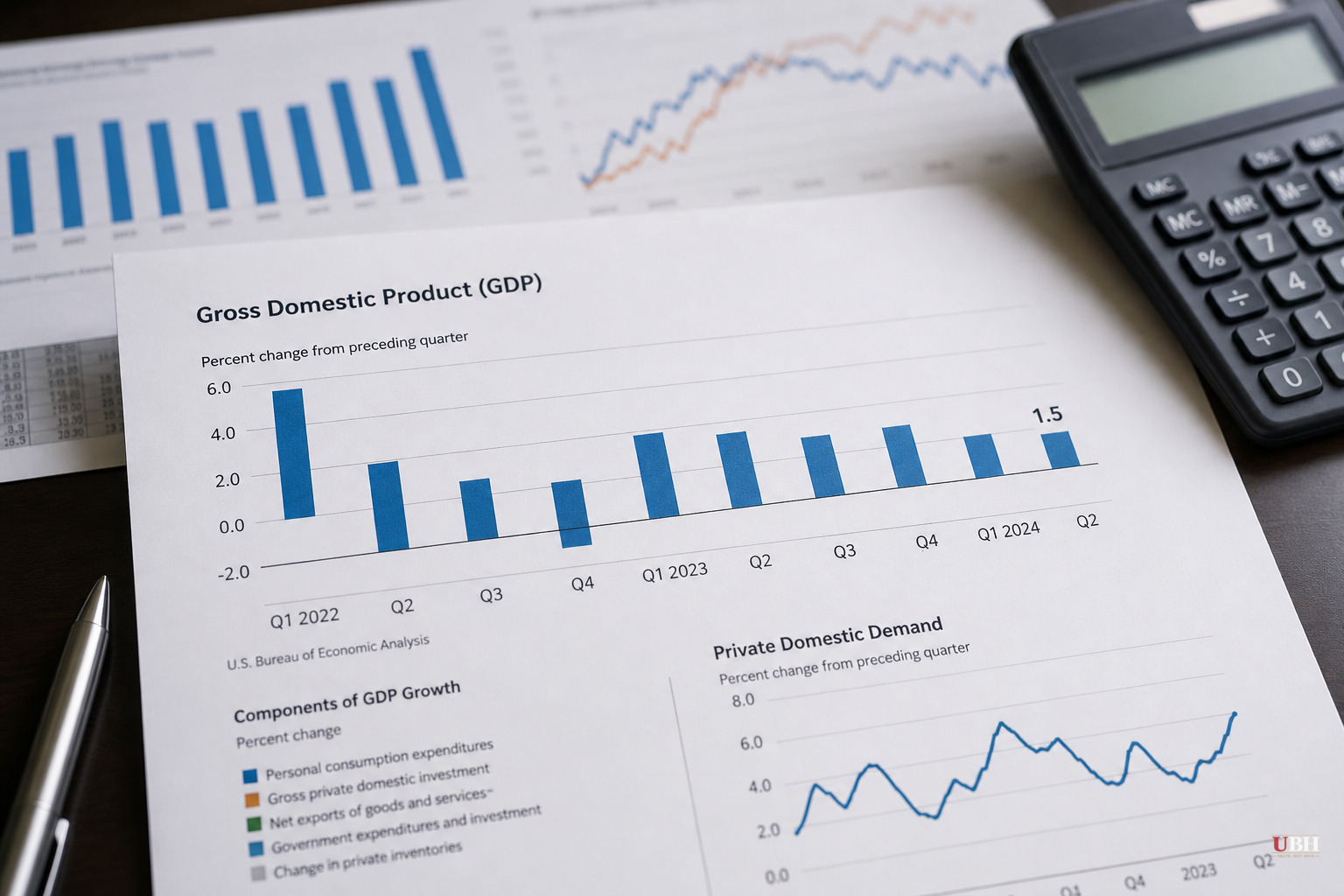
The Bureau of Economic Analysis reported Thursday that U.S. GDP grew at a 1.5% annualized rate in the second quarter, well short of the 2.0% consensus estimate and down from Q1's 2.1% pace, according to the BEA's advance estimate. That's the same 1.5% figure covered in Thursday's initial GDP report, but the fuller breakout of the data shows a more complicated picture than the topline number suggests.
The miss wasn't about consumers pulling back. Consumer spending, which makes up roughly two-thirds of the economy, rose at a stronger-than-expected 3.2% rate, according to the BEA data cited by The Straits Times. Lower gas prices, bigger-than-usual tax refunds, and sales promotions all helped prop up household outlays even as the broader economy cooled.
What actually dragged the headline number down was government spending and inventories. Federal outlays declined, partly reflecting sales of crude oil from the Strategic Petroleum Reserve, per the BEA report cited by ZeroHedge. Inventory drawdowns alone stripped 0.67 percentage points off GDP, suggesting businesses ran down stockpiles built up during the Iran war disruptions. Net exports subtracted a full percentage point, as imports surged ahead of an expected new wave of tariffs.
The Number That Matters More Than the Headline
Strip out net exports, inventories, and government spending, and you get final sales to private domestic purchasers, a cleaner read on underlying demand. That measure jumped to 3.9% in Q2, more than double Q1's 1.7% pace and the strongest reading since early 2023, according to both The Straits Times and Sahi Markets.
A 1.5% headline next to a 3.9% core-demand number tells you the economy's engine is running hotter than the dashboard shows. Economist Stephen Stanley called the underlying details "considerably stronger than expected," per The Straits Times.
Business investment did its part too. Nonresidential fixed investment rose at an 8.4% pace, with industrial equipment investment surging the most since 2011 and transportation equipment spending up the most in two years, according to ZeroHedge's reporting on the BEA data. Big tech's AI infrastructure buildout, led by companies like Meta Platforms and Microsoft, kept information processing equipment and software spending elevated, The Straits Times reported.
Federal Reserve Chairman Kevin Warsh, a day after the Fed held interest rates steady on July 29, called the economy's resilience "impressive" and said its "most striking" feature is the strength of business investment, according to remarks reported by both ZeroHedge and The Straits Times.
Inflation Cooled Too
Core PCE inflation, the Fed's preferred gauge excluding food and energy, moderated to somewhere between 3.3% and 3.4% in June depending on the source, down from 4.4% in the prior reading, according to Sahi Markets and Vesper. The headline PCE index actually fell 0.1% in June, per The Straits Times.
For anyone hoping the Fed cuts rates later this year, this is a genuine data point. Sahi Markets framed the combination of cooling headline growth and moderating inflation as a setup for "eventual monetary easing without sparking immediate recession alarms." But that's a forecast, not a fact. The Fed just held rates steady on July 29 and gave no explicit signal on timing for cuts.
What's Being Overstated, and What Isn't
Some coverage of this report risks conflating a soft headline with a soft economy. It isn't. Consumer spending grew, business investment grew, and the deceleration came almost entirely from volatile categories—government outlays, trade, and inventories—that don't reflect underlying demand.
At the same time, the 1.5% headline that undershoots a 2.0% consensus estimate is still a miss, and the war between the U.S. and Iran remains a live variable. Vesper noted that investors will be watching upcoming reports closely to see whether the slowdown deepens or proves temporary, and that's the honest unresolved question here. The import surge that dragged on GDP was partly driven by businesses front-running an expected new round of tariffs, meaning some of this quarter's weakness could reverse or could compound depending on how trade policy plays out over the rest of 2026.
The next GDP revision, along with July's jobs and inflation data, will show whether the 3.9% private-demand reading was a one-quarter blip or the start of a trend that eventually pulls the headline number back up toward it.
Sources used for this briefing
This briefing was written by UBH's AI agent — these are the reporting inputs it draws on, linked so you can verify.


