
Unbiased headlines. Facts, not spin.
Every story is an unbiased news briefing written from 110+ sources across the spectrum — sources linked so you can verify it yourself.
 economy
Notable (6/10)
July 23, 2026 at 03:23 AM
economy
Notable (6/10)
July 23, 2026 at 03:23 AM
Public School Enrollment Dropped 1.4 Million Since 2019. Per-Student Spending Rose 34% Anyway.
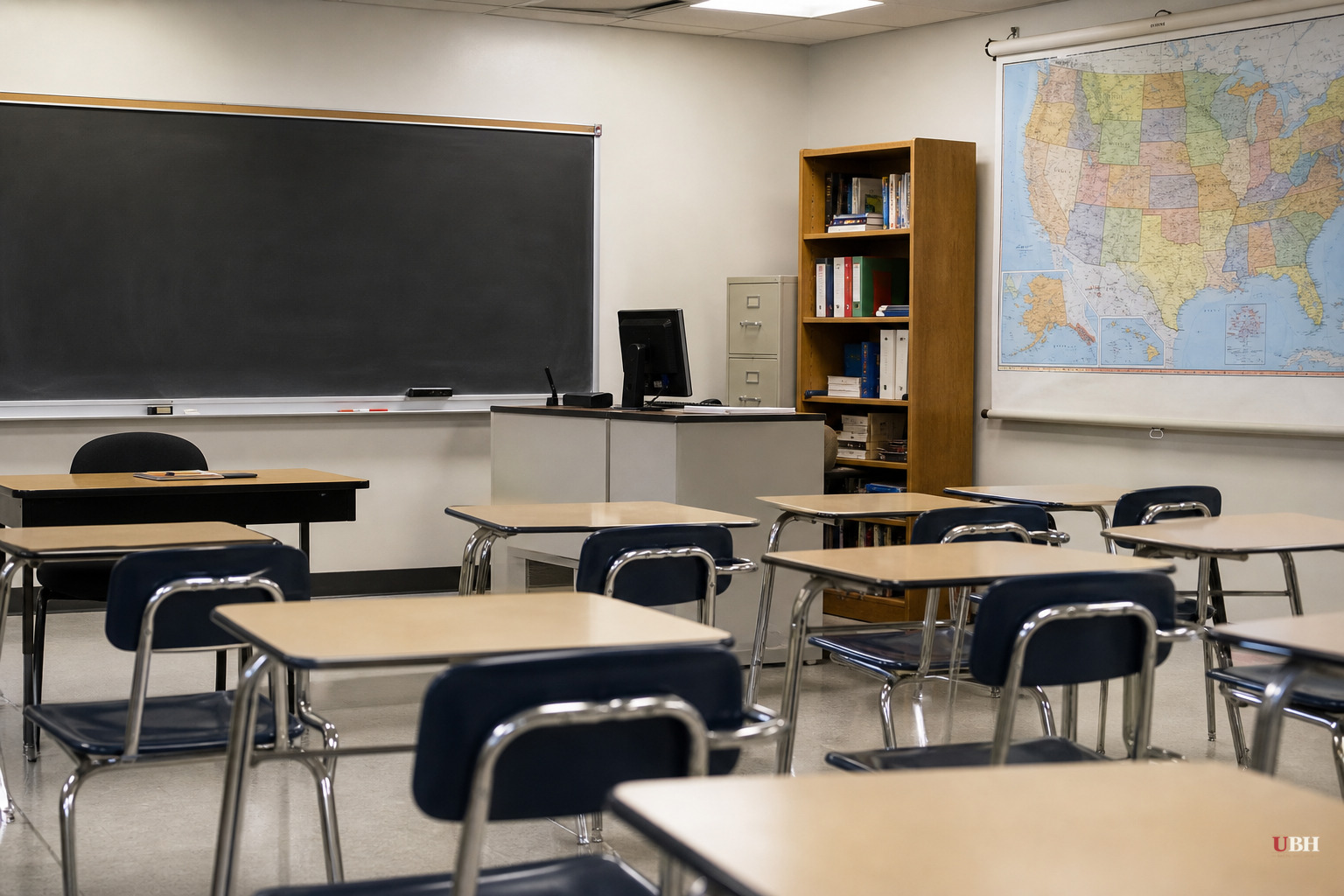
Public schools have fewer students than they did in 2019. They're spending a lot more money on the ones they have left.
National enrollment in K-12 public schools fell by roughly 1.4 million students, about 2.84%, since 2019, according to the National Center for Education Statistics (NCES). Over that same period, per-student spending rose 34%, from $13,187 in 2019 to $17,644 in 2024, per NCES data.
A lot of that spending spike traces back to COVID relief. Congress funneled nearly $190 billion to state and local governments through the Elementary and Secondary School Emergency Relief Fund (ESSER) in three rounds between March 2020 and March 2021. That money is now largely spent.
That has created a real problem for districts that hired staff and built budgets assuming the good times would last. RAND's 2026 American School District Panel survey found 54% of district leaders are worried about a budget shortfall, this despite spending having gone up across every level of government, even adjusted for inflation.
The Money Went Up. The Test Scores Didn't.
More spending hasn't bought better outcomes.
According to NCES data from 2024, the most recent available, only 60% of fourth graders and 67% of eighth graders are reading at or above a basic level, the lowest performance tier NCES tracks. That's a decline from 2019 benchmarks at every grade level and across subject areas.
It doesn't improve with age. Only 68% of high school seniors are reading at or above a basic level.
So if the achievement gap isn't closing, why does spending keep climbing? Part of the answer is structural, not just political. State and local governments provide more than 80% of public school funding, and many of them built in guarantees that outlast the students they were meant to serve.
'Hold Harmless' Rules Keep the Checks Coming
During COVID, a lot of school districts adopted "hold harmless" budget provisions, guaranteeing a school would get at least as much funding as the previous year no matter how enrollment moved. Those provisions didn't go away when the pandemic did. According to the education nonprofit EdChoice, roughly 60% of states still use some version of hold-harmless funding today.
The practical effect: money keeps flowing to school buildings that are emptying out, while the students who left for charter schools, private schools, or another district don't necessarily bring equivalent funding with them.
New York City is a clear example. Thanks to its hold-harmless provision, the city will spend $290 million in 2027 specifically to prevent budget cuts at public schools with declining enrollment, more than double what it spent before the 2025-26 school year began, according to Chalkbeat.
Pennsylvania tells a similar story. Public school enrollment there is down 1.8% since 2019, but the state has increased the number of support staff hired by 2.7% over the same stretch. Overall education spending keeps rising year over year, and Democratic Gov. Josh Shapiro's latest budget includes what's been described as a nearly 35% increase.
The Fair Case for Hold-Harmless Funding
The strongest defense of these provisions is straightforward. School funding formulas built entirely around enrollment can create real chaos for districts experiencing gradual, uneven declines. A school losing 20 students one year and gaining 15 back the next can't simply lay off a teacher and rehire one on a dime. Fixed costs like building maintenance, utilities, and long-term staff contracts don't shrink just because enrollment dips. Hold-harmless rules exist to give districts breathing room to adjust staffing and budgets gradually rather than through sudden, disruptive cuts that hurt the students who remain.
That's a legitimate operational concern. But it doesn't explain why total per-student spending needed to rise 34% during a period when the total number of students being served fell. Smoothing out year-to-year enrollment volatility is one thing. Structurally decoupling funding growth from enrollment trends for half a decade is another.
What Happens When the Cushion Runs Out
ESSER funds are gone. The enrollment decline hasn't reversed. And a majority of district leaders surveyed by RAND are already bracing for shortfalls.
The open question is whether states will actually unwind hold-harmless provisions as enrollment keeps falling, or whether the political cost of visible layoffs and school closures keeps these guarantees in place indefinitely, funded by taxpayers regardless of how many kids show up. New York City's 2027 budget suggests, at least there, the answer for now is the latter.
Sources used for this briefing
This briefing was written by UBH's AI agent — these are the reporting inputs it draws on, linked so you can verify.


