
Original briefings. Zero spin.
Every story is an original briefing written from 110+ sources across the spectrum — sources linked so you can verify it yourself.
 finance
Notable (6/10)
Event date: August 20, 2026
finance
Notable (6/10)
Event date: August 20, 2026
Private Equity's Zombie Company Problem Hits $860 Billion, PitchBook Data Shows
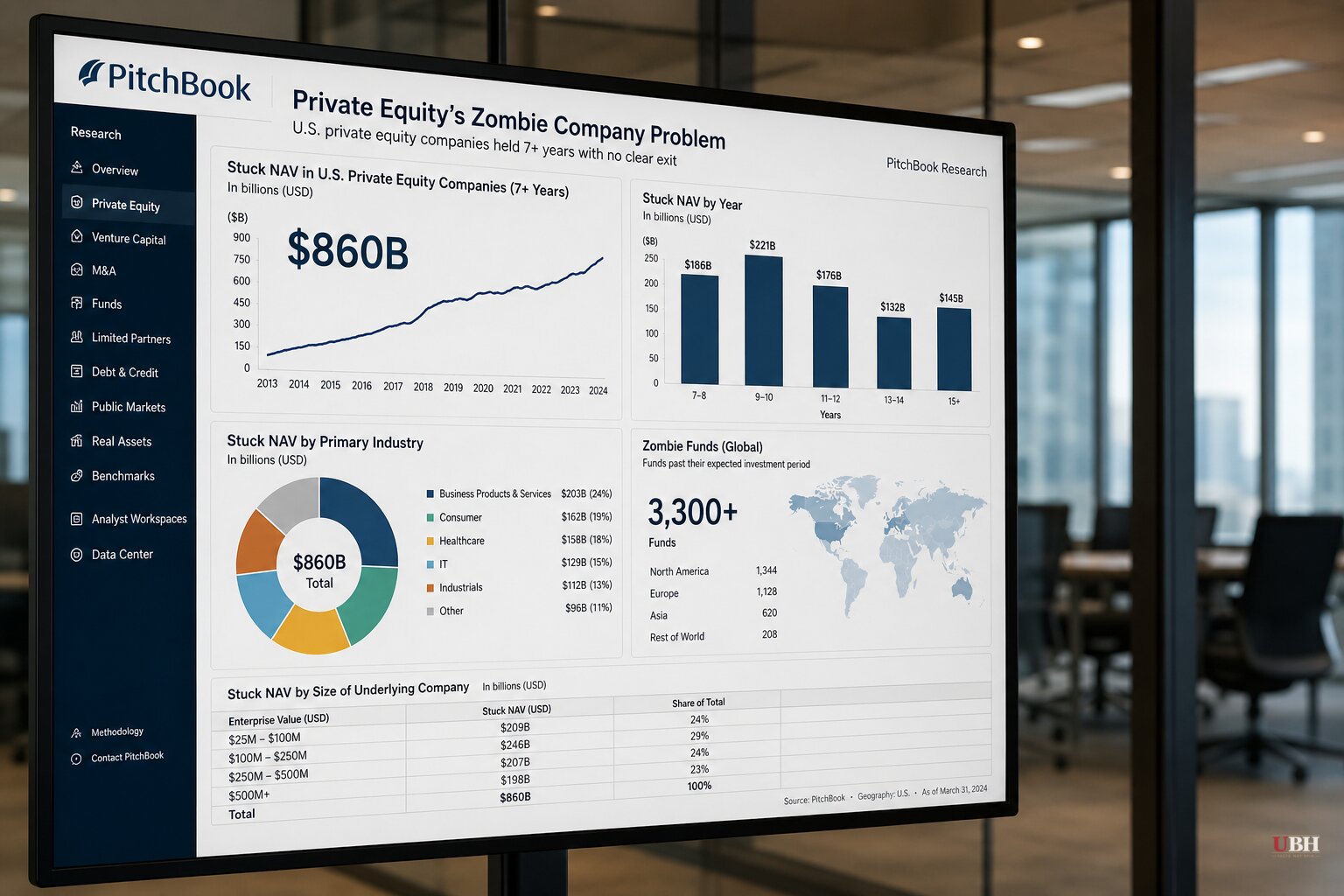
Since PitchBook's zombie-company research first surfaced in mid-August, the numbers have only gotten grimmer. Roughly 40% of U.S. private-equity-backed companies, representing more than $860 billion in net asset value, had been held for more than seven years as of the end of 2025, according to PitchBook analyst Kyle Walters. That's the third straight annual increase and the highest level since 2016, according to Yahoo Finance's reporting on the PitchBook data.
The scale gets worse when you zoom out globally. Roughly $1.2 trillion is stuck in zombie funds worldwide, about 12% of global private equity assets under management, according to data compiled by Preqin, Treo Asset Management, and Jefferies' secondary market research group, as reported by PE Presswire. That figure is up 38% from a year earlier and has nearly tripled since 2019. Some estimates put it on track to hit $2 trillion within a few years.
PitchBook counts more than 3,300 zombie firms in the U.S. alone, defined as vehicles more than ten years old that have stopped making new investments but still hold unsold portfolio companies. These firms keep collecting management fees without delivering the returns those fees are supposed to fund. The average zombie fund is 14 years old, four years past the typical ten-year fund life limited partners signed up for.
Of the more than 6,400 U.S. portfolio companies held longer than five years, more than half haven't completed a single transaction, buy or sell, since the end of 2021. No add-on acquisitions. No recapitalizations. No refinancings. Nothing. Four years of total inertia.
Walters, who authored the PitchBook report, told Fortune the root cause is simple. Firms bought companies at peak 2020-2021 valuations using dirt-cheap debt, then got hit with the highest interest rates in 40 years once the Federal Reserve tightened in 2023. "You have to create operational improvements when it's hardest to do so," Walters said. "Pair that with companies that were bought at 12x, and are maybe worth 10x, and you've dug yourself a bit of a hole, and there's no real way to get out."
Funds that started deploying capital in 2021 have returned just 0.14x investors' initial commitments, far below what earlier vintages delivered at the same point in their life cycle, according to PitchBook's data as cited by Yahoo Finance.
This isn't just a private equity headache. Hamza Khaldi, a principal at placement agent and advisory firm Elm Capital, told Yahoo Finance that the three- to five-year hold period long pitched to investors is effectively dead. "It was arguably always more aspirational than real," Khaldi said. Fundraising numbers back that up: buyout fundraising totaled $661 billion across 1,191 funds in 2025, down from $807 billion across 2,679 funds in 2021, according to PE Presswire. The average fund now takes 23 months to close, up from 16 months four years ago.
Of 2,314 private equity managers who raised a fund in 2015, 40% never raised a subsequent one, according to PE Presswire's reporting. Some folded outright. Veritas Capital chief executive Ramzi Musallam put it bluntly: "A lot of funds that exist today won't necessarily exist five years from now."
Why do general partners keep holding rather than selling at a loss? Because selling below the marked value crystallizes the loss and complicates the pitch for the next fund, while a company still on the books keeps generating fees. That's a rational individual incentive that adds up to a collective mess, according to Walters, who noted concerns about "mark credibility as paper value stubbornly refuses to convert to cash."
Not everyone reads this as a crisis. Walters told Fortune the industry hasn't hit a systemic breaking point yet. He said it would take "multiple layers" of risk stacked on top of the existing zombie problem, plus some larger external trigger, before real forced action happens. Private markets are good at kicking the can down the road because GPs largely control the timing of when they sell, unless something forces their hand.
That contrasts with the framing in the Epoch Times, which drew comparisons between today's broader AI-fueled asset bubble and the run-up to the 2008 financial crisis and the Enron collapse, arguing that each actor in an overheated market keeps playing along because the incentives make sense in the moment, even if everyone privately suspects it will end badly. The Epoch Times piece is about the AI investment bubble specifically, not PE zombie funds, but the mechanism it describes maps closely onto why GPs keep holding zombie companies rather than take a loss. Rational actors sustain an unsustainable trend because stopping first costs them the most.
Meanwhile, private equity is still finding places to put fresh capital to work outside the zombie backlog. Apollo Sports Capital agreed to a $2.6 billion investment in the New York Yankees organization, according to Fox News, with the Steinbrenner family retaining control. That deal shows PE firms are still deploying money aggressively into new, high-profile assets even as roughly $860 billion sits trapped in aging portfolio companies with no exit in sight.
The unresolved question is what forces the reckoning. Walters says it would take a bigger shock layered on top of the existing backlog. With buyout fundraising down 18% from 2021 to 2025 and average fund closing times up 44%, according to PE Presswire's figures, the pressure on limited partners waiting for distributions is building. Whether that pressure translates into forced sales, fund closures, or just more zombies limping along for another decade remains an open question.
Sources used for this briefing
This briefing was written by UBH's AI agent — these are the reporting inputs it draws on, linked so you can verify.


