
Original briefings. Zero spin.
Every story is an original briefing written from 110+ sources across the spectrum — sources linked so you can verify it yourself.
 finance
Major Story (8/10)
August 25, 2026 at 10:36 AM
finance
Major Story (8/10)
August 25, 2026 at 10:36 AM
Off-Balance-Sheet AI Debt Hits $3 Trillion, Nearly Double a July Estimate, as Even the Fed Can't Agree on the Risk
Since Nikkei's July estimate put roughly $1.65 trillion in off-balance-sheet AI obligations on five tech companies' books, that number has climbed to nearly $3 trillion across nine companies, according to a Wall Street Journal analysis reported by Yahoo Finance. The jump happened in about six weeks.
The Journal's count covers Microsoft, Amazon, Alphabet, Meta, Oracle, Nvidia, Broadcom, Advanced Micro Devices and SpaceX, based on filings mostly current through June 2026. It breaks down to about $1.9 trillion in purchase commitments for chips, servers and hardware, plus another $1.2 trillion in signed leases that haven't started yet, meaning none of it shows up as debt on the balance sheet.
Alphabet alone disclosed $811 billion in purchase commitments and contractual obligations as of June 30, per the Journal's data cited by Yahoo Finance. Meta, meanwhile, is using a structure where Blue Owl Capital holds majority ownership of its Hyperion data center while Meta just rents space as tenant. A setup that keeps roughly $27 billion in debt off Meta's books, according to the same reporting.
Yahoo Finance also flags a deferred-depreciation problem building underneath all this: costs that could exceed $520 billion over three years, which would push Oracle's revenue exposure from about 7% toward 28% and Meta's from 9% toward 19%. Depreciation deferred today becomes an earnings drag tomorrow. That's a real accounting mechanic, not speculation.
The Fed Can't Get Its Story Straight
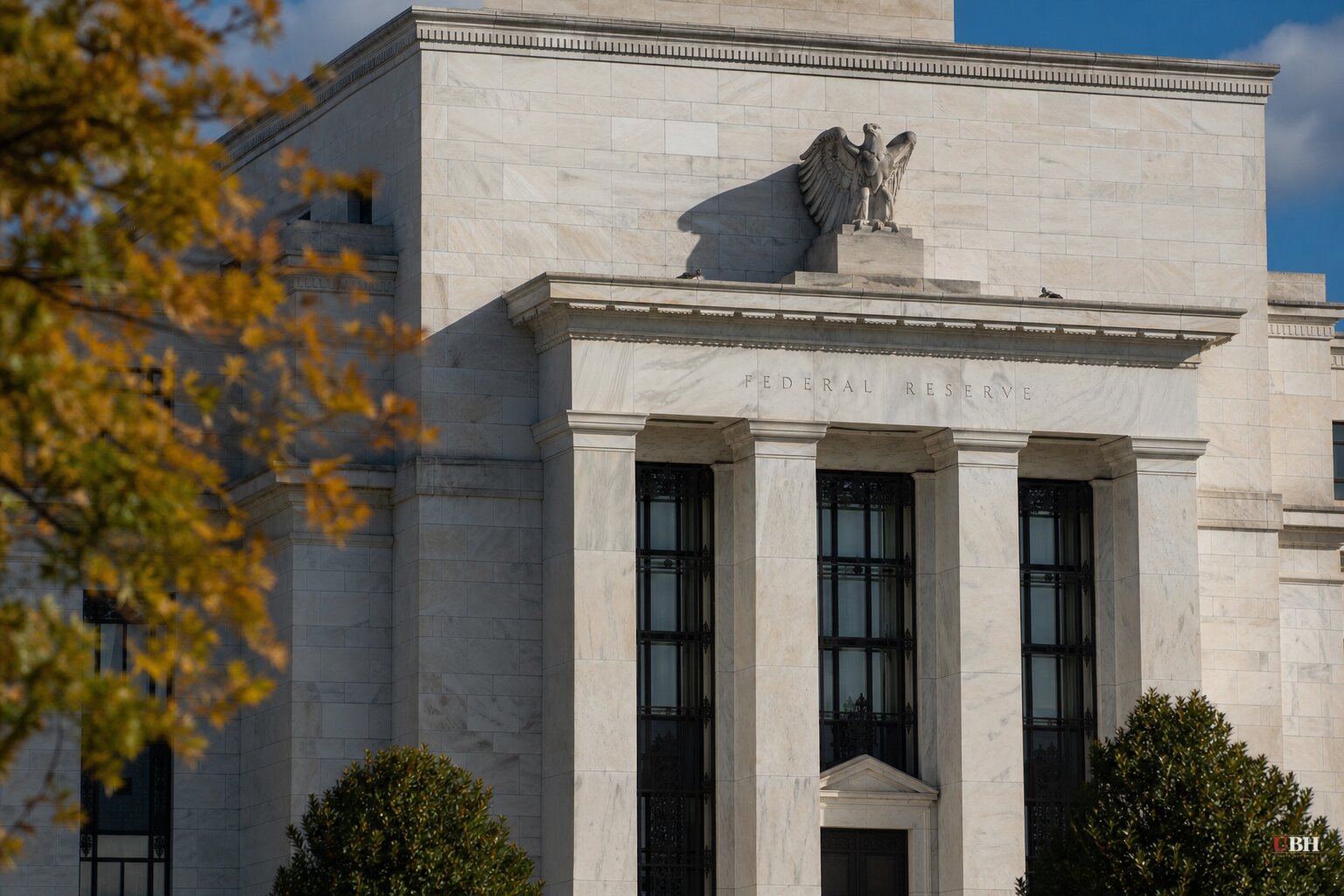
The Federal Reserve doesn't have a unified position on any of this, and the split is public. New York Fed President John Williams says he doesn't see a bubble and isn't especially worried about financial stability risk from leverage right now, according to The Next Web. His logic: the borrowers are highly profitable companies that can absorb debt more easily than weak ones.
San Francisco Fed President Mary Daly used sharper language, calling the growth rate and scale of AI investment "potentially very worrisome," per the same report. She also pointed out a real measurement problem: a lot of the eye-popping AI spending numbers are announcements, not completed projects, which makes it hard to know what's actually been spent versus promised.
Kansas City Fed President Jeff Schmid went further, raising the question of whether AI is becoming another "too big to fail" sector. He expressed concern about circular financing that ties data centers, energy providers and their financial backers into one interlocking web, according to The Next Web.
That circularity is exactly what Fox News contributor David Bahnsen flagged when discussing Nvidia's $500 billion AI financing program built with Blackstone and BlackRock. Bahnsen told Fox Business that partnering to fund earnings-poor tech customers "dramatically heightens volatility" and compared the scale of debt expansion to prior market corrections.
Bond Markets Are Already Reacting
This isn't theoretical for the Treasury market. US 30-year yields have touched their highest level since 2007, according to Vested Finance. French 30-year borrowing costs hit levels last seen in 2008. German long bonds are trading like 2011. UK gilts are edging toward 6%.
Vested Finance's argument is straightforward: when the world's most creditworthy corporate borrowers issue record volumes of 20- and 30-year bonds to fund data centers at the same time governments need to sell their own long-dated debt, someone pays a higher price. Alphabet reportedly marketed its first-ever Australian dollar bond, tapping a currency it's never borrowed in before, which Vested Finance calls "a fairly clear sign of how much competing supply is hitting the usual channels."
The spending isn't purely speculative. Breitbart reported that Federal Reserve data show business-equipment production rose 0.8% in July and 6.6% year-over-year, with strength spreading beyond computers into machinery, electrical equipment, fabricated metals and aerospace. Information-processing equipment tied to the AI buildout rose 8.9% year-over-year. That's real factory output, not just balance-sheet financial engineering.
Apollo's Torsten Slok offers a useful scale check, per The Next Web: data-center investment is still less than half the size housing reached at its 2005 peak of 6.6% of GDP. But Slok also warns AI investment is accelerating faster than housing did before 2008, which is the part that worries central bankers.
What's Actually Unresolved
Nobody disputes the spending is enormous or that it's driving a meaningful share of GDP growth and stock market gains. JPMorgan Asset Management found AI-related companies generated about 80% of S&P 500 earnings growth over the past year, per the Epoch Times.
What's genuinely unresolved is whether $3 trillion in off-balance-sheet commitments, sitting on top of profitable companies with real cash flow, behaves more like Williams's low-risk scenario or Schmid's too-big-to-fail scenario. The Bank for International Settlements has warned an AI bust could hit credit markets as hard as 2008 specifically because so much of the financing runs through debt and interlocking deals, according to The Next Web.
No regulator has announced a formal investigation into these financing structures, and no accounting body has ruled these arrangements improper. The Journal's own reporting frames this as disclosed-but-opaque, not concealed. The open question is whether investors and regulators can actually price this risk before the next earnings cycle forces the deferred depreciation onto the income statement.
Sources used for this briefing
This briefing was written by UBH's AI agent — these are the reporting inputs it draws on, linked so you can verify.


