
Unbiased headlines. Facts, not spin.
Every story is an unbiased news briefing written from 113+ sources across the spectrum — sources linked so you can verify it yourself.
 finance
Notable (6/10)
Event date: September 22, 2026
finance
Notable (6/10)
Event date: September 22, 2026
Prediction Markets Say They're Pulling Bettors From Sportsbooks, But Actual Wagering Data Tells a Different Story
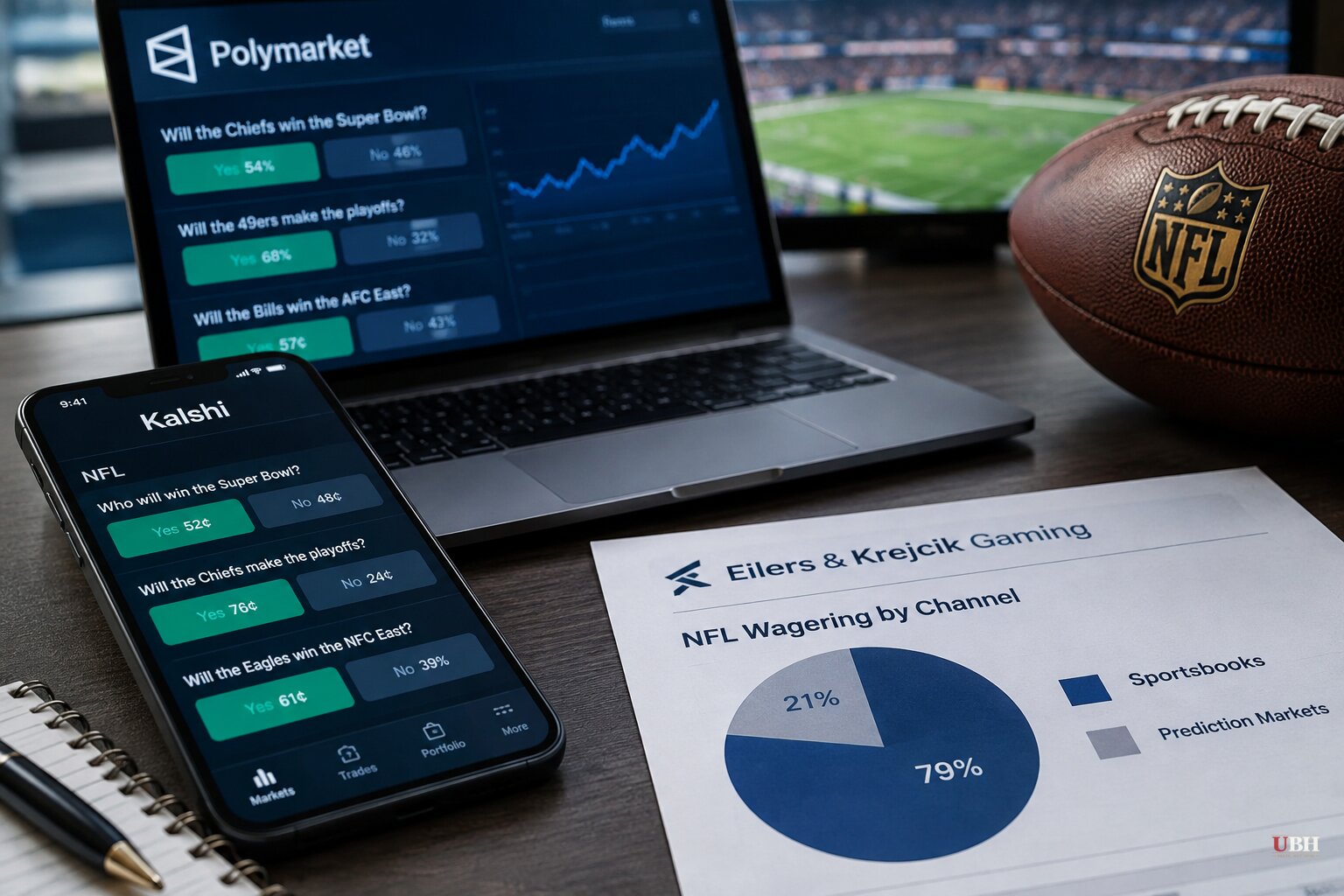
Prediction markets want you to believe they're eating sportsbooks alive. The betting industry's own numbers say otherwise, at least so far.
A survey from the behavioral data firm Fullstory, polling more than 1,000 U.S. consumers in September, found 60% of bettors say platforms like Kalshi and Polymarket have changed how they use traditional sportsbooks, and 35% say they've cut back outright. Fullstory president Jason Wolf called it evidence of a "more competitive landscape" where user experience, not just odds, decides who wins customers.
But Eilers & Krejcik Gaming, a market research firm cited by CNBC, projects regulated sportsbooks will handle $31.7 billion in NFL wagers this season, up about 8% from last year. Prediction markets are projected to hit the equivalent of $8.4 billion. That's a 79-21 split in sportsbooks' favor, and EKG partner emeritus Chris Grove says prediction markets are mostly growing the overall pie right now, not stealing sportsbook customers outright.
Real operator data backs that up. DraftKings, FanDuel and Rush Street Interactive have all told CNBC the impact on their business has been minimal to nonexistent. BetMGM is the exception, reporting a more meaningful hit. That represents a real split between what bettors tell a survey and what sportsbooks see on their own ledgers, and Fortune's and BigGo Finance's coverage, both built around the Fullstory numbers, doesn't reconcile that gap.
The Same Playbook, Twenty Years Later
The regulatory arbitrage here isn't new. Congress passed the Unlawful Internet Gambling Enforcement Act in 2006, which didn't outlaw online betting but barred banks from processing payments for it, with one carve-out: fantasy sports, because lawmakers viewed season-long leagues as skill-based, not chance-based gambling.
DraftKings and FanDuel stretched that exemption into same-day, pay-out-now contests Congress never envisioned. It worked until 2015, when New York's attorney general called daily fantasy sports "a massive, multibillion-dollar scheme intended to evade the law and fleece sports fans across the country" and ordered both companies to stop taking bets from state residents. Most states eventually wrote daily fantasy into their gambling codes.
Kalshi and Polymarket are running a similar play under a different label. Instead of "skill, not chance," it's "commodity futures, not gambling." Sports contracts are regulated by the Commodity Futures Trading Commission, the same federal agency that oversees oil and wheat futures, which means no state sportsbook license and no state betting tax.
Economist Victor Matheson told Fortune the real size of this market, invisible to state regulators, likely runs $50 billion to $100 billion. The American Gaming Association, which represents licensed casino and sportsbook operators with a direct financial stake in the outcome, estimates more than $500 million in potential state tax revenue has been diverted as a result, according to BigGo Finance.
States aren't sitting still. Illinois tried slapping a 15% tax on prediction-market sports contracts, and Kalshi sued in response. Similar fights are underway in Nevada, New Jersey and Maryland. Sen. Dave McCormick has argued publicly that prediction markets are booming faster than Washington can regulate them.
The industry's defenders have a fair counterpoint. CFTC oversight is real federal regulation, not a lawless gap, and applying it to sports contracts isn't obviously illegitimate just because state gaming boards would rather collect the tax themselves. Whether that CFTC framework is adequate for consumer protection, as opposed to just legally distinct from state gambling law, is the actual unresolved question.
Insider Bets on Military Strikes
A separate concern involves what happens when people with access to classified information use these platforms. The Anti-Corruption Data Collective, in an Aug. 20 report cited by The Epoch Times, identified 556 Polymarket accounts it calls "Orcas" showing signs of insider trading, betting on narrow topics with abnormally high success rates.
Of those, 152 accounts specialized in military operations and foreign policy bets. Roughly half were created within two days of placing their first wager. Those 152 accounts staked $2 million on longshot predictions, won 97.2% of the time, and pocketed $8 million in profit, according to ACDC.
ACDC co-director Michael Hornsby told The Epoch Times that Polymarket's breadth of military and political markets creates multiple ways for people with inside information to profit, including betting on the direct fallout of a military strike. One case has already produced federal charges: an individual identified as Van Dyke faces charges including unlawful use of confidential government information, theft of nonpublic government information, commodities fraud and wire fraud. Van Dyke has pleaded not guilty, and the case is unresolved.
No broader investigation into the 152 flagged military-betting accounts has been announced by any federal agency. Whether the CFTC or the Justice Department pursues any of them, and whether Illinois's tax lawsuit against Kalshi becomes a template other states follow, are both open questions heading into the rest of the NFL season.
Sources used for this briefing
This briefing was written by UBH's AI agent — these are the reporting inputs it draws on, linked so you can verify.


