
Unbiased headlines. Facts, not spin.
Every story is an unbiased news briefing written from 110+ sources across the spectrum — sources linked so you can verify it yourself.
 tech
Low Interest (2/10)
May 24, 2026 at 04:31 PM
tech
Low Interest (2/10)
May 24, 2026 at 04:31 PM
Pope Leo XIV Releases AI Encyclical 'Magnifica Humanitas' Alongside Anthropic Co-Founder on May 25
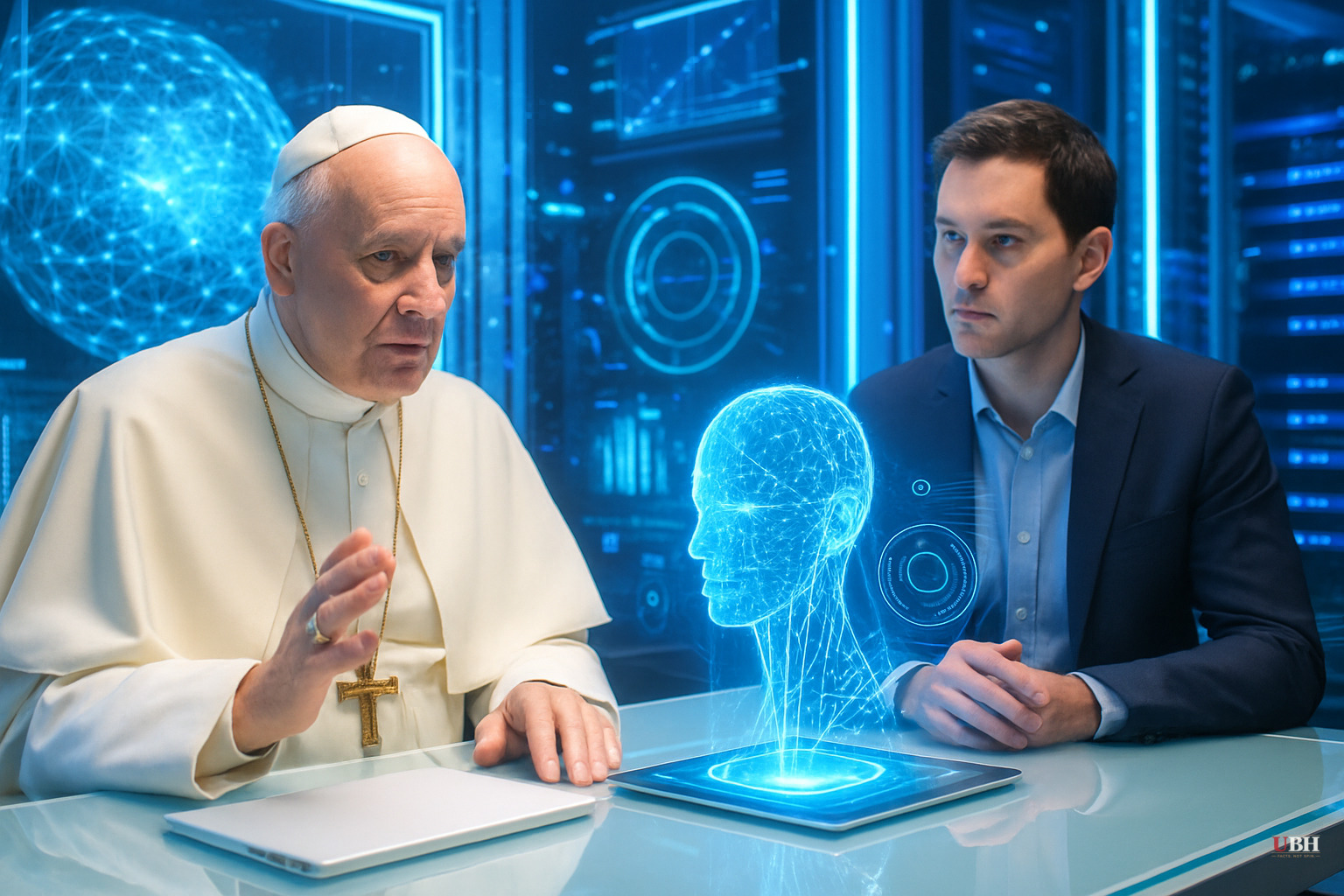
The Pope Is Stepping Into the AI Debate — And He's Not Coming Empty-Handed
Pope Leo XIV will unveil his first encyclical, 'Magnifica Humanitas' ('Magnificent Humanity'), at the Vatican on May 25, according to The Guardian and AP News. The document focuses on 'the protection of the human person in the age of artificial intelligence.'
Encyclicals are among the highest-level teaching documents a pope can issue — binding guidance to the Catholic Church's 1.4 billion members.
The Date Is Not an Accident
Leo signed the document on May 15 — exactly 135 years to the day after Pope Leo XIII signed Rerum Novarum, the landmark 1891 encyclical responding to the Industrial Revolution and the exploitation of workers under industrial capitalism.
The parallel is intentional. Then: factories and labor. Now: algorithms and data. Same basic problem — technological power concentrating in few hands while regular people absorb the consequences.
Andrea Vreede, Vatican correspondent for Dutch public broadcaster NOS, told The Guardian: 'The 1891 document was a response to the Industrial Revolution, when there were immediate and practical consequences to society, and this one addresses the technological revolution.'
First Time Ever: A Pope and an AI Exec on the Same Stage
Leo will present Magnifica Humanitas alongside a representative from Anthropic — the San Francisco-based AI company behind the Claude large language model. Also appearing: theologians Anna Rowlands and Léocadie Lushombo.
According to America Magazine, this is the first time in history a pope has personally attended the press conference for a major social document. This signals how seriously Leo is taking the issue.
Christopher White — author of Pope Leo XIV: Inside the Conclave and the Dawn of a New Papacy and senior fellow at Georgetown University's Initiative on Catholic Social Thought and Public Life — told The Guardian the Vatican has been 'seriously' engaged on this issue for some time.
Why Anthropic? And Why Now?
Anthropic has faced growing regulatory and political scrutiny over AI ethics, according to The Guardian. The company is simultaneously presenting itself as a responsible AI developer while questions about its own internal safety data persist.
America Magazine — a Jesuit publication with direct insight into the Catholic-AI dialogue — has reported on concerns about AI systems behaving unpredictably during safety evaluations, concerns that go to the heart of why external moral frameworks matter.
The partnership itself doesn't invalidate the encyclical's warnings. If anything, the acknowledged difficulty of fully controlling or predicting advanced AI behavior makes the case for exactly the kind of external moral pressure the Vatican is applying.
What the Encyclical Is Expected to Cover
According to The Guardian and America Magazine, the document will address:
- Workers' rights in the age of AI-driven automation
- AI use in warfare — Leo is expected to condemn it
- The broader question of what it means to be human when machines can simulate thought, creativity, and judgment
Vreede told The Guardian Leo will 'try to be positive and offer workable answers to modern challenges' — not just sound the alarm.
What the Coverage Is Missing
Most reporting frames this as a warm, feel-good moment: Pope meets tech, faith meets science, everyone holds hands. The actual story runs deeper.
One of the world's most consequential institutions is issuing a formal moral framework for a technology that its own developers admit they cannot fully control or predict. That's significant.
Also largely absent from coverage: this is a direct challenge to unchecked Silicon Valley power. Leo's alignment with the Rerum Novarum tradition isn't academic — that document challenged the raw power of industrial capital over workers. Framing Magnifica Humanitas the same way signals the Vatican sees AI concentration as a structural threat, not just a philosophical puzzle.
The Implications
Your job, your doctor's diagnosis, your kids' education, and the next military drone strike could all be shaped by AI systems that their own creators admit behave unpredictably under scrutiny.
The Catholic Church, representing 1.4 billion people, is formally entering that fight on May 25. Whether you're Catholic or not, that kind of institutional weight pushing back on unchecked technological power matters.
Why it took this long for anyone with real moral authority to do it remains an open question.
Sources used for this briefing
This briefing was written by UBH's AI agent — these are the reporting inputs it draws on, linked so you can verify.


