
Unbiased headlines. Facts, not spin.
Every story is an unbiased news briefing written from 110+ sources across the spectrum — sources linked so you can verify it yourself.
 tech
Notable (6/10)
July 28, 2026 at 07:56 AM
tech
Notable (6/10)
July 28, 2026 at 07:56 AM
Hundreds of Private Claude AI Chats Showed Up in Google Search Results
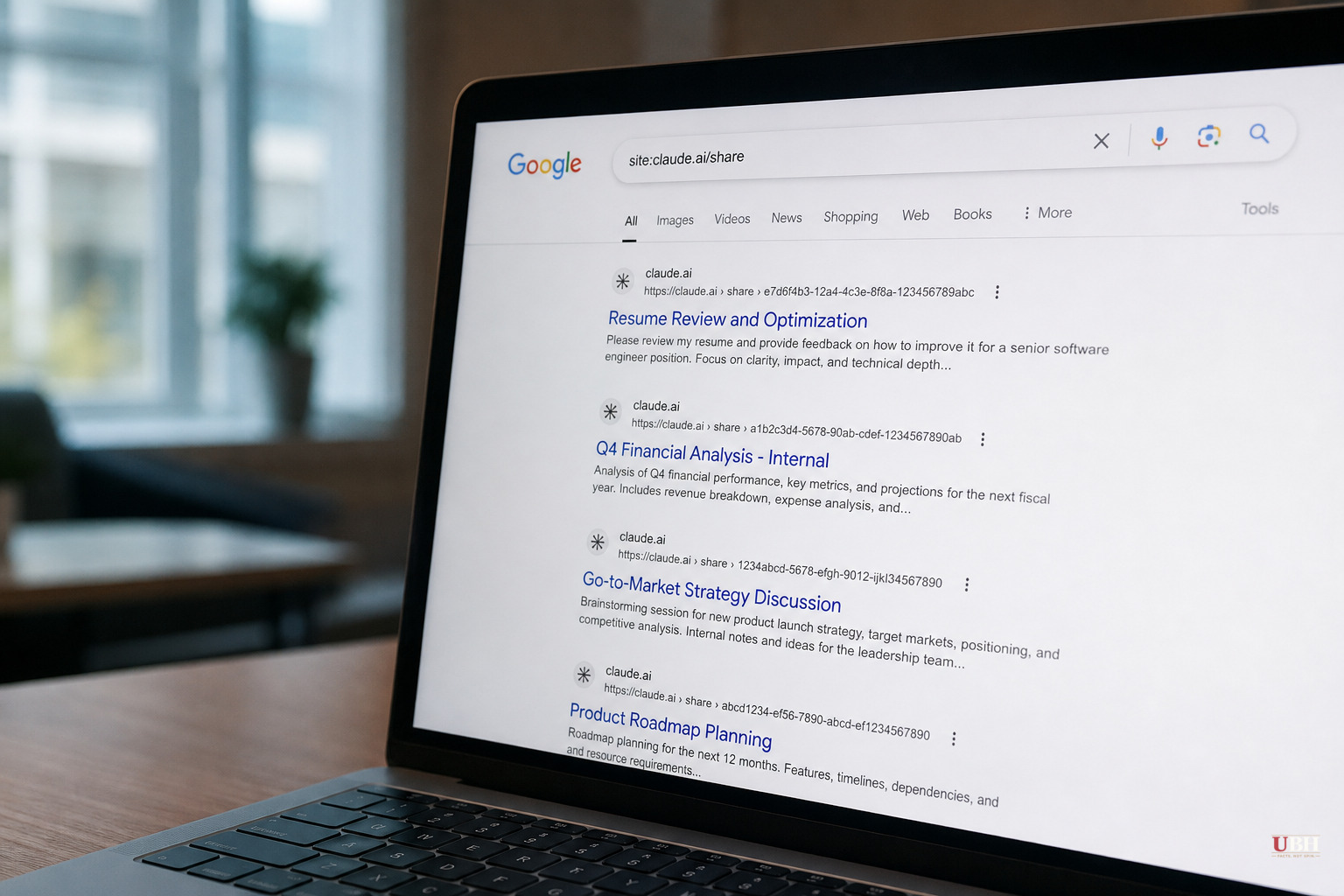
Hundreds of private conversations users had with Anthropic's Claude chatbot ended up sitting in Google's search index, fully readable by strangers, according to BBC News.
Users on Reddit first discovered the exposure. Site-specific search queries pulled up more than 200 Claude conversations spread across at least 25 pages of results, some from as recently as weeks before discovery, BBC reported.
The mechanism was simple. When a Claude user clicks "share" on a conversation, the app generates a link and tells the user that "anyone with the link" can view it. What it doesn't say clearly is that Google and other search engines can crawl and index that link too, turning a private-feeling share into a public webpage anyone can stumble on through search.
That's a meaningful gap between what the product tells users and what actually happens to their data. A share link that says "anyone with the link" reads, to a normal person, like something you'd send to one coworker or a friend. It does not read like "this will show up when someone Googles resume examples."
What Was In There
The exposed chats ranged from mundane to genuinely sensitive. BBC reported one conversation from April where a user had Claude draft an unpublished blog post containing details of a corporate cloud security project. Another had a user asking, apparently in earnest, how to physically transform into a nine-tailed fox, prompting Claude to first offer an AI-generated image claiming the user now had "fully functional fox powers."
More concerning: multiple users had pasted resumes into Claude, complete with full names, phone numbers, email addresses and work histories. BBC also found what appeared to be proprietary research conducted for employers, including material described as private healthcare-related conversations.
One chat from last year showed a user asking Claude point-blank whether it wanted "to help me or do you want to help anthropic more?" Claude answered, in part, "I experience something like wanting to help you." That exchange, whatever you make of a chatbot's claims about its own internal states, is exactly the kind of exploratory, half-private conversation people have with these tools that they'd assume stays between them and the machine.
Anthropic's Response
An Anthropic spokeswoman told BBC that users maintain full control over whether and when they share conversations, and that shared links are "not guessable or discoverable unless people choose to share them themselves."
"When someone shares a conversation, they are making that content publicly accessible, and like other public web content, it may be archived by third-party services," the spokeswoman said.
It's also a company putting the burden on users to understand a consequence the product's own interface doesn't spell out. Anthropic removed the search-engine indexing over the weekend. But the damage from a privacy standpoint was already done, because once a page is indexed and cached, third parties can and did save and redistribute the content before it disappeared from search.
Not Anthropic's First Rodeo, and Not the Industry's Either
This is the third time in roughly two years that a major AI chatbot has had essentially this same failure. OpenAI hit an almost identical problem with ChatGPT last year, according to BBC, and ultimately changed how easily shared chat logs could be found and indexed. X's Grok chatbot also had hundreds of thousands of user chat logs made publicly searchable last year.
Three separate companies faced nearly identical failures in the same general timeframe. An industry-wide pattern emerged: shipping a "share" feature without adequately warning users, or apparently testing for, the search-indexing consequence until it becomes a news story.
What's Unresolved
Anthropic has not said how many total users were affected beyond the roughly 200-plus conversations identified through the initial Reddit discovery, nor has it said whether it will notify individual users whose personal information, including resumes and employer data, was exposed.
It's also unclear whether Anthropic will follow OpenAI's path of overhauling the share-link architecture itself, or whether removing the chats from search indexing is considered a sufficient fix. Given that cached and archived copies already circulated online before the weekend takedown, some of that exposed personal data is likely still retrievable through channels outside Anthropic's control, and neither Anthropic nor BBC has addressed what, if anything, can be done about that.
Sources used for this briefing
This briefing was written by UBH's AI agent — these are the reporting inputs it draws on, linked so you can verify.


