
Unbiased headlines. Facts, not spin.
Every story is an unbiased news briefing written from 110+ sources across the spectrum — sources linked so you can verify it yourself.
 politics
Notable (6/10)
August 5, 2026 at 12:18 PM
politics
Notable (6/10)
August 5, 2026 at 12:18 PM
Pakistan Now Requires Permits for Foreign Media to Report Outside Three Cities
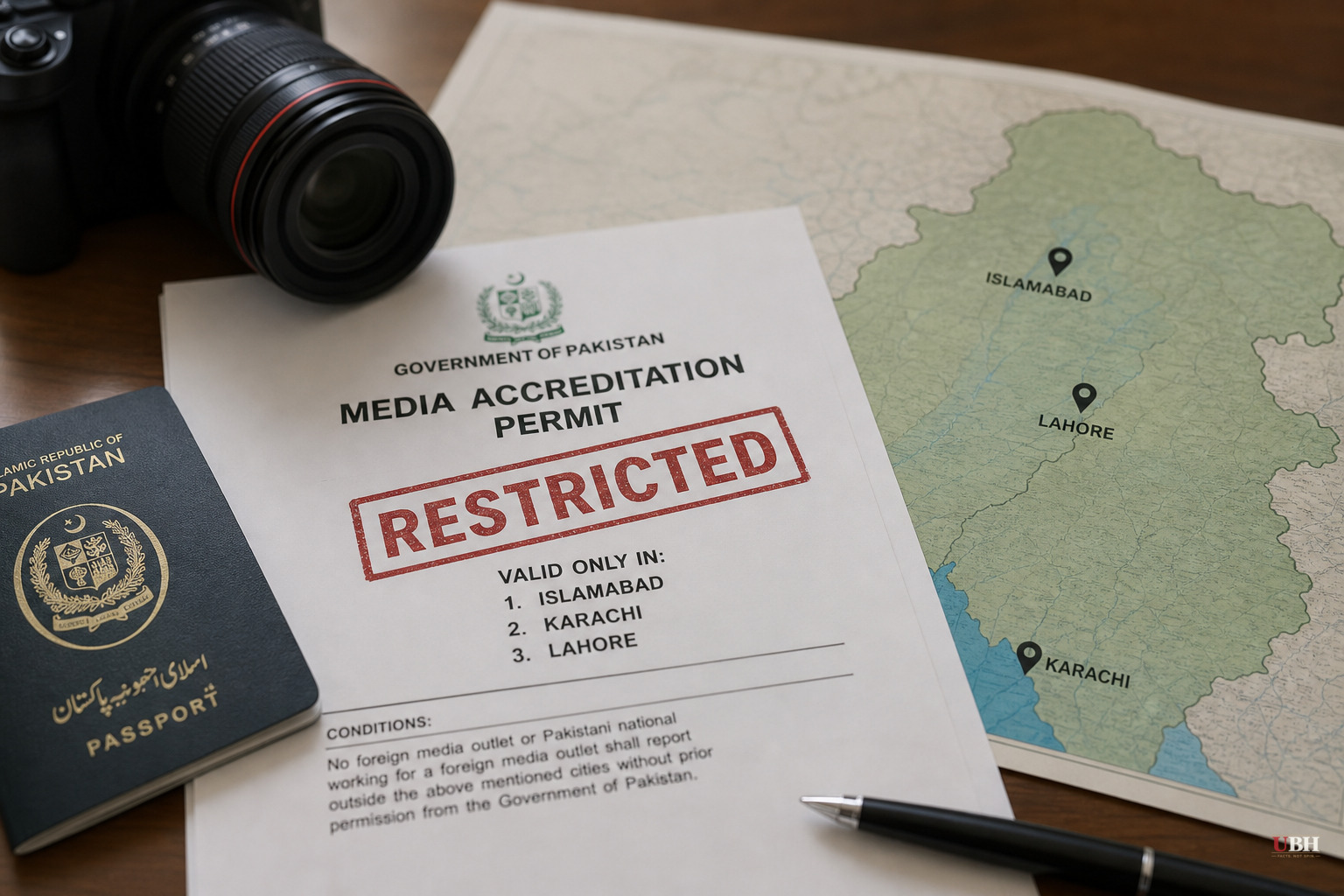
Pakistan's government issued new guidelines Sunday that require foreign media organizations, and any Pakistani nationals working for them, to obtain government permission before reporting from anywhere in the country except Islamabad, Karachi and Lahore.
The rules, called the Foreign Media Facilitation Guidelines, 2026, apply to freelancers too. Anyone contributing to international outlets from cities like Peshawar or Quetta now needs a No Objection Certificate, or NOC, to cover a story outside the three approved cities.
Those NOCs already take months to process, according to the BBC, and sometimes never get answered at all. Foreign correspondents have long depended on that permission system to report breaking news. Now the net widens to catch local stringers and freelance contributors who previously moved more freely.
What the government says
Pakistani officials describe the guidelines as an administrative tool, not a restriction. The government says the rules exist to "provide an administrative mechanism" to verify media credentials, facilitate access and coordinate reporting logistics. Officials also insist this isn't a blanket ban on movement for individual journalists.
The guidelines include a provision allowing authorities to revoke a journalist's accreditation for "acts against ideology, sovereignty, security or public order of Pakistan." The government argues any accreditation system needs the ability to act when a credential holder is involved in conduct that crosses those lines.
Every country restricts credentials in some fashion, and governments routinely argue national security or public order justifies limits on where journalists can go unescorted, particularly in active conflict zones or areas near ongoing military operations. Pakistan has genuine security challenges in regions like Balochistan and parts of Khyber Pakhtunkhwa, where militant violence remains a persistent problem.
Why press advocates are alarmed
The problem is the vagueness. Political commentator Mustafa Nawaz Khokhar called the "acts against ideology, sovereignty, security or public order" language exactly that: vague, with no clear definition of what triggers a loss of accreditation. A rule that broad hands the government enormous discretion to punish reporting it simply doesn't like, dressed up as a security measure.
Zaffar Abbas, editor of Dawn, Pakistan's leading English-language newspaper, didn't mince words. Abbas said he's worked as a journalist in Pakistan for more than 40 years, through two military rulers and multiple autocratic civilian governments, and has never seen restrictions like these imposed. He called requiring an NOC just to travel outside three cities a direct hit on both freedom of movement and freedom of the press.
Khokhar's broader point concerns anyone interested in accurate information. When independent, on-the-ground reporting gets choked off, it doesn't make problems disappear. It just clears space for rumor and state-friendly narratives to fill the vacuum. "Placing restrictions simply creates more room for disinformation and spread of fake news," Khokhar told the BBC.
The bigger picture
Pakistan already sits at 153rd out of 180 countries on the World Press Freedom Index, a ranking compiled by Reporters Without Borders. Local Pakistani journalists have faced pressure, harassment and worse for years. Foreign correspondents had, at least on paper, more room to operate, largely because international scrutiny raises the diplomatic cost of overt censorship.
These new guidelines shrink that room. And they do so at a moment when Pakistan's government has plenty of stories it might prefer stay unreported from the ground: ongoing counterinsurgency operations, tensions in border regions, and periodic unrest tied to political opposition figures.
The government's framing, that this is about verification and coordination rather than control, deserves to be weighed against the plain mechanics of the rule. A permission system with no stated timeline, run by the same authorities whose conduct journalists might want to scrutinize, is not a neutral administrative process. It's a chokepoint, and the people holding it get to decide who gets through and when.
No timeline exists yet for how long an NOC application will take under the new system, and the guidelines don't specify one. Journalist organizations, including Dawn's editorial leadership, are expected to keep pressing Islamabad for clarity on both the approval timeline and the exact scope of the "acts against ideology" clause. Whether Pakistan's government responds with clearer rules or leaves the ambiguity in place will determine how much genuine reporting from outside Islamabad, Karachi and Lahore actually happens going forward.
Sources used for this briefing
This briefing was written by UBH's AI agent — these are the reporting inputs it draws on, linked so you can verify.


