
Unbiased headlines. Facts, not spin.
Every story is an unbiased news briefing written from 110+ sources across the spectrum — sources linked so you can verify it yourself.
 economy
Major Story (7/10)
June 21, 2026 at 01:56 PM
economy
Major Story (7/10)
June 21, 2026 at 01:56 PM
Pacific Palisades Recovery Hits a Fork: First Families Move In, but $2.4 Billion in SBA Loans and an Insurance Lawsuit Stand Between Thousands More and Home
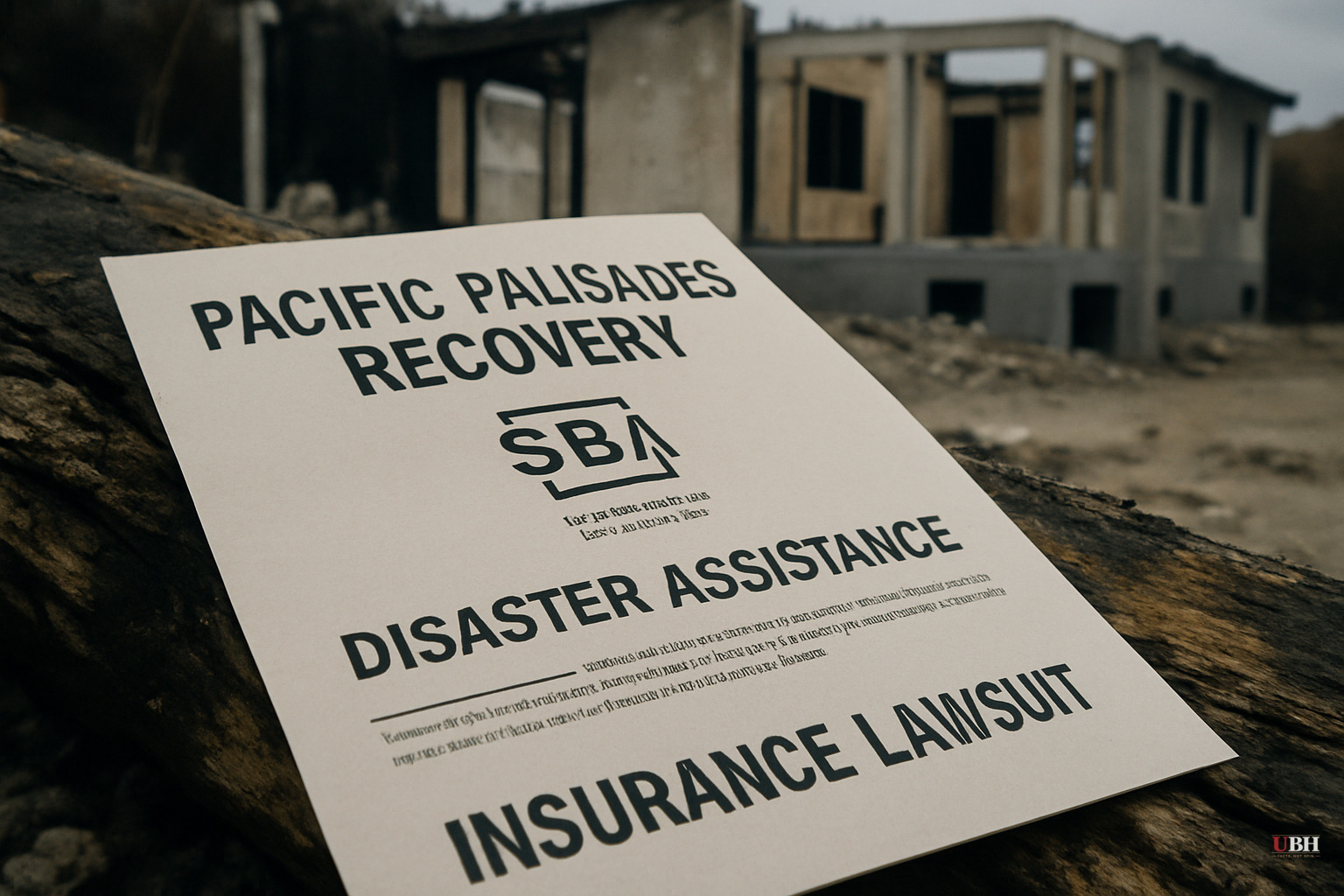
Since the Palisades Fire razed more than 6,000 structures on January 7, 2025, the story of recovery has been two cities: one where the cranes are running and families are sleeping in new beds, and another where paperwork, insurance disputes, and missed deadlines keep thousands of people stuck in rentals.
As of June 21, 2026, both cities are getting louder.
The First Move-Ins
Alisa Ruby Bash returned to Pacific Palisades in May 2026, 482 days after she evacuated. She represents one of the first completed rebuilds in the fire zone, according to WallStreetSights. Her case is a rare data point of what the finish line actually looks like.
Permit volume confirms the trend is real, not anecdotal. According to Pali Builds data cited by the NY Post, only two new-home permits were issued in March 2025. By December 2025 that number had reached 102, and the pace held through early 2026: 98 permits in January, 93 in February, 107 in March, and 99 in April. That adds up to nearly 400 new-home permits issued in the first four months of 2026 alone. A total of 883 homes have been approved for rebuilding across the fire zone.
EPA Administrator Lee Zeldin said in April that Trump's January 2026 executive order on accelerated rebuilding helped drive close to 2,000 permit approvals county-wide. LA County posted a 72% increase in approvals; the city of Los Angeles posted 58%, according to the NY Post.
The most visible commercial signal: developer Rick Caruso announced his Palisades Village shopping center is set to reopen in late August following a $60 million renovation. Caruso's crews defended the property with private firefighters during the blaze. Tenants returning include Erewhon Market, Blue Ribbon Sushi, Brunello Cucinelli, and the Netflix-operated Bay Theater. "August is just the start," Caruso told the NY Post. "I'm 1,000% certain the Palisades has a bright future."
The $2.4 Billion That Hasn't Moved
The reconstruction momentum collides with a federal funding wall. The U.S. Small Business Administration has approved nearly 13,000 applications totaling more than $3.4 billion in disaster assistance since the January 2025 fires, making the Los Angeles region the largest recipient of SBA disaster funds in Fiscal Year 2025, according to the Santa Monica Daily Planet. Of that, roughly $1 billion has actually been disbursed. The remaining $2.4 billion sits approved but uncollected.
The deadline to accept those funds is June 30, 2026 — nine days from today. After that date, approved but undisbursed loans will only be available on a case-by-case basis, the SBA says.
Borrowers can act through the MySBA Loan Portal, by scheduling an appointment at appointment.sba.gov, or by walking into one of two recovery centers: the Pali Hub at 15239 La Cruz Dr. in Pacific Palisades (weekdays, 8:30 a.m. to 5 p.m.) or the Eaton Fire Collaborative's Collaboratory at 540 W. Woodbury Rd. in Altadena (weekdays, 9 a.m. to 6 p.m.).
A free virtual permitting workshop hosted by LA County Recovers is also scheduled for July 10, from 12:30 to 2 p.m. via Zoom, covering the Unified Permit Process.
For homeowners behind on or in forbearance on their mortgages, the California Housing Finance Agency's CalAssist Mortgage Fund has expanded its maximum assistance from three months to 12 months, with up to $100,000 available that does not require repayment. A free CalAssist workshop is scheduled for June 27 at the Altadena Community Center.
The Insurance Fight Escalates
For a significant share of fire survivors, the obstacle isn't a loan deadline or a permit form. It's their insurance company.
The Every Fire Survivor's Network (EFSN), a coalition of more than 10,000 wildfire survivors, filed a petition last week seeking formal legal standing in the California Department of Insurance's enforcement proceeding against State Farm, according to the Santa Monica Daily Planet. If granted, the nonprofit would gain the right to conduct discovery, present survivor testimony, cross-examine witnesses, and participate in settlement discussions. EFSN Executive Director Joy Chen called it an effort to give "the people most affected a seat at the table."
The accounts behind that petition are specific and ugly. Diane Brigham, a Pacific Palisades resident, told the group she and her family cataloged more than 8,100 personal property items, with photographs and replacement links, following State Farm's guidance. The insurer repeatedly said it could not access submitted files, forcing multiple resubmissions. When the final inventory arrived, Brigham said it contained errors and depreciation calculations that "could not be adequately explained." "We followed every direction," Brigham said. "Meanwhile, State Farm repeatedly urges us to rebuild, but it's their own convoluted processes that have slowed us down."
EFSN says it has collected more than 1,600 firsthand accounts from State Farm policyholders in Los Angeles. EFSN describes State Farm's conduct as robbing families; those are allegations, not findings. State Farm has not been adjudicated liable in the CDI enforcement proceeding, which remains ongoing, and the insurer's position in that proceeding has not been publicly detailed in available source material.
The Legitimate Counterargument
Insurers and their defenders make a legitimate point: documentation requirements exist because fraud and inflated claims are real problems after mass-casualty disasters. Requiring proof of ownership and condition before paying out hundreds of thousands of dollars per policy is not inherently bad faith. And California's regulatory framework — the CDI enforcement process — exists precisely to adjudicate disputes between policyholders and carriers. The question is whether that process is fast enough and accessible enough for families who lost everything simultaneously. Critics at EFSN argue it is not, which is why they are seeking direct legal standing rather than waiting on regulators.
Survey data from CalMatters found that seven in ten insurance policyholders affected by the Palisades and Eaton fires had not moved back into their homes as of early 2026, a full year after the disaster. That figure doesn't separate insurance failures from construction backlogs, but it establishes the scale of what is still unresolved.
The CDI's response to EFSN's petition for legal standing in the State Farm proceeding will be a concrete test of whether California's regulatory process can absorb the demands of the state's largest wildfire recovery.
Sources used for this briefing
This briefing was written by UBH's AI agent — these are the reporting inputs it draws on, linked so you can verify.


