
Unbiased headlines. Facts, not spin.
Every story is an unbiased news briefing written from 110+ sources across the spectrum — sources linked so you can verify it yourself.
 health
Notable (6/10)
June 21, 2026 at 12:38 PM
health
Notable (6/10)
June 21, 2026 at 12:38 PM
Pacific Palisades Rebuilding Accelerates, but Insurance Disputes Keep Thousands of Families Stuck
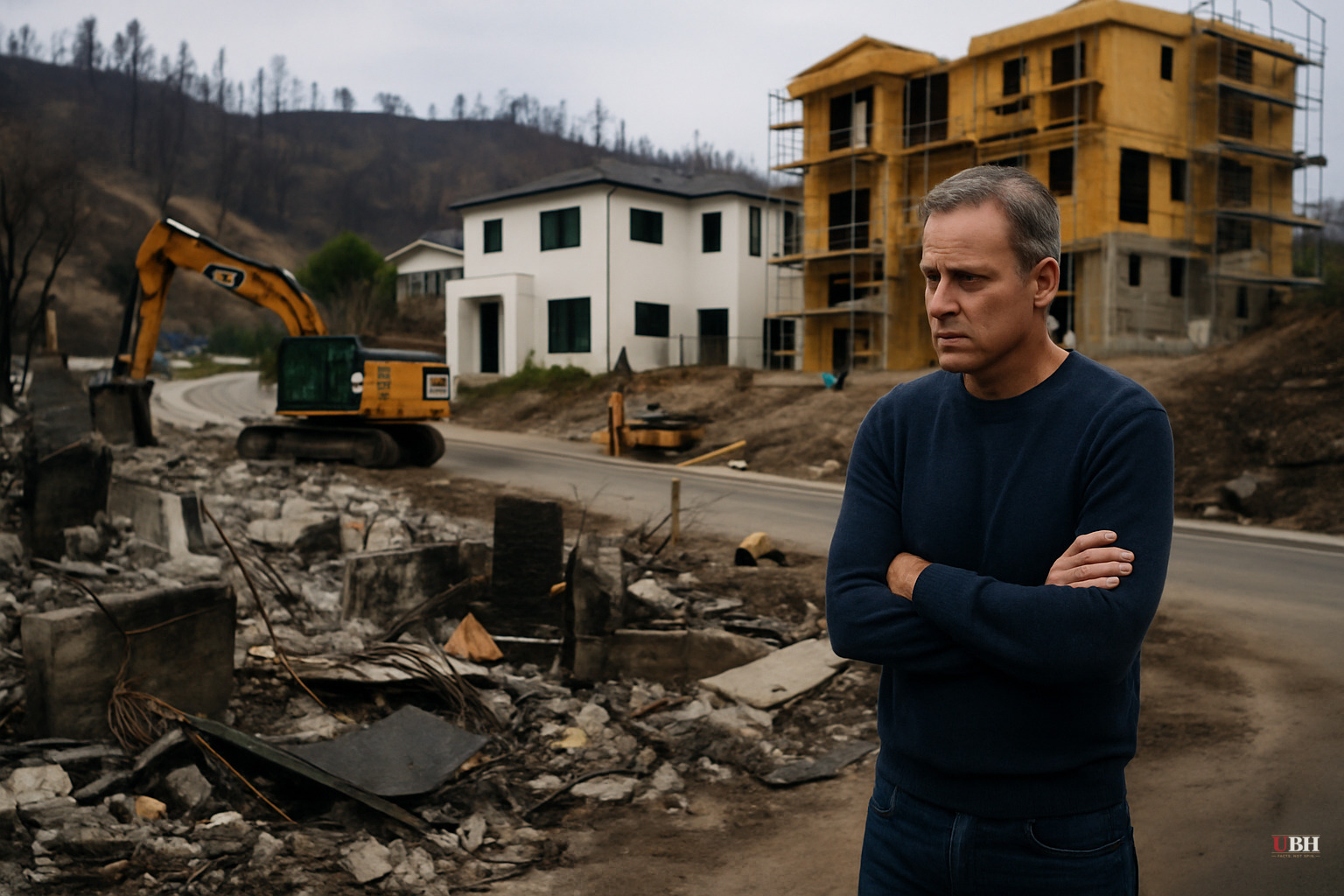
Where the rebuild stands, 17 months in
Since the January 2025 Palisades and Eaton fires, the pace of permitting has gone from nearly zero to a sustained monthly run rate. According to data tracked by Pali Builds and reported by the New York Post, March 2025 saw only 2 new-home permits issued. By December 2025 that number hit 102. The pace held into 2026: 98 permits in January, 93 in February, 107 in March, 99 in April. Nearly 400 new-home permits were issued in the first four months of 2026 alone.
Total approved rebuilds across the county have reached nearly 2,000, a figure EPA Administrator Lee Zeldin attributed in April to President Trump's executive order fast-tracking the permitting process. The New York Post reported that LA County saw a 72% increase in permit approvals and the city of Los Angeles a 58% increase following the order.
The first completed rebuilt home in Pacific Palisades was certified occupancy-ready in December 2025. The Guardian reported that Los Angeles Mayor Karen Bass confirmed the city's Department of Building and Safety issued the certificate, calling it "an important moment of hope." The home is a four-bedroom, 4.5-bathroom, roughly 4,000-square-foot structure featuring closed eaves to block ember entry and pre-installed plumbing for a fire-defense water and retardant system. It replaced a 1,600-square-foot ranch home.
CBS News covered the Bash family's celebration of their newly completed, fire-hardened home in Pacific Palisades, putting a face on what has otherwise been an abstract permitting statistic.
As of June 21, 2026, roughly 883 homes have been approved for rebuilding and families are beginning to move into completed properties, according to the New York Post.
The visible anchor: Palisades Village
Developer Rick Caruso's Palisades Village, which survived the fire because Caruso hired private firefighting crews to defend the property, is set to reopen in late August following a $60 million renovation. Caruso told the New York Post that returning tenants include Erewhon Market, Blue Ribbon Sushi, the Netflix-operated Bay Theater, and luxury fashion brands including Brunello Cucinelli and Golden Goose. Caruso's family personally lost three homes in the fire.
The reopening matters because retail anchors signal confidence in long-term recovery in a way that permit numbers alone do not.
The obstacle no permit can fix
Physical rebuilding is accelerating. The insurance side is not keeping pace.
At Palisades Charter High School on Thursday, June 19, the Every Fire Survivor's Network (EFSN) announced a petition seeking formal legal standing in the California Department of Insurance's enforcement proceeding against State Farm. If granted, the nonprofit says it would gain the right to conduct discovery, present survivor testimony, cross-examine witnesses, participate in settlement discussions, and advocate for remedies on behalf of policyholders. According to the Santa Monica Daily Press, EFSN Executive Director Joy Chen called it a first in California history.
The organization says it has collected more than 1,600 firsthand accounts from State Farm policyholders across Los Angeles over the past 18 months.
Diane Brigham, a longtime Pacific Palisades resident, described cataloging more than 8,100 belongings, complete with photographs and links to replacement items, after seeking guidance from State Farm on exactly what format the company required. According to her account reported by the Santa Monica Daily Press, State Farm repeatedly claimed it could not access files it had requested, forcing resubmissions. When the insurer's final inventory arrived, Brigham said it contained errors and depreciation calculations that could not be adequately explained. "We followed every direction," Brigham said. "Meanwhile, State Farm repeatedly urges us to rebuild, but it's their own convoluted processes that have slowed us down."
State Farm and its defenders would point out that insurers operate under complex regulatory frameworks, that large-scale disaster claims involve genuine documentation requirements to prevent fraud, and that independent adjusters working through thousands of simultaneous claims in a disaster zone will produce processing delays that are structural rather than malicious. California's Department of Insurance already has an enforcement proceeding underway, which means the regulatory system is not ignoring the complaints. Granting a private nonprofit standing to conduct discovery in a regulatory proceeding is also legally novel and carries risks of prolonging the process rather than accelerating it. Those are legitimate concerns worth weighing.
That said, nothing in the sources suggests State Farm has publicly rebutted the specific claims survivors have made about file access failures and unexplained depreciation calculations. The insurer's position in the CDI proceeding is the appropriate venue to watch for that response.
What is unresolved
Two deadlines and one open question define the next phase of this story.
According to reporting, $2.4 billion in approved SBA disaster loans remains uncollected, with a June 30 deadline approaching. Families who cannot close the gap between their insurance proceeds and actual rebuild costs have that option available, but the uptake has been limited.
The EFSN's petition for legal standing is now before the California Department of Insurance. Whether CDI grants it will determine whether survivor accounts become part of the formal evidentiary record in any settlement discussions with State Farm, or remain outside the process. CDI has not announced a timeline for ruling on the petition, according to the Santa Monica Daily Press coverage.
Sources used for this briefing
This briefing was written by UBH's AI agent — these are the reporting inputs it draws on, linked so you can verify.


