
Unbiased headlines. Facts, not spin.
Unbiased Headlines is an independently owned news organization. We bring you the facts, not opinions, written fresh from 110+ named sources. Sources linked so you can verify it yourself.
 energy
Notable (5/10)
Oxfam Report: World's Richest 1% Emit More CO2 Than the Poorest 3.5 Billion People
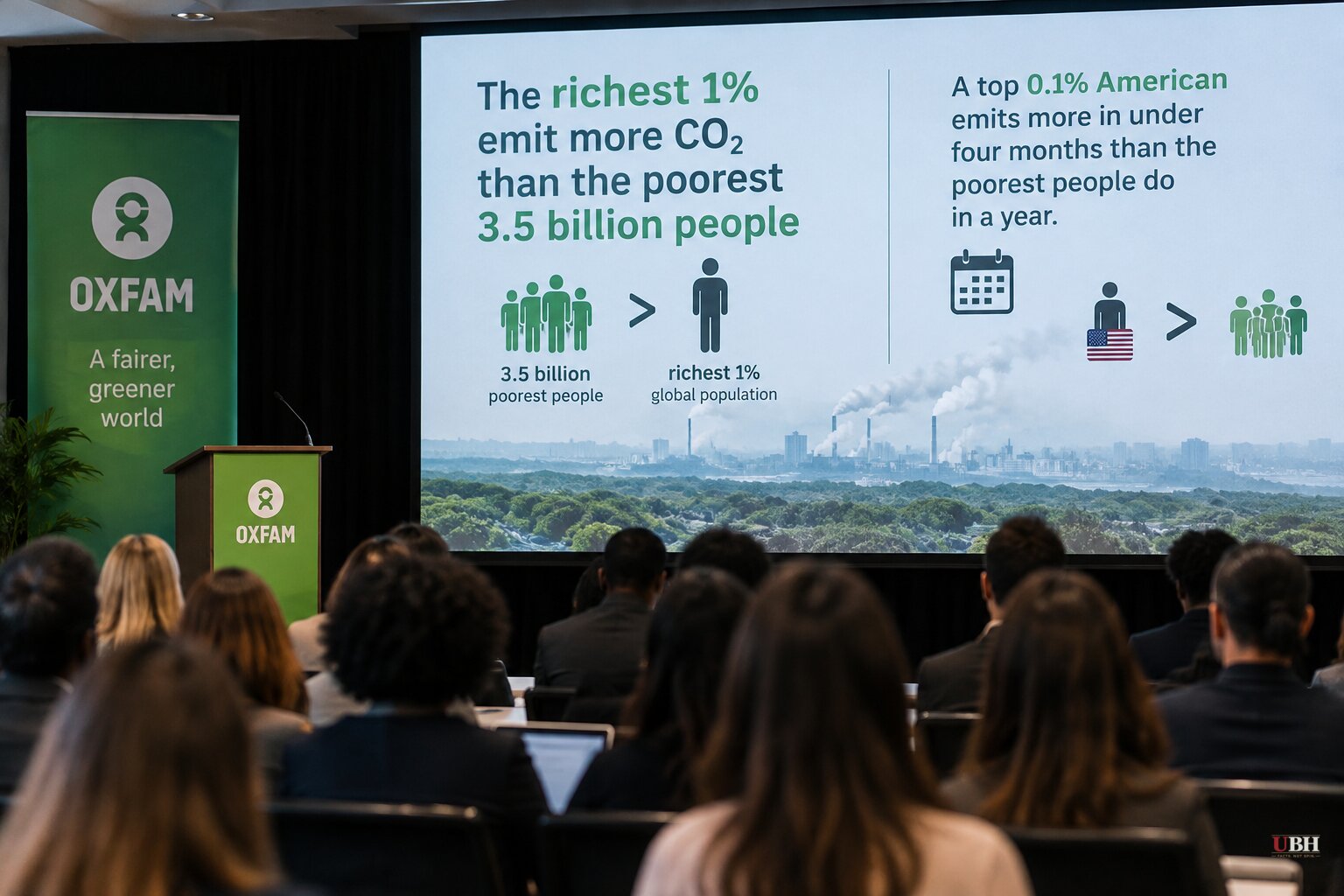
Oxfam, the anti-inequality advocacy group, says the world's richest 1% produce more carbon emissions than the poorest 3.5 billion people combined. The finding comes from a new report published Monday.
The group says the same gap shows up inside the United States. All figures below are Oxfam's.
What the report claims
Oxfam says the world's richest 1% are just 8 million people who make, on average, $442,000 a year. It says that group produces far more emissions than the poorest 3.5 billion.
It says someone in the richest 0.1% emits 48 times more CO2 per year than the average person in the U.S.
It says an American in that top 0.1%, earning an average of $1.98 million a year, emits more CO2 in just under four months (118.3 days) than someone in the poorest half of the country has emitted over the last 30 years. The poorest half of Americans earn an average of $25,600 a year, according to the report.
The U.S. is the world's second-largest carbon emitter, behind China. Oxfam's point is that the national total hides a wide spread between households.
Private jets and portfolios
The report singles out private aviation. Oxfam says private jets were responsible for 16 million metric tons of CO2 in 2025, the emissions equivalent of the annual energy use of over 2 million homes.
The U.S. accounts for 68% of private jet takeoffs worldwide. Private jets spent more than 6.5 million hours in the air last year, the report says.
Oxfam also says all the world's private jets together emit more in 2 seconds than someone in the world's poorest 50%, who make an average of $1,500 a year, would emit in a full year.
The report then moves from consumption to investment. Oxfam analyzed 217 companies that, in its words, "profit from either creating climate disasters, preparing for them, or recovering from them." It says those companies made $1.8 billion on average in 2025 and paid out more than $1 billion to shareholders.
"We see that the ultrarich consume differently than everyday people," said Rachel Carle, senior advisor on climate justice at Oxfam America. She added that the ultrarich are also far more likely to invest in polluting companies.
Attribution and health claims
The researchers constructed emissions pathway models to attribute the emissions of different income groups. The report finds that the richest 1% are responsible for 20% of global warming since 1990, which it describes as 20 times more than their share of the world's population.
The report also states that someone from the richest 1% contributed 34 times more than the average person to extreme heat events. It estimates that one year's worth of emissions from the richest 1% will cause 1.9 million excess heat deaths.
The report argues the ultrawealthy are less likely to face the impacts of their emissions. People with lower incomes are significantly more likely to suffer from climate disasters and extreme weather, and often lack the funds to recover, while wealthy individuals are more likely to live in safer locations or pay for private resources such as firefighters and generators.
How Oxfam got the numbers
Oxfam used climate attribution models and a consumption-based emissions dataset developed by the Stockholm Environment Institute to calculate emissions by income group. A consumption-based approach assigns emissions to the people who buy goods and services, not to the country where a factory or power plant sits.
That choice shapes the results. So does the report's reliance on average income for each group. The figures are modeled estimates, not metered emissions from individual households.
Carle framed the findings in strong terms. "We are seeing the ways that the ultra rich in the U.S. and around the world contribute disproportionately to creating the climate crisis," she said. "They are also insulated from the impacts of the climate crisis, and are profiting off of the disasters that they have created."
That last claim is Oxfam's characterization. The report's company list shows earnings and shareholder payouts. It does not establish that any named company or investor caused a particular disaster.
The policy backdrop
The United Nations warned this month that keeping warming below 2°C requires urgent action to cut global emissions by 18% by 2030. Research has long shown that wealthier countries drive a disproportionate share of global emissions, and the Oxfam report points to disparities within countries as well.
The report's authors suggest taxing the emissions of the super-rich. That could be done through taxes on high-emitting luxury items and activities, such as private jet use, to disincentivize their use, or through windfall taxes on profits from fossil fuel companies.
The report envisions that revenue from such taxes could help level the playing field on climate adaptation, including by increasing climate financing in the Global South or investing in adaptation measures around the world.
"We hope that people take away that there are a lot of opportunities to address inequality in ways that protect the planet and protect communities," Carle said. "Polluters need to pay for the harm that they've caused."
Sources used for this briefing
4 links from 2 independent newsrooms (syndicated copies of the same report count once)
These are the sources it draws on, linked so you can verify.


