
Unbiased headlines. Facts, not spin.
Every story is an unbiased news briefing written from 110+ sources across the spectrum — sources linked so you can verify it yourself.
 economy
Notable (5/10)
June 21, 2026 at 10:40 AM
economy
Notable (5/10)
June 21, 2026 at 10:40 AM
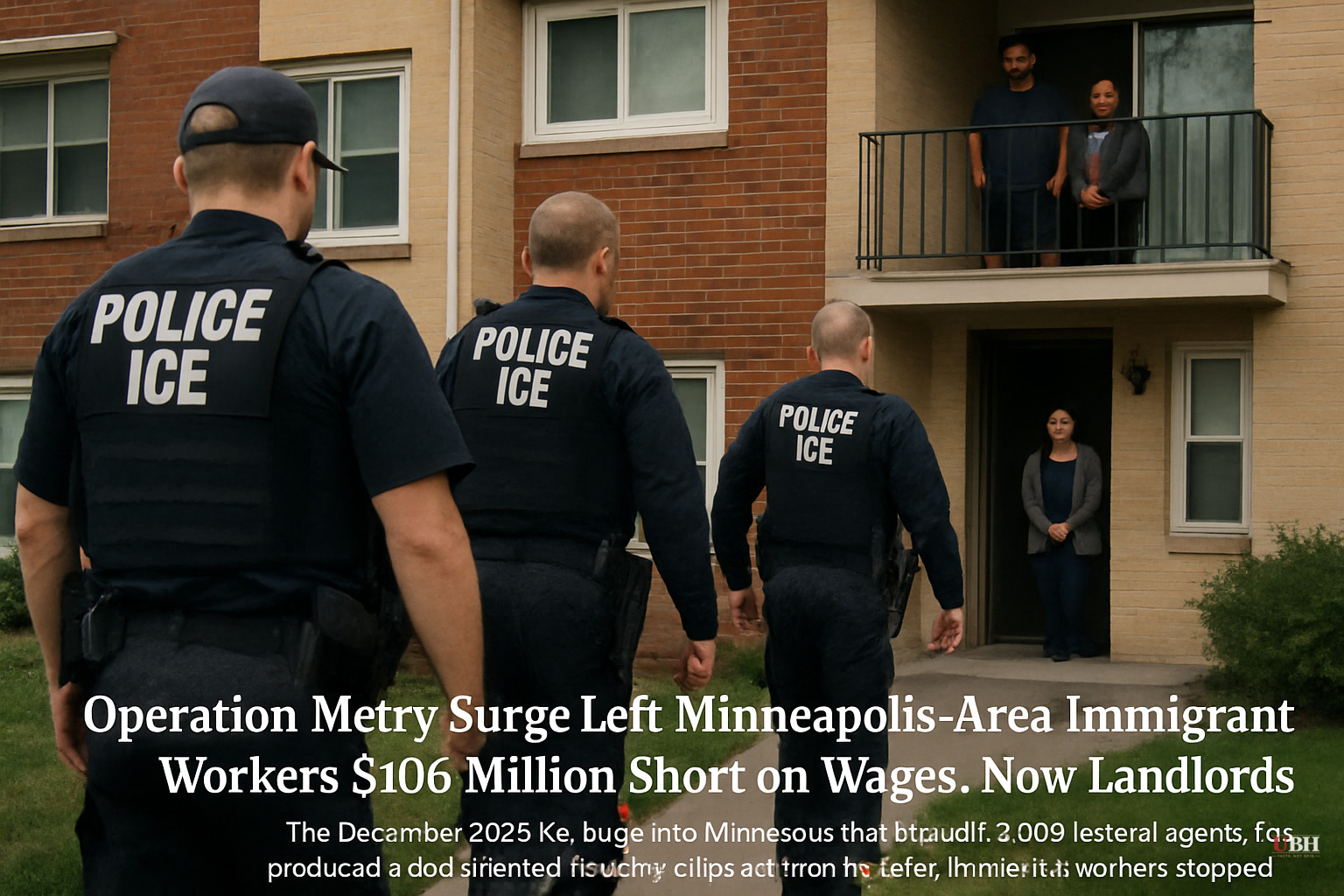
Operation Metro Surge Left Minneapolis-Area Immigrant Workers $106 Million Short on Wages. Now Landlords Want Their Rent.
The Numbers Behind the Fear
Six months after Operation Metro Surge deployed roughly 3,000 federal immigration agents into Minnesota, the economic fallout is still working through Twin Cities households.
Twin Cities workers lost an estimated $106 million in wages as a result of the operation, according to Inquilinxs Unidxs por Justicia, a Minneapolis tenant union. The Spanish-language help line they and allied groups operate saw a 1,600 percent increase in calls requesting rent assistance compared to the previous quarter, according to the same organization.
The philanthropic Wilson Foundation put a price on the resulting eviction risk: $32 million to cover rent owed from February through June for affected residents across the Twin Cities metro. John Wilson, the foundation's president, told CBS Minnesota he arrived at that figure after hearing directly from neighborhood groups in Minneapolis, Columbia Heights, and Shakopee.
What the Federal Operation Actually Did
Operation Metro Surge launched in December 2025. Federal agents detained people at workplaces, in residential buildings, and at routine immigration check-ins. According to the tenant advocacy site Pestakeholder, agents shot three people during the operation and killed two, racially profiled residents, detained legal residents, shipped detainees across state lines, and smashed car windows to remove occupants. ICE has NOT publicly disputed these specific claims in the sources reviewed for this article, but no independent federal accounting of use-of-force incidents has been published.
What is documented: Maria, a woman from Ecuador interviewed by CBS Minnesota, said her husband was detained at a routine monthly check-in at the Whipple Federal Building in Minneapolis in February. CBS Minnesota found no evidence he had committed a crime in Minnesota, based on the name and date of birth she provided. He holds a work permit and a state driver's license. He remains detained.
His wife, recovering from a C-section and caring for a 10-month-old and a 15-year-old, has been afraid to leave their south Minneapolis apartment. Her husband was the household's only income.
Family by Family
A hotel housekeeper identified by the American Prospect as Maria Gonzalez returned to work at the end of March after watching ICE agents enter her hotel in February, then pound on her own apartment door for 20 minutes while she hid inside with her husband and two U.S.-citizen teenage children. Her husband cannot work due to diabetes-related kidney failure requiring regular dialysis. She is the sole earner.
She now works three or four days a week rather than full time, her landlord raised her rent $75 a month, and the mutual aid money that covered June's rent is expected to run out. Her children are applying for after-school jobs. If she cannot pay July's rent, she told the American Prospect she fears the family will have to leave the country, taking her U.S.-born children to Mexico.
No charges, no criminal record. That is the factual baseline.
Where the Money Stands
The Wilson Foundation has pledged to match whatever the Minneapolis City Council appropriates in emergency rental assistance. City Councilor Jason Chavez told CBS Minnesota that progressive council members plan to propose $2.8 million. The Wilson Foundation match would bring that to $5.6 million, roughly 17 percent of the $32 million Wilson himself estimates is needed.
Minneapolis Mayor Jacob Frey vetoed a City Council measure that would have extended the required eviction notice period from 30 to 60 days. Frey and large nonprofits argued the measure would merely delay inevitable evictions while introducing uncertainty for landlords. He counter-proposed $1 million in emergency rental assistance from the city.
Council member Robin Wonsley, who introduced the 60-day notice measure, argued the extension would give tenants time to access funds being raised. More than 80 community members testified in support, according to Pestakeholder.
The Strongest Counterargument
The case for Frey's position deserves a fair hearing. Extending eviction notice periods sounds humane on the surface, but if it signals to landlords that they cannot rely on standard legal timelines, some will simply stop renting to higher-risk tenants or accelerate eviction filings before any new rule takes effect. Several major nonprofits aligned with Frey's veto, not with the council progressives, and those groups work in housing daily. A delayed eviction is not a prevented eviction if no money materializes to close the gap.
Wonsley's math is also straightforward: keeping someone housed is cheaper than re-housing them after eviction, because eviction records make future rentals harder to obtain. Both things are true simultaneously.
What Remains Unresolved
The tenant union coalition Pestakeholder says tried to organize a rent strike beginning March 1 fell short of its 10,000-person commitment goal, though it mobilized roughly 270 volunteers and 26,000 phone calls in two weeks.
As of June 21, 2026, the gap between the $32 million estimated need and the dollars actually committed is approximately $26 million. The Wilson Foundation's matching pledge is contingent on a city appropriation figure that has not yet been finalized. If the council settles on $2.8 million and Wilson matches it, the total public-philanthropic response covers roughly one-sixth of the estimated shortfall.
July rent is due in ten days. Whether the City Council finalizes its appropriation before that deadline and whether the Wilson Foundation's match moves fast enough to reach landlords is the specific, unresolved question that will determine how many Twin Cities families face eviction court this summer.
Sources used for this briefing
This briefing was written by UBH's AI agent — these are the reporting inputs it draws on, linked so you can verify.


