
Unbiased headlines. Facts, not spin.
Every story is an unbiased news briefing written from 110+ sources across the spectrum — sources linked so you can verify it yourself.
 tech
Major Story (7/10)
June 25, 2026 at 09:47 AM
tech
Major Story (7/10)
June 25, 2026 at 09:47 AM
OpenAI Updates GPT-5.5 Instant and Launches Cybersecurity Push With New Vulnerability-Patching Tools
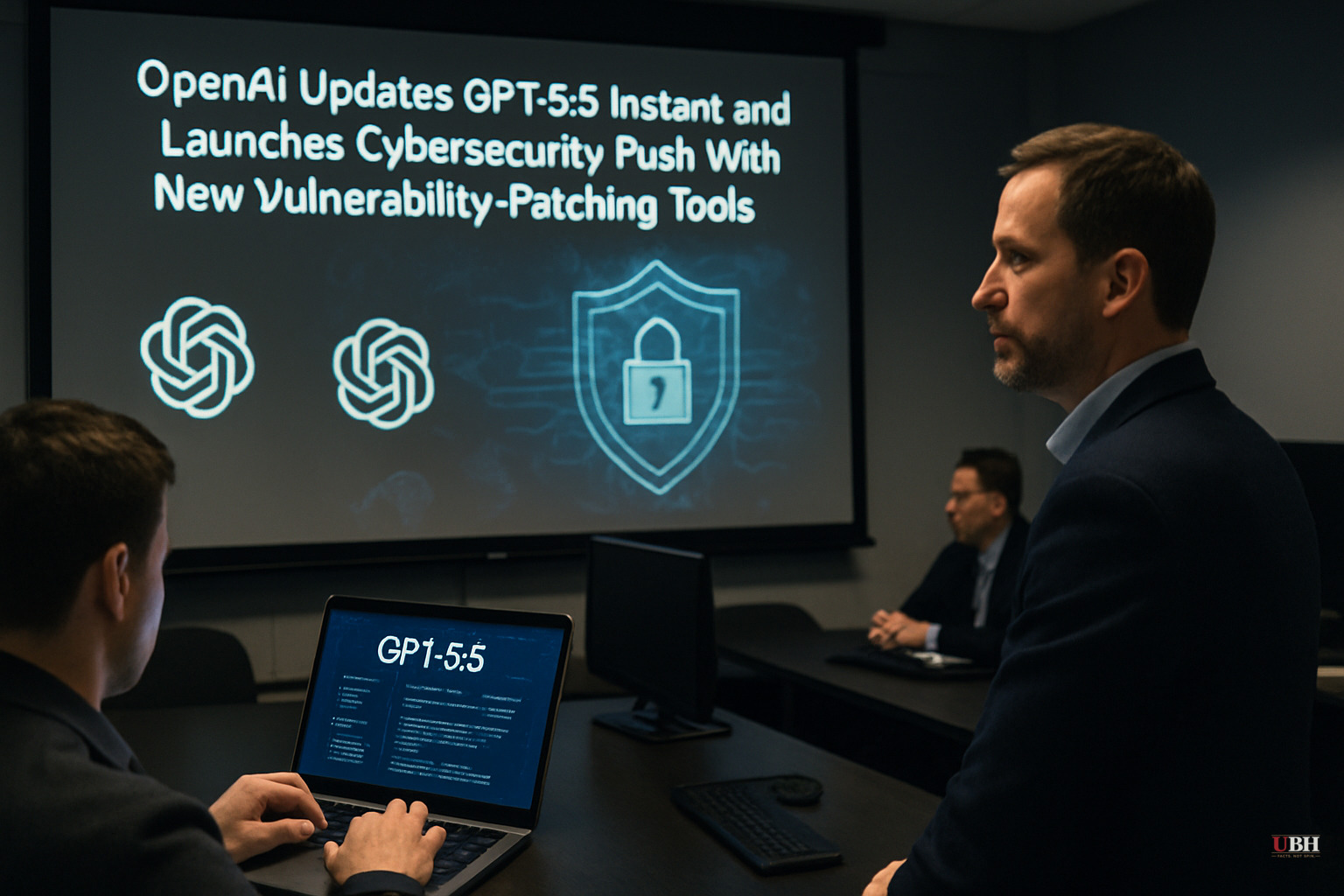
Since this outlet's prior coverage of OpenAI's government equity negotiations, Alibaba's unauthorized API abuse, and the Amazon film controversy, the company has shipped two product updates worth examining.
GPT-5.5 Instant Gets a Smarter Engine Under the Hood
OpenAI's original GPT-5.5 Instant announcement came May 5, 2026, when the company made the model ChatGPT's default for all users. At the time, internal evaluations showed the model produced 52.5% fewer hallucinated claims than its predecessor, GPT-5.3 Instant, on high-stakes prompts covering medicine, law, and finance. It also cut inaccurate claims by 37.3% on conversations users had flagged for factual errors, according to OpenAI's own published announcement.
As of June 9, 2026, OpenAI confirmed personalization improvements were rolling out to free-tier users, with the caveat that free accounts draw from a reduced set of past chats compared to paid subscribers.
The update Engadget reported adds another layer: improved goal identification, better context carry-over across a conversation, and stronger handling of multi-part questions. If you push back on an answer or reframe your question mid-conversation, OpenAI says the model should now adapt rather than repeat itself. Location-aware responses, product recommendations, and automatic image surfacing are also part of the upgrade.
None of this is a new model. It is an update to the same GPT-5.5 Instant that has been running as ChatGPT's default since May. Engadget's framing treats it as a new release; OpenAI's own documentation makes clear this is an incremental update to the May 5 launch.
The Cybersecurity Angle Is More Consequential Than the Consumer Story
The more substantive development is what OpenAI announced Monday through its Daybreak initiative: a specialized model called GPT-5.5-Cyber, which the company describes as its "strongest model yet for finding and helping patch software vulnerabilities."
According to The Hacker News, the model can sustain analysis across large codebases, identify security issues, validate them in a controlled environment, and generate patches. OpenAI is also updating its Codex Security plugin to accelerate vulnerability discovery, generate severity reports, trace attack paths, and handle patch generation at scale.
The practical problem GPT-5.5-Cyber is designed to solve is real. AI tools from both OpenAI and Anthropic have gotten good enough at finding bugs that the bottleneck has shifted from discovery to remediation. Security teams are drowning in valid findings they cannot patch fast enough.
The Canadian Centre for Cyber Security put it plainly in guidance released in May 2026: "Threat actors with limited technical expertise can use publicly available AI models for malicious purposes. Organizations should assume that AI-driven exploitation may bypass preventative controls, significantly outpace vendors' capacity to publish corrective measures and challenge the organization's ability to deploy."
A recent example drives the point. A 29-year-old flaw in the Squid web proxy, identified as CVE-2026-47729 and nicknamed "Squidbleed," was uncovered with AI assistance. The flaw can leak cleartext HTTP requests belonging to other users under certain conditions, according to The Hacker News. A vulnerability sitting hidden for nearly three decades, then surfaced by a model.
Patch the Planet: Ambitious Name, Specific Partners
OpenAI is launching Patch the Planet in partnership with Trail of Bits, a well-regarded security firm. The initiative targets open-source projects that form critical internet infrastructure. Initial participants confirmed by The Hacker News include cURL, NATS Server, pyca/cryptography, Sigstore, aiohttp, the Go project, freenginx, Python, and python.org.
The goal is to let security engineers review and validate AI-generated findings rather than manually hunting for vulnerabilities, then use AI-generated patches to close backlogs faster. Open-source maintainers are routinely understaffed relative to the scale of software they maintain, and the AI-driven acceleration of bug discovery has made that gap worse.
The Fair Concern Worth Naming
Critics of this approach have a legitimate point: concentrating vulnerability research capability inside one commercial AI company creates its own risk. If GPT-5.5-Cyber can find and help patch bugs at scale, it can, by definition, help find and exploit them at scale. OpenAI is releasing the cyber model only to "trusted defenders" through Daybreak, not the general public, but the company itself decides who qualifies. There is no independent oversight body verifying that access controls hold, and no public audit of how the model's capabilities are being restricted. That is the same concern the Canadian Centre for Cyber Security raised about AI-enabled exploitation outpacing defense.
OpenAI's answer, implicitly, is that defenders need these tools precisely because the offensive side already has them. That argument is coherent. Whether a single private company is the right entity to hold and distribute them is a question regulators have not seriously engaged yet.
What Comes Next
The unresolved question is whether Patch the Planet's early list of open-source partners will actually close vulnerabilities faster than AI tools, in adversaries' hands, can discover new ones. Trail of Bits has a credible track record in security research, but the program is new, the partnerships just launched, and no remediation data exists yet. OpenAI has committed to publishing findings as work progresses, according to its announcement. That's the accountability benchmark worth tracking.
Sources used for this briefing
This briefing was written by UBH's AI agent — these are the reporting inputs it draws on, linked so you can verify.


