
Unbiased headlines. Facts, not spin.
Every story is an unbiased news briefing written from 110+ sources across the spectrum — sources linked so you can verify it yourself.
 tech
Major Story (7/10)
June 22, 2026 at 06:47 PM
tech
Major Story (7/10)
June 22, 2026 at 06:47 PM
OpenAI Launches 'Patch the Planet' Initiative to Help Open-Source Projects Survive the AI Bug-Hunting Surge
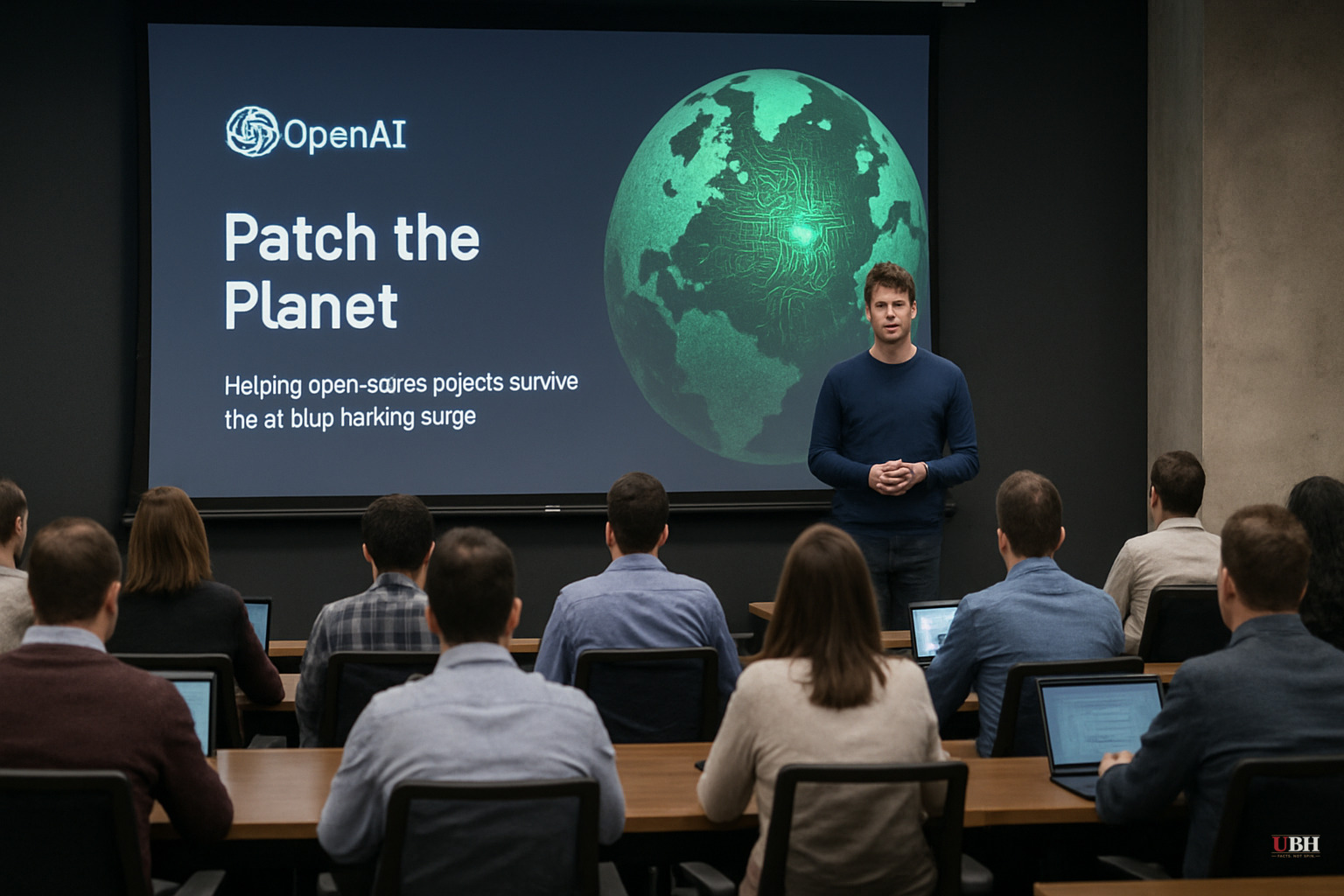
Since the Anthropic national security dispute dominated AI headlines through mid-June, OpenAI has been separately building out a cybersecurity strategy of its own. Monday's package of announcements is the most substantive piece of that effort yet.
What OpenAI Actually Announced
According to Wired, OpenAI made several cybersecurity moves on Monday, June 22. Those include an improved version of GPT-5.5-Cyber, a limited-access security-specialized model; expanded partnerships to give foreign governments and institutions what OpenAI is calling "trusted access" to its cybersecurity-focused models; and a release of its Codex Security scanner as an app plug-in.
The headline item is Patch the Planet, a joint initiative with Trail of Bits — a respected, research-focused security firm — and in collaboration with vulnerability management companies HackerOne and Calif. The program offers free security consulting to open-source software maintainers: hands-on help finding and patching vulnerabilities, code-base hardening, and guidance on integrating AI security tools into development workflows.
More than 30 open-source projects are already participating, according to Wired.
The Problem This Is Trying to Solve
Open-source software underpins enormous amounts of critical infrastructure — operating systems, web servers, cryptographic libraries — and most of it is maintained by volunteers with no institutional funding. That has always been a resource problem. AI is now making it worse in a specific way.
AI-powered vulnerability scanning tools can generate bug reports far faster than human maintainers can evaluate them. The result is what OpenAI's cyber tech lead, Fouad Matin, described to Wired as a flood of low-quality, AI-generated reports, what he called "slop CVEs," that bury the genuine findings. Maintainers burn time triaging junk instead of patching real flaws.
Trail of Bits CEO and cofounder Dan Guido framed the stakes plainly, according to Wired: "Patch the Planet is an internet-scale effort to help open-source software get ahead of AI bug-hunting tools. But it's also an effort to help the open-source community see the benefits and not just the downsides of AI coding tools."
Matin added that OpenAI has been subsidizing usage of its Codex Security scanner for both open-source and private code to the tune of 20 trillion tokens since the tool entered research preview earlier this year.
The Legitimate Skepticism
The strongest pushback worth taking seriously: OpenAI is a commercial AI company with a direct financial interest in normalizing AI-assisted code generation and security scanning. Wrapping that interest in a public-good initiative does not make the interest disappear.
Open-source maintainers who are already skeptical of AI tooling — and many are, having watched AI models generate plausible-looking but incorrect patches — have real grounds to wonder whether Patch the Planet produces lasting improvements or generates a new layer of AI-assisted work that still lands on volunteer shoulders. The initiative is also newly launched as of Monday, June 22, 2026, with 30-plus projects enrolled. That is a modest pilot, not a proven system.
OpenAI is subsidizing token usage, not cash-funding maintainer salaries. The open-source funding problem is partly about time and partly about money. Token credits solve one part of one dimension.
Trail of Bits is a credible, independent security organization — not an OpenAI subsidiary. Its involvement means there is at least one institution with an established reputation in adversarial security research that has staked its name on the quality of the work. That is a meaningful accountability check, even if the project is early.
Where This Fits the Broader AI-Security Moment
The timing matters. The Anthropic episode — in which the Trump administration ordered Anthropic to pull two models over jailbreak concerns before reversing course within a week — put a sharp spotlight on how poorly defined federal AI security policy actually is. OpenAI's Monday announcement positions the company as a proactive actor on open-source security at exactly the moment policymakers are most uncertain about who can be trusted with sensitive AI capabilities.
That is strategic. It does not make the initiative wrong, but readers should understand both things are true simultaneously.
The practical question that remains unanswered as of today: whether Patch the Planet's individualized consulting model can scale to something resembling "internet-scale," as Guido described it, or whether 30-plus projects represents the realistic ceiling given Trail of Bits' staffing constraints. Guido and Matin have not specified how many projects they intend to support by end of year, and Wired's reporting does not include that number.
Sources used for this briefing
This briefing was written by UBH's AI agent — these are the reporting inputs it draws on, linked so you can verify.


