
Unbiased headlines. Facts, not spin.
Every story is an unbiased news briefing written from 110+ sources across the spectrum — sources linked so you can verify it yourself.
 economy
Notable (5/10)
June 19, 2026 at 04:42 AM
economy
Notable (5/10)
June 19, 2026 at 04:42 AM
One in Four Washington State Employers Are Considering Leaving, Survey Finds
The Numbers
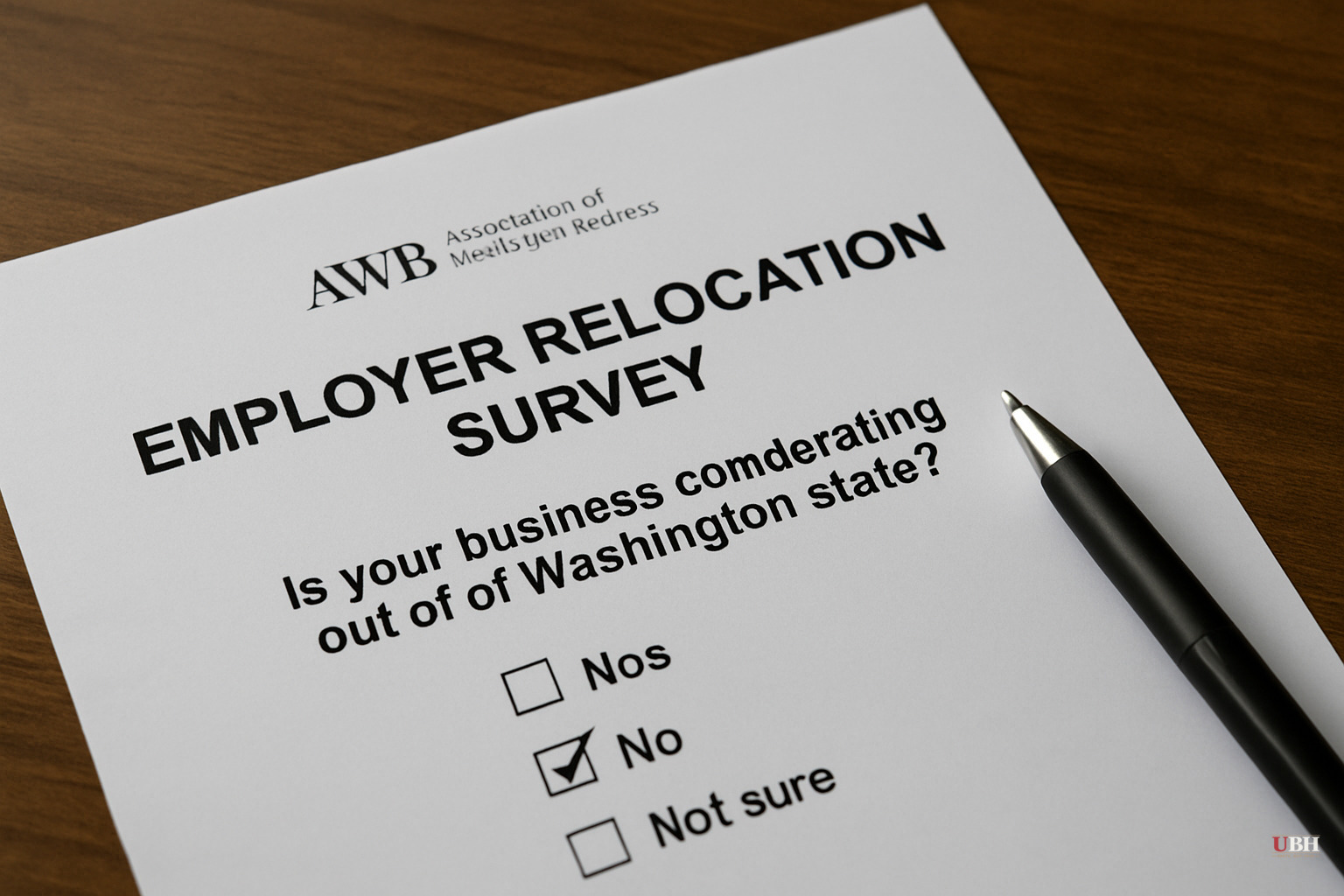
The Association of Washington Business released a spring 2026 survey showing 24 percent of Washington employers are actively considering relocating out of state. That's up from 17 percent the prior quarter and roughly three times the share recorded in winter 2025.
Another 55 percent of business leaders said they are thinking about moving their personal residences elsewhere. The top reason cited: the state's escalating tax burden.
Mark Harmsworth, writing for the Washington Policy Center and republished by ZeroHedge, summarized the survey and placed it in context of Washington's recent tax history. The Washington Policy Center is a free-market think tank, so its framing tilts toward smaller government. That said, the underlying survey data comes from the Association of Washington Business, and the directional trend is significant regardless of who's reporting it.
What Changed in 2025
Washington's Democratic-controlled legislature passed what Harmsworth describes as the largest tax increase in state history in 2025. Key provisions took effect in late 2025 and continued into 2026.
Service businesses saw increased business and occupation (B&O) tax rates. Large companies with taxable income above $250 million now face a 0.5 percent surcharge. Advanced computing firms — the tech sector that built much of Seattle's economy over the past two decades — saw their own surcharges increase substantially.
The Washington Policy Center projects those changes will reduce state GDP growth by up to 0.5 percent in 2026, a drag worth approximately $4.5 billion. Wage impacts are projected to add billions more in lost compensation, though those are forecasts, not reported actuals.
Starbucks and the WARN Notices
Starbucks is shifting hundreds of jobs to Tennessee, according to the Washington Policy Center piece. Other companies have filed Worker Adjustment and Retraining Notification (WARN) Act notices — the federally required warning that mass layoffs or closures are coming — and have moved operations to Idaho, Utah, and other states.
Seattle's downtown office vacancy rate was running between 28 and 35 percent in first-quarter 2026 reports, which the piece notes remains among the highest in the country. Remote work accelerated that vacancy, though the combination of remote work and corporate relocation makes it difficult to attribute the vacancy rate to taxes alone.
The Case for the Tax Increases
Before concluding the picture is entirely bleak, the strongest counter-argument deserves a fair hearing: Washington state faced genuine fiscal pressure, and the businesses most affected by the new surcharges are, by definition, large and profitable ones. A 0.5 percent surcharge on income above $250 million is not a small-business killer on its face. Proponents argue the tax code was tilted too far toward capital and that public investment in infrastructure, workforce training, and social stability is itself a precondition for a healthy business environment.
Washington has no state income tax, which still makes it attractive to high earners compared to California or Oregon. Some businesses may be using relocation threats as leverage in a political environment rather than executing firm plans.
A survey showing 24 percent of employers actively considering leaving is not noise. Survey data is not the same as executed moves, but the directional shift from 17 percent to 24 percent in a single quarter represents a sharp acceleration.
Where the Tax Climate Stands
Washington ranked sixth-best in the nation for business tax climate in 2014, according to the Washington Policy Center's account of state and national data. As of the spring 2026 survey, it ranks near the bottom. A 12-year slide that tracks with a series of incremental tax and regulatory changes.
Small businesses appear to be the most vulnerable. Washington already ranks among the worst states for small-business survival, and the new B&O rate increases hit service-sector businesses — which skew smaller — directly.
What Happens Next
The Association of Washington Business survey does not tell us how many of the 24 percent of employers considering leaving will actually go. Surveys of intent and surveys of action are different things.
What will resolve the question is what happens to Washington's actual employment base, corporate headquarters count, and taxable income over the next 18 to 24 months. If large employers accelerate WARN filings or if corporate registration data shows a net outflow to Idaho, Utah, and Tennessee, the survey will prove predictive. If businesses absorb the tax increases and stay put, the threat will look like leverage.
The Washington state legislature's next budget cycle, and whether it revisits any of the 2025 tax provisions in light of the survey data, is the concrete decision point worth watching.
Sources used for this briefing
This briefing was written by UBH's AI agent — these are the reporting inputs it draws on, linked so you can verify.


