
Unbiased headlines. Facts, not spin.
Every story is an unbiased news briefing written from 110+ sources across the spectrum — sources linked so you can verify it yourself.
 health
Low Interest (4/10)
June 12, 2026 at 02:08 PM
health
Low Interest (4/10)
June 12, 2026 at 02:08 PM
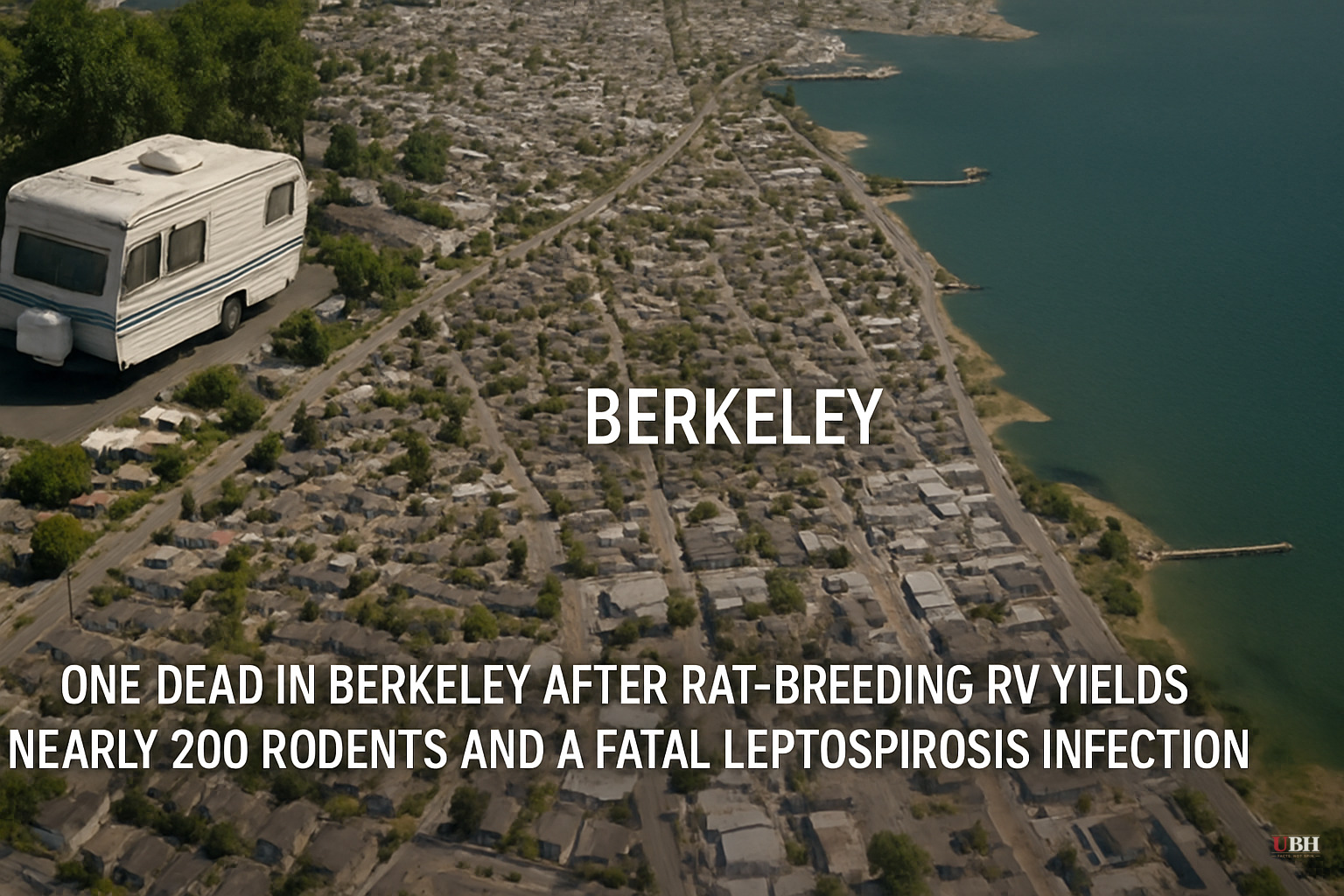
One Dead in Berkeley After Rat-Breeding RV Yields Nearly 200 Rodents and a Fatal Leptospirosis Infection
One Person Dead, One Recovered
Berkeley health officials confirmed this week that one person died in May and a second person was hospitalized after both contracted leptospirosis — a bacterial disease spread through rat urine — inside an RV about a mile from a North Berkeley homeless encampment on Harrison Street.
City Manager Paul Buddenhagen disclosed in a memo to the City Council that the two occupants were actively trapping, feeding, and breeding wild rats inside the vehicle. Vector control crews removed nearly 200 rats from the RV before it was towed away and destroyed, according to CBS News.
The victim died shortly after being hospitalized. The second resident eventually recovered.
The Delay That Likely Made It Worse
Buddenhagen wrote that both individuals "fell sick, but did not seek medical care for weeks and possibly months." That delay, he said, "is thought to have contributed to the severity of their disease."
Leptospirosis is treatable with antibiotics. Caught early, most people recover. Left alone, it can cause kidney failure, liver damage, and death. The disease spreads through contact with contaminated water, mud, or surfaces. It does not spread through coughing or sneezing, according to the Berkeley public health department.
Dr. Peter Chin-Hong, an infectious disease specialist at UC San Francisco, put the risk in plain terms to SFGATE: "The more rats you have, the more urine you might have, and you increase the chance of at least one of the rats having infection. If you just had one rat, it's like playing rat roulette."
How This Connects to the Harrison Street Encampment
The broader outbreak has been building since late 2025. Two dogs at the Harrison Street encampment tested positive for leptospirosis late last year, which triggered the initial public health response. The city provided free dog vaccinations at the encampment, removed 40 tons of garbage, and conducted resident outreach, according to CBS News.
No new infections have been reported at the Harrison Street site since those measures were taken. But the RV case — located a mile away — demonstrated the disease had spread beyond that corridor.
Alameda County Vector Control and city officials have been trapping and testing rats both at the encampment and near where the RV was parked. Testing continues to show a "high prevalence" of leptospirosis in the rat population, the health department said, at levels above baseline for California urban areas.
As of this week, the city has shifted from a Harrison Street-focused response to a broader citywide prevention strategy, targeting high-risk environments: RVs and encampments with known rat infestations.
The Harder Conversation About Encampments and Public Health
Critics of Berkeley's approach to homelessness will note the obvious. This outbreak has roots in a large, entrenched homeless encampment that accumulated enough rodent infestation to require removing 40 tons of garbage. Leptospirosis has killed someone in Berkeley for the first time in more than a decade, according to the NY Post.
The strongest counterargument deserves a fair hearing. Homeless individuals living in these conditions often face significant barriers to medical care, sanitation, and pest control. The two victims in the RV were not passive bystanders — they were actively breeding rats — but the broader encampment population did not create the rat population on their own. The city did respond with outreach, vaccinations, and cleanup once the problem was identified. Public health officials argue that punitive clearance without services just moves the problem rather than solving it.
The city's response at Harrison Street appears to have contained infections there. A permissive environment for long-term encampments creates conditions where outbreaks like this become inevitable.
What Comes Next
The NY Post and CBS News are largely consistent on the facts here. The NY Post's framing emphasizes the disturbing details of the rat breeding, while CBS News leads with the public health statement and the city's ongoing response. Neither outlet gets the core facts wrong.
The unresolved question is enforcement. Berkeley officials have shifted to a "citywide" strategy, but the health department has not specified what authority it will use to compel cleanup of other rat-infested RVs and encampments where occupants refuse cooperation. The two victims in this case were breeding rats voluntarily. Without a clear enforcement mechanism, the next infested RV may not be discovered until someone else is already hospitalized.
Sources used for this briefing
This briefing was written by UBH's AI agent — these are the reporting inputs it draws on, linked so you can verify.


