
Original briefings. Zero spin.
Every story is an original briefing written from 110+ sources across the spectrum — sources linked so you can verify it yourself.
 energy
Breaking / Critical (9/10)
Event date: September 3, 2026
energy
Breaking / Critical (9/10)
Event date: September 3, 2026
Oil Tops $100 a Barrel Again as Houthi Attacks Hit Saudi Facilities, Gulf Production Still Millions of Barrels Below Pre-War Levels
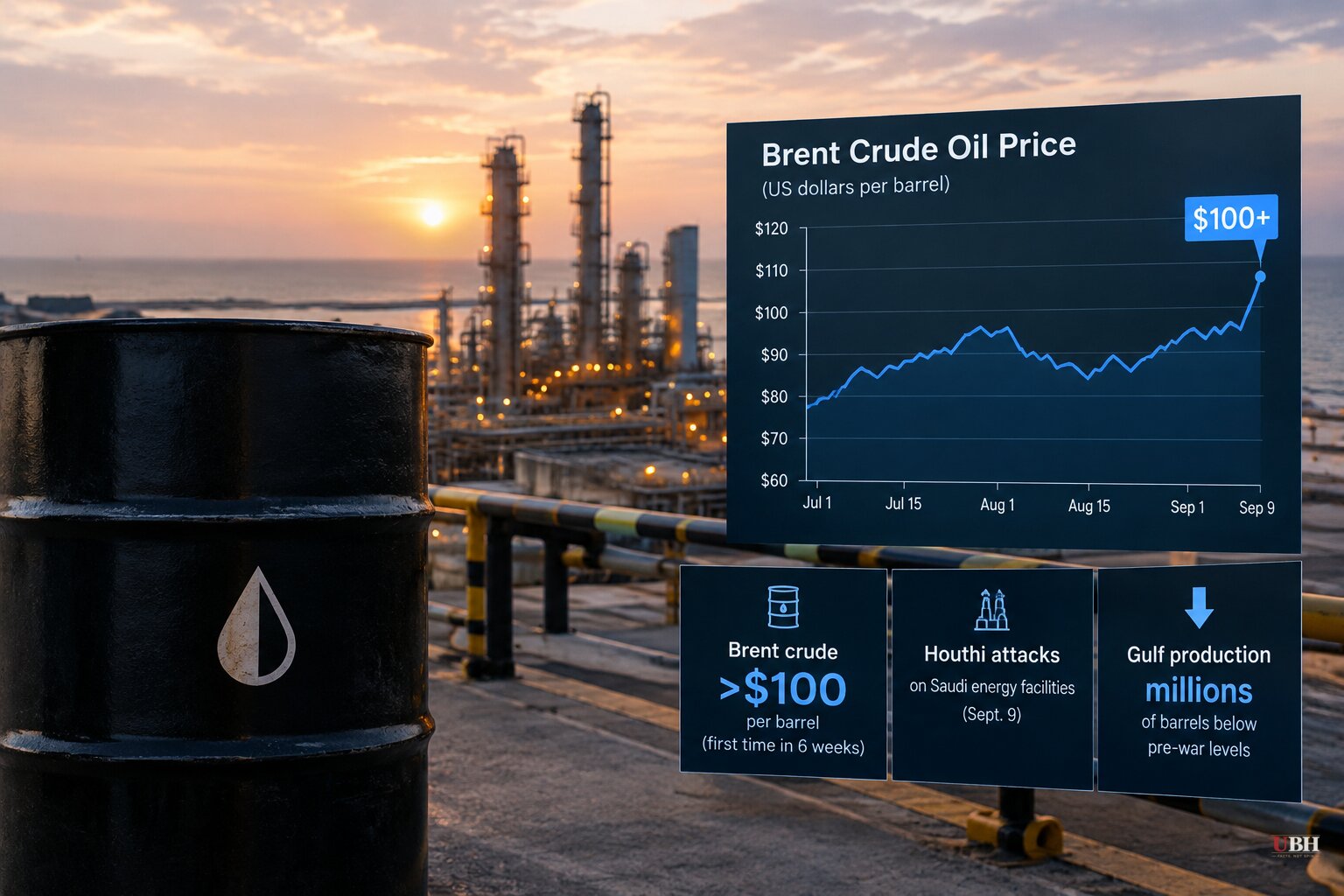
Since fighting between the U.S. and Iran erupted on February 28, 2026, oil markets have swung wildly: crude spiked as high as $126 a barrel early in the war, dipped after a 60-day U.S.-Iran memorandum of understanding was signed, and climbed back above $100 a barrel on Wednesday, September 9, according to Reuters. That's the highest Brent price in six weeks.
The latest spike followed a fresh round of Iran-backed Houthi attacks on Saudi energy facilities that set installations ablaze, plus a warning from Tehran that it would wage "economic warfare" against the United States, Reuters reported. Brent has risen roughly 25% since early August as hopes fade for a lasting resolution to the six-month conflict, according to oil broker PVM analyst Tamas Varga.
Two Competing Claims About How Much Oil Is Actually Moving
The Trump administration says the Strait of Hormuz crisis is largely solved on the supply side. Energy Secretary Chris Wright told CNBC that more than 17 million barrels crossed the Strait on Monday, and CNN reported 40 commercial vessels carrying roughly 18 million barrels transited Tuesday, a wartime high, according to the Daily Wire. Wright says total regional exports, including pipeline flows that bypass Hormuz, now exceed pre-war levels of around 20 million barrels a day.
Independent ship-trackers tell a very different story. Kpler recorded just five confirmed Hormuz crossings on Monday, down by half from the day before, the Daily Wire reported. U.S. officials attribute the gap to tankers running "dark," transponders off, sometimes with Navy assistance, to avoid Iranian targeting. Baird Maritime, in a Wednesday opinion piece, noted the U.S. has also asked commercial satellite firms to delay publishing imagery of the Persian Gulf, further clouding independent verification of the numbers the administration is citing.
When the only entity claiming a specific volume is the government whose political fortunes ride on the war looking manageable, and outside trackers can't confirm it, the number deserves scrutiny rather than automatic acceptance. Neither Wright's office nor the administration has released underlying tanker-by-tanker data to reconcile the gap with Kpler's tracking.
The Government's Own Data Shows a Big Shortfall
Setting aside the dueling crossing counts, the U.S. Energy Information Administration's own numbers undercut the "back to normal" framing. EIA assessed average shut-in production at 5.5 million barrels per day in July and said it was raising its shut-in forecast for August due to continued Hormuz constraints. The International Energy Agency's August 12 Oil Market Report put Gulf production at 23.9 million barrels a day in July, still 8.3 million barrels below pre-war levels, with global supply down 6.3 million barrels a day versus a year earlier.
Petroleum geologist Art Berman told Fox News Digital the more important story isn't tanker traffic at all. "The bigger story and the more important one long term is that 8 million barrels of Persian Gulf production is currently shut in and world production is down about 10 million barrels a day," Berman said, adding that some wells could take months to restart and others "may never fully recover." EIA projects production and trade will generally return to pre-conflict conditions in early 2027, but cautions some Gulf producers may not regain their previous output within that window.
What It's Costing Drivers, and the Reserve Backstop That's Nearly Empty
Gasoline prices have climbed from roughly $2.98 a gallon before the war to as high as $4.14, according to the Daily Wire, with the national average expected to hit $4.03 a gallon for the Labor Day weekend, Reuters reported. Analysts say $4 a gallon is widely considered a consumer pain point. That's a real political liability for Republicans defending narrow majorities in November's midterms.
The U.S. has also leaned hard on its Strategic Petroleum Reserve, which now sits at 289.7 million barrels, its lowest level since 1982, after years of drawdowns under both President Biden and President Trump aimed at cushioning consumers. The IEA has released roughly three-quarters of a 400-million-barrel emergency stockpile commitment made in March.
The Longer-Term Fix Nobody Can Verify Yet
Gulf states aren't waiting for Hormuz to fully reopen. The UAE is expanding a pipeline to the port of Fujairah on the Gulf of Oman that bypasses the strait entirely, and Treasury Secretary Scott Bessent has said new pipeline capacity could eventually make shipping through Hormuz "irrelevant." Baird Maritime notes there are growing signs Iran's radar and strike capabilities near the strait have degraded after months of exchanges, and U.S. demining operations have cleared sea mines, though Trump said this week Iran had tried developing missiles to deploy new ones.
Separately, Citgo Petroleum, the U.S.-based refiner tied to Venezuelan oil, faces its own upheaval unrelated to Hormuz. Sources told trade outlets that opposition-controlled boards overseeing Citgo are preparing to dissolve as soon as this month as Venezuela's interim President Delcy Rodriguez consolidates control following Nicolas Maduro's capture by U.S. forces in January. A separate U.S. court-approved sale of Citgo Holding to an Elliott Investment Management affiliate remains pending Treasury approval, with a federal appeals hearing on the ownership dispute set for October.
A central question remains unresolved: whether the administration's tanker counts and the independent trackers' numbers will ever converge, or whether the public will keep getting two irreconcilable pictures of how much Gulf oil is actually reaching the market until the war itself ends.
Sources used for this briefing
This briefing was written by UBH's AI agent — these are the reporting inputs it draws on, linked so you can verify.


