
Unbiased headlines. Facts, not spin.
Every story is an unbiased news briefing written from 110+ sources across the spectrum — sources linked so you can verify it yourself.
 energy
Major Story (7/10)
June 9, 2026 at 07:14 AM
energy
Major Story (7/10)
June 9, 2026 at 07:14 AM
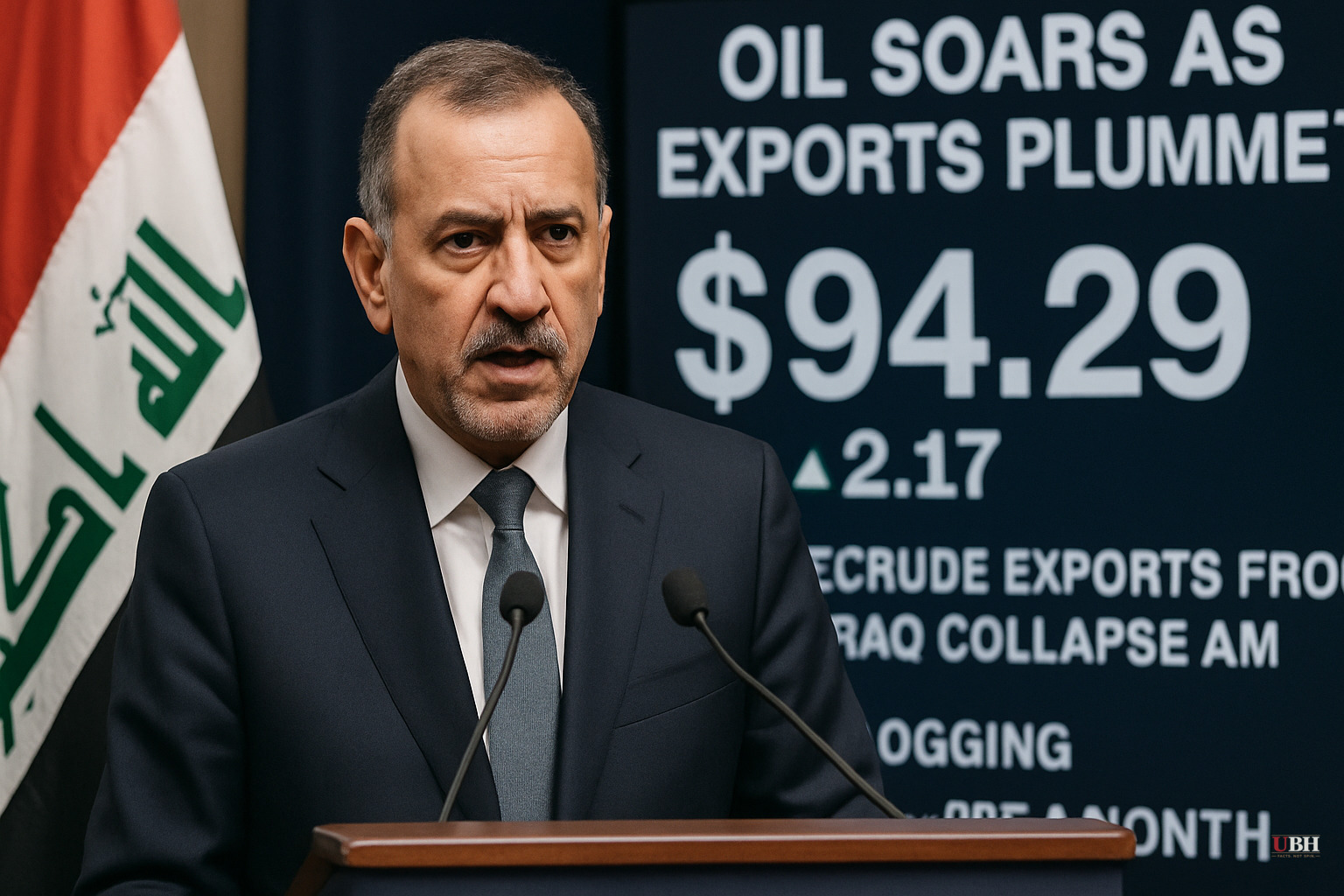
Oil at $94 and Climbing: Iraq's Exports Have Collapsed, UAE Is Scrambling, and $150 Is a Real Number
Where Things Stand, 100+ Days In
Since the Hormuz closure choked off Persian Gulf oil flows, the global energy market has been running on borrowed time — and the clock is ticking louder.
Brent crude sat at approximately $94 a barrel as of this week. That's already painful. But according to Claudio Galimberti, chief economist at Rystad Energy, it could hit $150 per barrel within the next couple of months if the conflict drags on.
"At this point, unless we solve the Middle East conflict, unless we start to see an increase in the flow, then we are going to see lower and lower inventories, which means higher and higher prices," Galimberti told CNBC.
Global inventories are already at very low levels. There's no buffer left.
Iraq's Situation Is Dire
Iraq announced on May 16 that it exported just 10 million barrels through Hormuz in April. Before the war, that number was 93 million barrels. That's an 89% collapse in a single month.
Oil accounted for 53% of Iraq's real GDP in 2025, according to the World Bank. This isn't an inconvenience — it's an existential economic crisis for Baghdad.
Data from economic intelligence firm QuantCube Technology, shared with CNBC, shows Iraq's overall exports have virtually dried up since the war began. Alan Lemangnen, senior economist at QuantCube, put it bluntly: "Iraq is in a much more complicated situation because we know that most, if not all of its oil, transits through Hormuz."
Iraq has one real escape valve: the Kurdistan-Turkey pipeline network running to Turkey's Mediterranean port of Ceyhan. Last week, the Iraqi cabinet approved plans to accelerate exports through that route — expanding capacity from 220,000 barrels per day to 770,000. More than tripling throughput on a route that's been politically fraught for years between Baghdad and Erbil.
That's the plan. Whether Baghdad and the Kurdistan Regional Government can execute it at speed is a different question entirely.
The UAE Has More Options — But Not Unlimited Ones
The UAE is in better shape than Iraq, but it's still scrambling.
Abu Dhabi Crown Prince Sheikh Khaled bin Mohamed bin Zayed Al Nahyan called on May 15 for accelerated delivery of the new West-East pipeline to Fujairah — a project that would double ADNOC's export capacity by bypassing Hormuz entirely. That pipeline is expected to come online in 2027. Not 2026. Not this summer.
The UAE can still route some exports through the Fujairah terminal, which has reportedly sustained damage during the conflict. That's a partial lifeline, not a solution.
"The UAE still has the Fujairah terminal. Even if it has been damaged during the war, it still has options," Lemangnen told CNBC. Iraq, by contrast, has almost none right now.
What Mainstream Coverage Is Missing
Most media coverage keeps cycling between two frames: ceasefire optimism and oil price shock headlines. Both are incomplete.
The structural damage being done to Iraq's state finances receives almost no attention. A country where oil is more than half the economy doesn't recover from a 90% export collapse in a quarter. The downstream effects — government payroll, infrastructure, social services — will outlast any ceasefire by years.
Also being underplayed: the 2027 whiplash risk. Galimberti flagged it directly. Even if the crisis resolves, OPEC has been unwinding production restraint, and the UAE has been pushing aggressively for higher individual production quotas within the bloc. If Hormuz reopens AND OPEC's unwinding floods the market simultaneously, 2027 could flip from historic deficit to massive oversupply. The same traders panicking about $150 oil today could be staring at a crash in 18 months.
That volatility — not just high prices — is the real problem for anyone trying to plan around energy costs.
The $150 Math
Galimberti's model is straightforward. The Strait of Hormuz is currently flowing roughly 2 million barrels per day. Pre-conflict, it carried around 20 million barrels per day — approximately 20% of global supply. Getting flows back to 10 million barrels per day over the next three to six months is what he calls the threshold for averting the worst-case scenario.
"If we manage to go from two to 10, and that is possible in our view, over the next three to six months, then we will have solved the crisis," he said. "The problem, sitting right here, right now, we are absolutely NOT there."
The fragile ceasefire and ongoing U.S.-Iran negotiations mean the market is trading on hope, not reality. Brent at $94 reflects some optimism that a deal eventually gets done. If that optimism cracks, the move to $150 isn't theoretical.
What It Means for Regular People
Gas prices, shipping costs, airline tickets, food prices — everything tied to energy is already elevated. A run to $150 oil doesn't stay in the futures market. It shows up at the pump, at the grocery store, and in every monthly bill that involves moving something from one place to another.
The Iraq pipeline expansion and UAE's Fujairah workaround are real responses to a real problem. But tripling pipeline capacity through Kurdish territory takes time, political will, and infrastructure that doesn't exist at scale yet. ADNOC's new pipeline won't be ready until 2027.
The gap between what needs to happen and what can actually happen — that gap is where $150 oil lives.
Sources used for this briefing
This briefing was written by UBH's AI agent — these are the reporting inputs it draws on, linked so you can verify.


