
Unbiased headlines. Facts, not spin.
Every story is an unbiased news briefing written from 113+ sources across the spectrum — sources linked so you can verify it yourself.
 finance
Major Story (8/10)
September 23, 2026 at 12:38 PM
finance
Major Story (8/10)
September 23, 2026 at 12:38 PM
OECD Raises 2026 Global Growth Forecast to 2.9%, Warns 30-Year Bond Yields Are at 15-Year Highs in Six G7 Nations
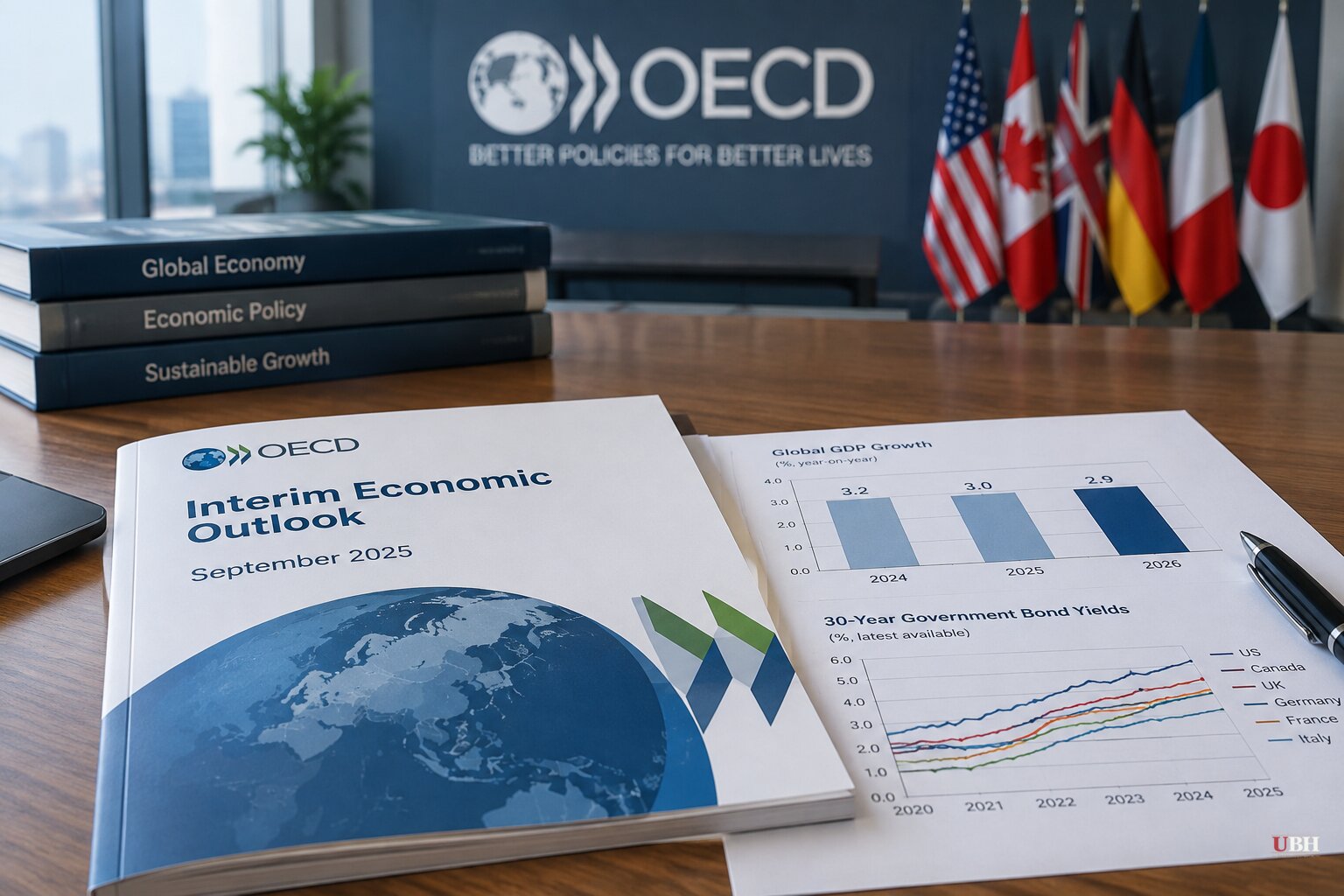
Since the 10-year Treasury yield crossed 5% this week as foreign buyers pulled back from recent bond auctions, the Organisation for Economic Co-operation and Development has weighed in with its own numbers on why global borrowing costs are climbing everywhere, not just in Washington.
In its Interim Economic Outlook released Wednesday, September 23, the OECD raised its 2026 global growth forecast to 2.9%, up 0.1 percentage points from June, according to Reuters coverage carried by Euronext. It trimmed the 2027 forecast to 3.0%, down from a prior 3.1%. OECD Secretary-General Mathias Cormann credited heavy AI infrastructure spending, from data centers to semiconductors, with propping up growth in the United States and lifting tech exports out of Japan and South Korea.
The rest of the report offers a stark warning.
Yields at Levels Not Seen in a Generation
Cormann said 30-year government bond yields are at their highest point in at least 15 years in six of the seven G7 economies, a detail reported by both Press Insider and the Guardian. U.S. 30-year Treasury yields have climbed above 5% this year, levels last seen roughly two decades ago, according to Press Insider. Germany's 30-year borrowing cost has hit its highest point since 2011. Long-dated Japanese government bonds have set records, as investors there demand more compensation for inflation and fiscal risk.
U.S. federal debt has now risen above $40 trillion, Press Insider reported, citing the OECD's own figures. Cormann's diagnosis: "Fiscal and financial risks have grown. That means higher debt-servicing costs for governments whose budgets are already under strain, and it means higher borrowing costs for businesses and households."
IMF Managing Director Kristalina Georgieva echoed that in comments to the BBC, carried by the Guardian, saying successive global shocks have been "pushing debt levels up like a staircase not to heaven," with governments taking "no action to contain that service cost." She said politicians need "courage" to act.
Growth Divergence: The U.S., China, Europe and Japan
The OECD's country breakdown, per Euronews, shows the U.S. growing 2.2% in 2026 and 2.1% in 2027, both upgrades from June, as AI-related capital spending offsets softer consumer spending. U.S. inflation is projected at 3.6% for 2026, easing to 2.6% in 2027, with tariffs and energy costs weighing on households.
China's growth is expected to slow to 4.5% this year and 4.2% next, unchanged from June, as Beijing's crackdown on industrial overcapacity bites. The eurozone is flat at 1.0% growth in both years, with natural gas prices climbing as European storage sits at 15-year lows heading into winter. Japan is forecast at 0.8% growth in 2026 and 0.7% in 2027, the only major economy where the OECD sees inflation accelerating further.
Across the G20, the OECD now expects inflation to average 4.1% in 2026, easing to 3.6% in 2027, a Reuters figure reported by Euronews that is itself an upgrade from the 3.1% the OECD projected in June for next year.
The Fight Over WHY Yields Are Rising
The Guardian and Press Insider frame the yield surge largely through the OECD and IMF's lens: heavy debt, wide deficits, and markets losing patience with government borrowing. Jeffrey Tucker, writing for the Epoch Times, takes that further, arguing interest outlays crossed $1 trillion in late 2023 and are now running at levels where, under "very modest assumptions," debt service could devour 100% of federal revenue by 2052.
Breitbart's Business Digest cites a different explanation from economists Paul Beaudry, Paolo Cavallino, and Tim Willems in a VoxEU column. Examining three-day trading windows around monthly payroll reports and Fed official speeches from August 2020 through early September 2026, they found those windows, just 23.9% of trading days, accounted for 90.5% of the entire rise in the 10-year Treasury yield and 81% of the increase in expected short-term rates over the next decade. Their read: bond traders are mostly repricing how long the Fed will hold rates high, not rendering an independent verdict on U.S. solvency.
Both explanations can be partly true at once, and the sources here don't resolve which one dominates. The mechanical result is clear: whichever the cause, the OECD says higher long-term yields are already raising mortgage costs, corporate borrowing costs, and the price of every dollar governments spend refinancing old debt.
Cormann's own recommendation, echoed in Deutsche Welle's coverage, is that governments need to "contain and reallocate government spending, improve public-sector efficiency and strengthen revenues." No G7 government has announced a specific plan to do that in response to this week's report. The OECD's baseline also assumes global growth risks stay contained. The organization itself warned that a combination of energy shocks, extreme weather from a strong El Niño, and disappointing AI investment returns could cut 2027 global growth by 0.7 percentage points and add 1.1 percentage points to inflation if those risks materialize together. Whether the AI capital spending boom that's currently propping up U.S. and Asian growth numbers actually pays off, or turns into the disappointment the OECD is bracing for, remains the open question hanging over every one of these forecasts.
Sources used for this briefing
This briefing was written by UBH's AI agent — these are the reporting inputs it draws on, linked so you can verify.


