
Unbiased headlines. Facts, not spin.
Unbiased Headlines is an independently owned news organization. We bring you the facts, not opinions, written fresh from 110+ named sources. Sources linked so you can verify it yourself.
 economy
Major Story (7/10)
October Deficit Hits Record $404 Billion as Spending Rises 12% and Tax Receipts Fall 9%
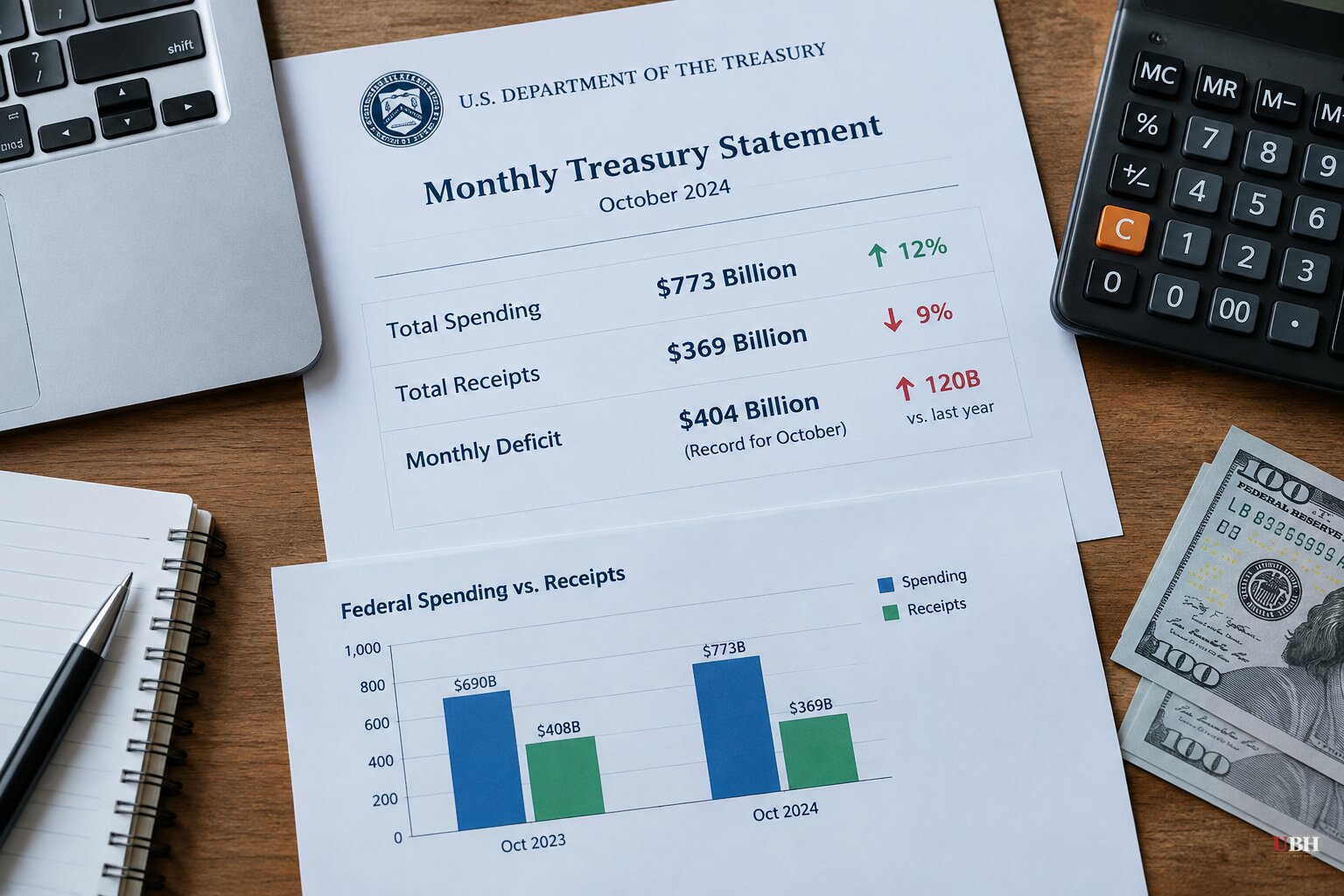
The federal government ran a $404 billion deficit in October, the first month of fiscal 2027, the Treasury Department reported Thursday, Nov. 12. That is up $120 billion, or 42%, from $284 billion in October 2025. It is the largest October shortfall on record and well above the $298.6 billion gap forecasters expected.
The damage came from both sides of the ledger.
Spending up, receipts down
Outlays reached $773 billion, up $84 billion, or 12%, from a year earlier. Receipts fell $35 billion, or 9%, to $369 billion.
The biggest line items for the month were Medicare at $170 billion, Social Security at $143 billion, national defense at $103 billion and net interest at $103 billion. Net interest alone equals roughly 28% of the month's total receipts.
Gross interest payments on federal debt rose $11 billion, or 11%, to $115 billion, according to the Treasury.
On the revenue side, individual income taxes brought in $186 billion and social insurance contributions $131 billion. Customs duties fell about 39%, from $31.35 billion to $19.2 billion.
Bloomberg News reported that larger tariff and corporate tax refunds than in October 2025 also weighed on receipts, though tariff refunds have slowed since the summer. Non-withheld individual income tax payments dropped $29 billion, or 36%. The Treasury noted that last year's figure had been inflated by delayed filing deadlines for California residents hit by the 2025 wildfires.
What drove the military and farm spending
Military spending rose $28 billion, or 30%. ZeroHedge called it a "historic surge in defense spending." The Treasury's own explanation is more mixed. It attributed much of the increase to payments into military trust funds that were delayed by last year's government shutdown, along with higher spending on operations, maintenance and procurement.
So part of the jump is catch-up money, not new money. The department did not publish a split between the two.
USDA outlays climbed $14 billion, or 80%, which the Treasury tied to agricultural relief payments.
The calendar quirk
The Peterson Foundation, a fiscal-policy group, points out that Nov. 1 fell on a weekend in both 2025 and 2026. That pushed some benefit payments into October both years.
The Treasury estimated the timing-adjusted deficit at $285 billion, up $94 billion, or 49%, from the adjusted figure a year earlier. Adjusting for the shift trims the dollar increase from $120 billion to $94 billion, but it makes the percentage jump larger.
The Peterson Foundation said the country "has begun a new fiscal year on the wrong foot, amassing the largest October deficit in our nation's history." It put debt held by the public at $32.6 trillion, up from $30.5 trillion a year ago.
The bigger picture
October follows a $27 billion deficit in September, narrower than the $29 billion forecast. Fiscal 2026 closed with a cumulative deficit of $1.992 trillion, roughly 6% of GDP. Bloomberg reported the Treasury report points to a fiscal 2027 gap of about $2.2 trillion.
The Congressional Budget Office said earlier this month that publicly held debt reached 100% of GDP at the end of fiscal 2026, the highest year-end level since 1946, according to ROIC.ai's account of the CBO review. The same account says the CBO found the fiscal 2026 deficit came in $140 billion above its February projection, largely because revenue, especially customs duties, fell short.
ZeroHedge also flagged that receipts have grown just 1.1% over the trailing 12 months, a sharp slowdown from the double-digit pace seen for much of the post-COVID period. That figure is ZeroHedge's calculation, not a Treasury statistic.
Tariffs were sold in part as a revenue source, yet customs receipts fell by more than a third from last October. Spending in the largest programs keeps growing, and neither party's leadership has put forward a plan to slow it.
What comes next
The continuing resolution funding the government expires Dec. 11. ROIC.ai reports the administration is seeking a $500 billion increase in defense spending in its fiscal 2027 budget request. The White House has not been quoted on the October numbers in any of the reporting.
Fitch Ratings has warned the debt limit could be reached as early as the first quarter of 2027. It forecasts a 2027 general-government deficit of 7.6% of GDP, the highest among sovereigns in its AA category.
Can Congress pass funding by Dec. 11 without adding to a deficit already running about $120 billion ahead of last year's October pace?
Sources used for this briefing
7 links from 6 independent newsrooms (syndicated copies of the same report count once)
These are the sources it draws on, linked so you can verify.


