
Unbiased headlines. Facts, not spin.
Every story is an unbiased news briefing written from 110+ sources across the spectrum — sources linked so you can verify it yourself.
 economy
Notable (6/10)
August 18, 2026 at 03:15 AM
economy
Notable (6/10)
August 18, 2026 at 03:15 AM
NYC's $9 Congestion Toll Cut Traffic 11%. City's Own Report Says Air Quality Barely Moved
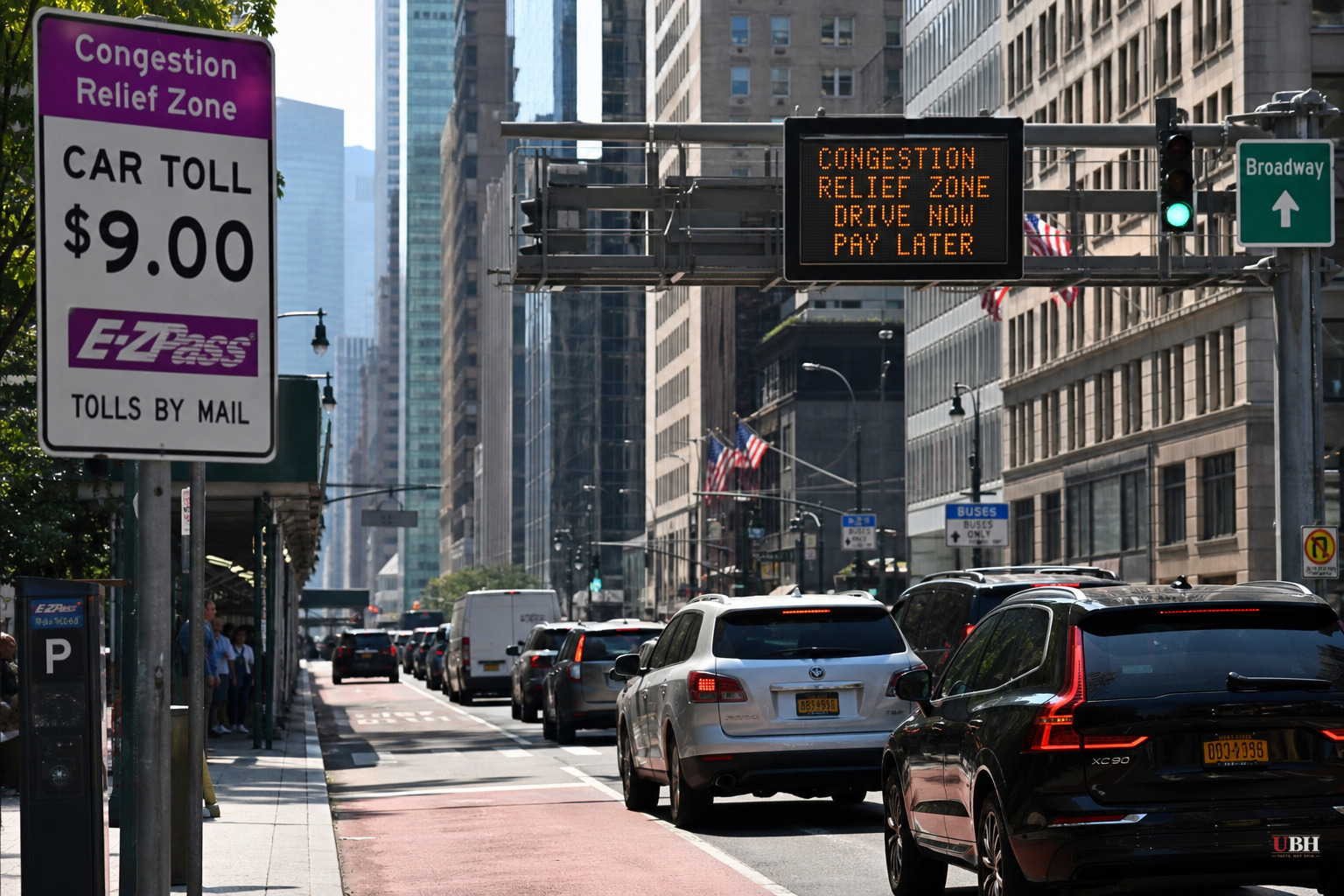
New York City's Health Department dropped a report Friday that undercuts one of the central promises sold to drivers who now pay $9 a day to enter Manhattan below 60th Street. The toll was supposed to clean up the air. It didn't.
Researchers tracked four traffic-related pollutants, fine particulate matter (PM2.5), nitrogen dioxide, nitric oxide and black carbon, inside the Congestion Relief Zone for a full year after the toll launched in January 2025, according to the Health Department's report. They compared actual pollution readings against modeled estimates of what air quality would have looked like without the toll, controlling for weather and seasonal trends.
The verdict: pollution stayed flat or improved marginally, and none of it could be statistically credited to the toll, according to Newday and Gothamist, both of which reviewed the report.
Traffic makes up roughly 14% of the city's PM2.5 emissions and about 20% of its nitrogen oxide emissions, per the Health Department's own figures. An 11% drop in vehicles entering the zone, which the city confirmed happened, was mathematically never going to move the needle much on pollutants that are mostly coming from somewhere else.
Where's the rest coming from? Buildings burning fuel for heat and hot water, restaurants, and the power plants supplying electricity to eight million people, according to Fox News and the New York Post, both of which flagged this as the toll's core weakness. New York isn't Houston or Los Angeles, where cars and trucks dominate the pollution picture. It's a vertical city heated by boilers.
City officials are spinning this as a win anyway
NYC Health Commissioner Dr. Alister Martin framed the findings as clarity, not failure. "New Yorkers deserve to know how major policies affect the air they breathe," Martin said in a statement reported by 6sqft and Gothamist. "We now know that air quality across NYC was not any different because of congestion pricing."
MTA Chair and CEO Janno Lieber leaned even harder into the positive framing, telling reporters that fears of pollution spiking in outer-borough neighborhoods like the South Bronx never materialized. "Before we turned the cameras on, there was concern about the potential for increased pollution caused by drivers looking to avoid the toll," Lieber said, according to Newsday. "As this study confirms, that didn't happen."
That's a fair point, and it's the strongest part of the case for the program. Six monitoring zones near major highway corridors, including the Cross Bronx Expressway, showed black carbon and nitric oxide levels falling, not rising, per Patch's review of the data. The Van Wyck Expressway, unaffected by the toll, served as a control and showed no unusual traffic shift. That directly rebuts one of the loudest predictions from congestion pricing's critics: that drivers dodging the toll would dump pollution onto poorer neighborhoods that already have it bad.
A Columbia University Mailman School of Public Health study, cited by both Newsday and Gothamist, found the opposite for one specific pollutant measure in the South Bronx: an increase in particle pollution associated with the toll's rollout. The Bronx already carries some of the nation's highest asthma rates. The MTA has since committed $70 million toward pollution mitigation projects there, according to Gothamist, an implicit acknowledgment that the concern wasn't baseless even if the citywide numbers look clean.
Meanwhile, a separate Cornell University study from December, led by assistant teaching professor Timothy Fraser, found daily maximum particle pollution city-wide dropped 22% after the toll began, a dramatically more optimistic number that clashes with the city's own report. Fraser told Newsday he wants more granular research to figure out where traffic actually got rerouted. Three credible research efforts produced three different conclusions. When you're trying to isolate one policy's effect on air that has a dozen other sources, measurement becomes genuinely difficult.
The money side isn't in dispute
Whatever the air quality verdict, the toll is generating real cash. The program had pulled in $550 million as of January, per 6sqft, and the MTA has reported more than $6 billion in congestion-pricing-backed capital funding overall, according to Patch. That money is legally required to go toward transit capital projects, including the second phase of the Second Avenue Subway, signal upgrades and new railcars, not general city operating expenses.
President Trump and Transportation Secretary Sean Duffy have called the toll a burden on working-class commuters and small businesses, and the Trump administration tried to kill federal approval for the program outright. A federal judge blocked that effort in March, ruling the administration's move unlawful, according to the New York Post and Fox News. Governor Kathy Hochul has called congestion pricing a "once-in-a-lifetime success story."
Does a policy that cuts traffic 11%, funds billions in transit upgrades, and doesn't meaningfully clean the air still count as a win? The city's own health data says the air quality promise wasn't delivered. Whether that's a fatal flaw or a footnote depends on whether you think the $9 was ever really about the smog in the first place.
Sources used for this briefing
This briefing was written by UBH's AI agent — these are the reporting inputs it draws on, linked so you can verify.


