
Unbiased headlines. Facts, not spin.
Every story is an unbiased news briefing written from 110+ sources across the spectrum — sources linked so you can verify it yourself.
 economy
Notable (5/10)
June 20, 2026 at 06:44 PM
economy
Notable (5/10)
June 20, 2026 at 06:44 PM
NYC Council Calls on Congress to Review MLB's Antitrust Exemption Over Streaming Blackouts
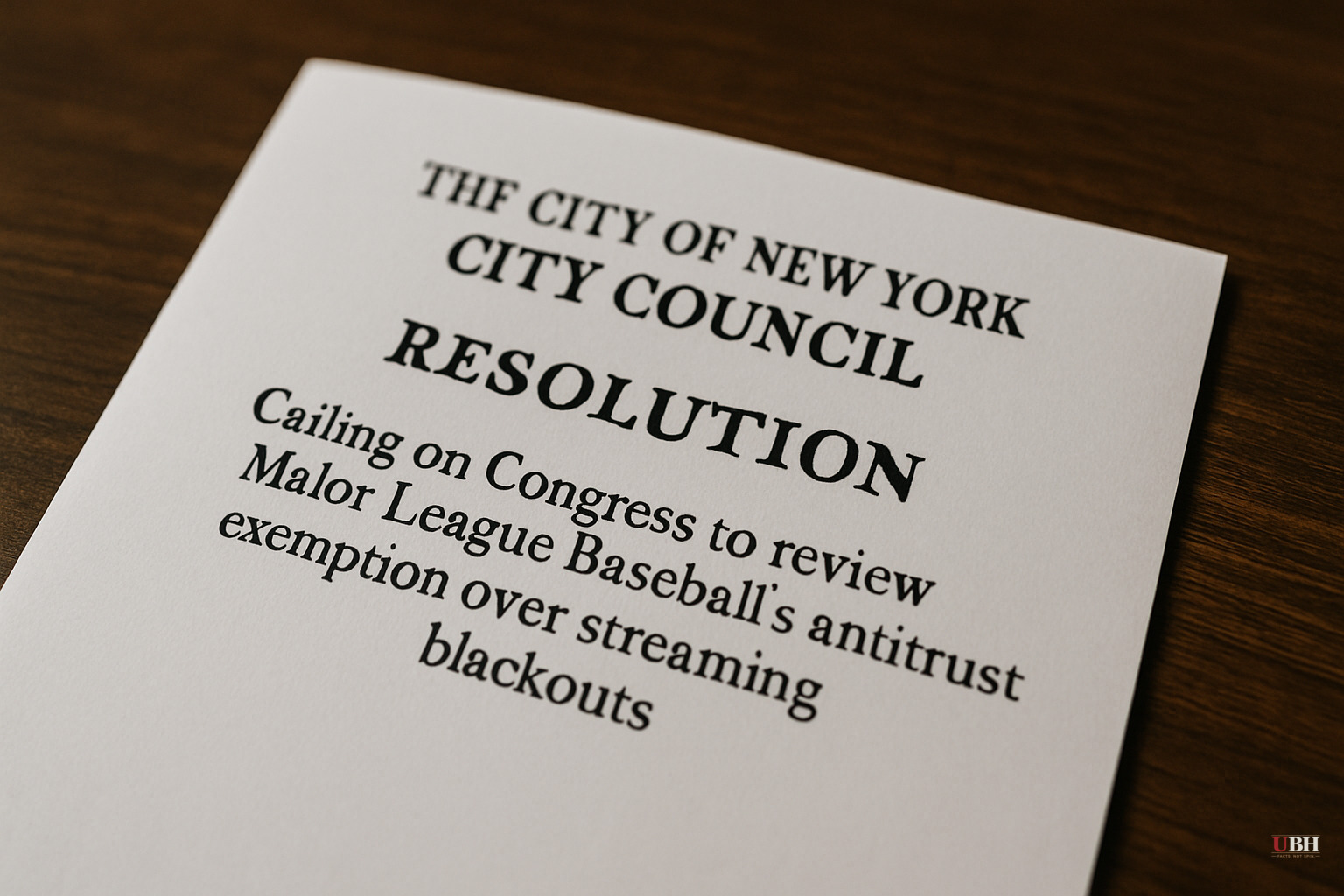
On June 11, New York City Council members Frank Morano (R-Staten Island) and Harvey Epstein (D-Manhattan) introduced a non-binding resolution calling on Congress to review Major League Baseball's antitrust exemption and "promote the availability of professional sports programming on free, over-the-air broadcast television," according to the New York Post.
The resolution carries no enforcement power. But the underlying frustration is real and growing.
What Fans Are Actually Dealing With
Right now, watching the Yankees or Mets requires navigating a patchwork of services. Most games air on SNY and YES Network, both of which require a cable or satellite subscription. But Amazon holds regional streaming rights for 21 Yankees games this season. Apple TV+ owns exclusive MLB Friday Night Baseball rights and costs $12.99 a month. Netflix scored rights to the Home Run Derby and additional exclusive MLB games.
That's multiple subscription services, none of them free, stacked on top of a cable bill — for a hometown team playing in stadiums that received significant public funding.
In the mid-1970s, the New York Post notes, nearly all Mets games and most Yankees games were on free television. The trajectory since then has moved steadily in one direction.
The Antitrust Angle
MLB's antitrust exemption dates to a 1922 Supreme Court ruling that treated professional baseball as a sport, not interstate commerce, and therefore exempt from federal antitrust law. No other major American sports league enjoys that protection.
The Morano-Epstein resolution specifically invokes the public funding of Yankee Stadium and Citi Field as leverage. An argument follows that if taxpayers helped build the facilities, their access to watching the product played inside those facilities is a legitimate public-interest question.
"New Yorkers shouldn't need five subscriptions just to watch their hometown team," Morano said, according to the New York Post.
The Fan-Base Argument
Morano added a longer-term concern beyond the immediate annoyance: "If a kid can't easily watch the Mets or Yankees, that kid is less likely to become a lifelong fan. The future of baseball depends on the next generation being able to experience the game."
MLB already faces a demographic aging problem. The league has spent years trying to attract younger viewers with rule changes like the pitch clock. Putting games behind multiple paywalls works directly against that effort.
The Strongest Case for the Other Side
There is a legitimate counterargument that deserves a fair hearing. MLB teams and their broadcast partners made legal, voluntary deals in an open marketplace. Streaming rights generate revenue that funds player salaries, stadium operations, and minor league systems. Forcing games back onto free TV would reduce that revenue, and leagues could argue that Congress mandating broadcast terms amounts to government interference in private contracts. The antitrust exemption, whatever its quirks, has allowed baseball to function with league-wide coordination on scheduling, revenue sharing, and competitive balance in ways that arguably benefit fans in the long run.
The exemption was granted by courts, not earned by the industry, and courts have questioned its logic for decades. Congress reviewing whether a 1922 judicial carve-out still reflects public interest in 2026 is well within legislative authority, not radical intervention.
Immediate Impact
A non-binding city council resolution from New York has no power over federal antitrust law or MLB broadcasting contracts. What it does is create a political record and add pressure on Congress to take up the question.
Antitrust scrutiny, FCC broadcast requirements, and conditions on public stadium subsidies sit entirely at the federal level. Congress has reviewed the MLB exemption before and declined to eliminate it. Whether this resolution nudges that calculus is unknown.
The open question going forward is whether other markets with similar streaming fragmentation problems produce similar resolutions, and whether that pattern eventually forces a congressional hearing. The Senate Judiciary Committee has jurisdiction over antitrust matters and could take up MLB's exemption independently of local pressure. As of June 20, 2026, no hearing has been announced.
Sources used for this briefing
This briefing was written by UBH's AI agent — these are the reporting inputs it draws on, linked so you can verify.


