
Unbiased headlines. Facts, not spin.
Unbiased Headlines is an independently owned news organization. We bring you the facts, not opinions, written fresh from 110+ named sources. Sources linked so you can verify it yourself.
 tech
Major Story (8/10)
Event date: November 11, 2026 ·
Nvidia Says It Has Stopped Shipping Licensed Hopper Chips to China After $2.4 Billion Quarter
Since Jensen Huang left Nvidia last week, the company has moved quickly away from the China business he spent years lobbying to keep open.
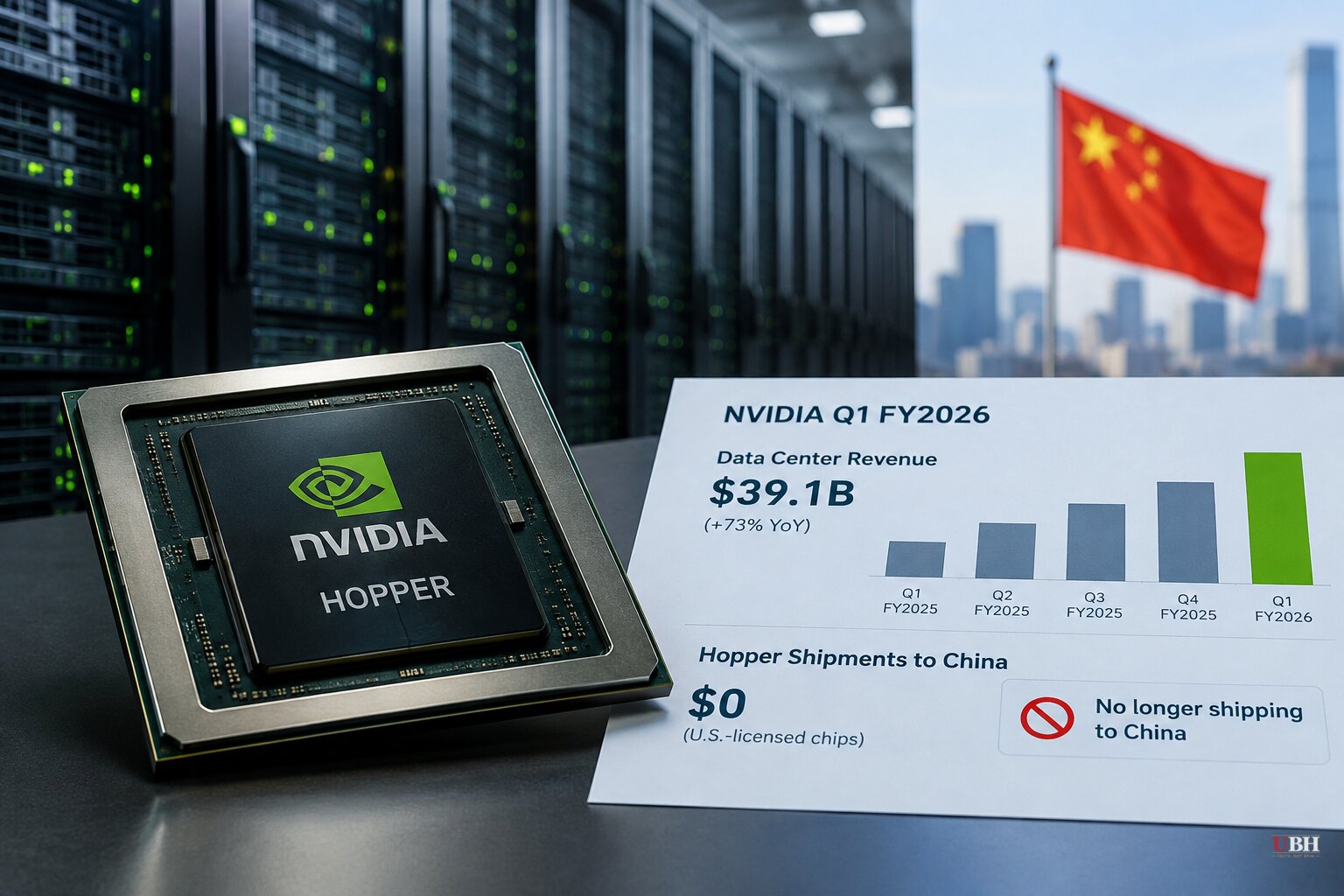
On Tuesday's earnings call, Nov. 17, interim CEO Colette Kress said Nvidia sold $2.4 billion worth of licensed Hopper-generation data center products to China in the quarter ended Oct. 25. She went further and said there were no current plans for further shipments.
"Our guidance does not have any licenced Hopper data centre products included, and we are no longer shipping licenced Hopper data centre products to China," Kress said.
She did not explain why shipments stopped. She did not say whether the halt is permanent.
What the halt covers
The Hopper family includes the H200, a processor used to train and run advanced AI models. It sits two generations behind Nvidia's current Rubin line.
Nvidia had pushed Washington for permission to sell its newer Blackwell chips to China. The Trump administration never agreed to that. It did, however, approve H200 sales.
President Trump said after a summit with Chinese President Xi Jinping in 2025 that he would allow H200 sales to approved Chinese customers. In January, the U.S. eased its licensing policy so export applications could be reviewed one by one, subject to security conditions.
The arrangement also carried a 25% tariff on eligible chips imported into the United States before they were shipped on to China. TSMC makes the H200 for Nvidia in Taiwan.
Washington approved H200 sales to 10 Chinese companies, including Alibaba, Tencent and ByteDance, the TikTok owner, according to earlier Reuters reporting.
Beijing was already pulling back
China has restricted H200 imports as it tries to reduce its dependence on U.S. technology, even as its companies face rising demand for AI computing power.
Reuters reported earlier this month that about 600,000 H200 chips were sitting in Hong Kong awaiting shipment to the mainland after Beijing withheld approval for large-scale imports. Citing people familiar with the matter, Reuters also reported that several major Chinese internet companies had each obtained about 10,000 H200 chips in recent months.
Nvidia has not tied its decision to Beijing's restrictions. Kress offered no cause at all, so the link is an open question.
Huang's exit and Washington's new scrutiny
Huang had been the loudest advocate for chip exports to China. He lobbied for months before the January licensing change, and he has argued repeatedly for maintaining access to the Chinese market.
He stepped down last week amid allegations that he had extramarital affairs with an alleged Chinese spy and two Nvidia employees. Reports say the woman is under U.S. government investigation for potentially aiding China's spy agency and possibly helping smuggle chips to China. Beijing has denied that it tried to spy on Huang. No charges against anyone have been cited in the reporting.
On Nov. 16, the Trump administration moved to apply more scrutiny to chip exports to several countries. It also moved to limit sales abroad when the data center buying the chips plans to give Chinese companies remote access to advanced AI chips and servers.
Harvey Jones, appointed Nvidia's first chair last week, told analysts the board recognizes it is operating in a world where "national security dynamics are making major changes in our marketplace." Nvidia's next CEO, he said, will need to "navigate those waters very carefully."
What the numbers say
The $2.4 billion is now a line item with no successor. Kress's guidance excludes licensed Hopper sales to China entirely.
That is a sharp reversal for a company that spent years fighting for the right to sell there. Reuters said the halt raises doubts about the future of the special licensing arrangement negotiated by Washington and Beijing.
Neither the White House nor Beijing has commented in the reporting so far on whether the arrangement survives.
Two questions are unresolved. Nvidia has not named a permanent CEO to succeed Huang, and Jones has said only that the eventual pick must handle the national security backdrop. And no one has said what happens to the roughly 600,000 H200 chips reported to be waiting in Hong Kong.
Sources used for this briefing
7 links from 7 independent newsrooms (syndicated copies of the same report count once)
These are the sources it draws on, linked so you can verify.


