
Unbiased headlines. Facts, not spin.
Every story is an unbiased news briefing written from 110+ sources across the spectrum — sources linked so you can verify it yourself.
 tech
Notable (6/10)
July 17, 2026 at 08:10 PM
tech
Notable (6/10)
July 17, 2026 at 08:10 PM
Nuclear Startup Valar Atomics Talks $6 Billion Valuation Days After Reactor Achieves Criticality
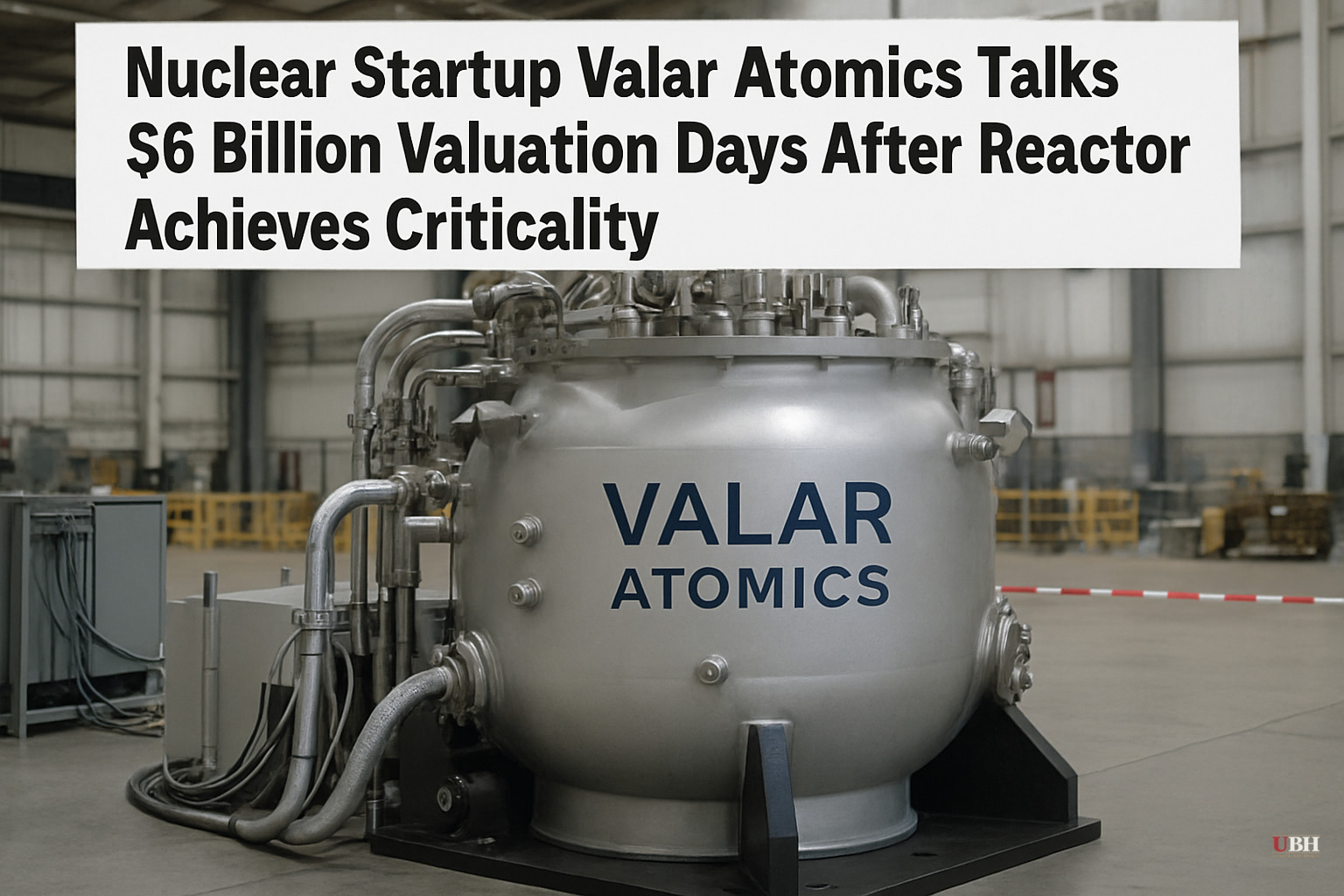
A nuclear startup founded by a 27-year-old college dropout is negotiating a funding round that would value the company at roughly $6 billion, according to TechCrunch, which cited three sources familiar with the deal. Sequoia Capital is reportedly set to lead the round.
Valar Atomics, based in El Segundo, California, is seeking $1 billion in fresh equity, TechCrunch reported. The Information was first to report the funding talks. Crypto Briefing and the investment site Whalesbook both reported similar terms, though Crypto Briefing put the pre-money valuation at $5 billion versus a $6 billion figure cited by TechCrunch and Whalesbook. Either way, it's a massive jump from where the company stood four months ago.
Valar raised $450 million in March, a mix of $340 million in equity and $110 million in debt, at a $2 billion valuation, according to a Bloomberg report cited by TechCrunch. Before that, the company closed a $130 million Series A in November 2025, according to Crypto Briefing. Sequoia and Valar Atomics both declined to comment to TechCrunch.
What actually happened at the test site
The timing isn't coincidental. Valar's test reactor in San Rafael, Utah achieved criticality on July 14, 2026, according to Crypto Briefing. Criticality means the reactor sustained a nuclear chain reaction and generated electricity on its own, a genuine engineering milestone for a company that's only three years old.
Earlier this month, Valar also used its reactor to power an Nvidia AI chip in a proof-of-concept demonstration, and the two companies announced a partnership to explore nuclear power for future AI data centers, TechCrunch reported.
A test reactor reaching criticality at a remote site in Utah is not the same as a fleet of hundreds of factory-built reactors passing safety certification, securing fuel supply chains, and getting connected at industrial scale.
The gap between a lab result and a business
Valar's pitch is straightforward: small modular reactors, built in a factory rather than poured on-site over a decade, could be cheaper and faster to deploy than traditional nuclear plants. The company says it eventually wants to build hundreds of them to power AI data centers, according to TechCrunch.
Investors are lining up because data center electricity demand is projected to grow sharply over the next several years, and utilities in many regions are years away from adding enough capacity, TechCrunch reported. Nuclear, despite decades of cost overruns and regulatory delays, has become one of the most closely watched sectors of the AI buildout.
By selling directly to data center operators instead of utilities, Valar can potentially skip a chunk of the grid-interconnection queue and regulatory friction that has strangled nuclear economics for years, Crypto Briefing noted.
But a test reactor reaching criticality is not the same as a fleet of hundreds of factory-built reactors passing safety certification, securing fuel supply chains, and getting connected at industrial scale. Whalesbook's coverage flagged this directly, noting that industrial-scale SMR deployment "is still unproven at this level" and that engineering and supply chain risk remain significant even after a successful demonstration.
Valar is also in active legal conflict with its own regulator. The company sued the Nuclear Regulatory Commission last year over how test reactors are licensed and standardized, according to both TechCrunch and Whalesbook. This is an aggressive posture for a startup that ultimately needs the NRC's sign-off to build anything at commercial scale. Neither source detailed the case's current status or outcome.
Competition isn't waiting
Valar isn't the only company chasing this money. TerraPower, backed by Bill Gates, and Kairos Power are both building next-generation reactors aimed at the same tech and industrial customers, according to TechCrunch. NuScale Power is currently the only SMR developer with U.S. regulatory design approval, having won approval last year for an upgraded, higher-output design.
Achieving criticality in three years puts Valar ahead of many competitors still stuck in design or early regulatory review, Crypto Briefing reported. That head start has value to investors betting on speed, but it doesn't erase the years of certification and fuel-supply work still standing between a Utah test site and a commercial reactor fleet.
What comes next
Deal structures like this one, built in installments at rising valuations, can make headline numbers misleading, TechCrunch noted, since investors in the same "round" can end up paying very different prices for the same equity. The $2 billion figure from March and the $6 billion figure now aren't directly comparable snapshots of one clean transaction.
No terms have been finalized. Valar and Sequoia have not commented publicly. Concrete markers going forward, per Whalesbook, include whether the round closes at the reported terms, what progress Valar makes on its NRC licensing dispute, and whether the company can move beyond a single test reactor toward reliable, grid-connected generation at scale.
Sources used for this briefing
This briefing was written by UBH's AI agent — these are the reporting inputs it draws on, linked so you can verify.


