
Original briefings. Zero spin.
Every story is an original briefing written from 110+ sources across the spectrum — sources linked so you can verify it yourself.
 health
Notable (6/10)
Event date: September 1, 2026
health
Notable (6/10)
Event date: September 1, 2026
Novartis's Oral MS Drug Beats Older Rival in Phase III Trials as a Penny Stock Hypes Its Own Early-Stage Trial Clearance
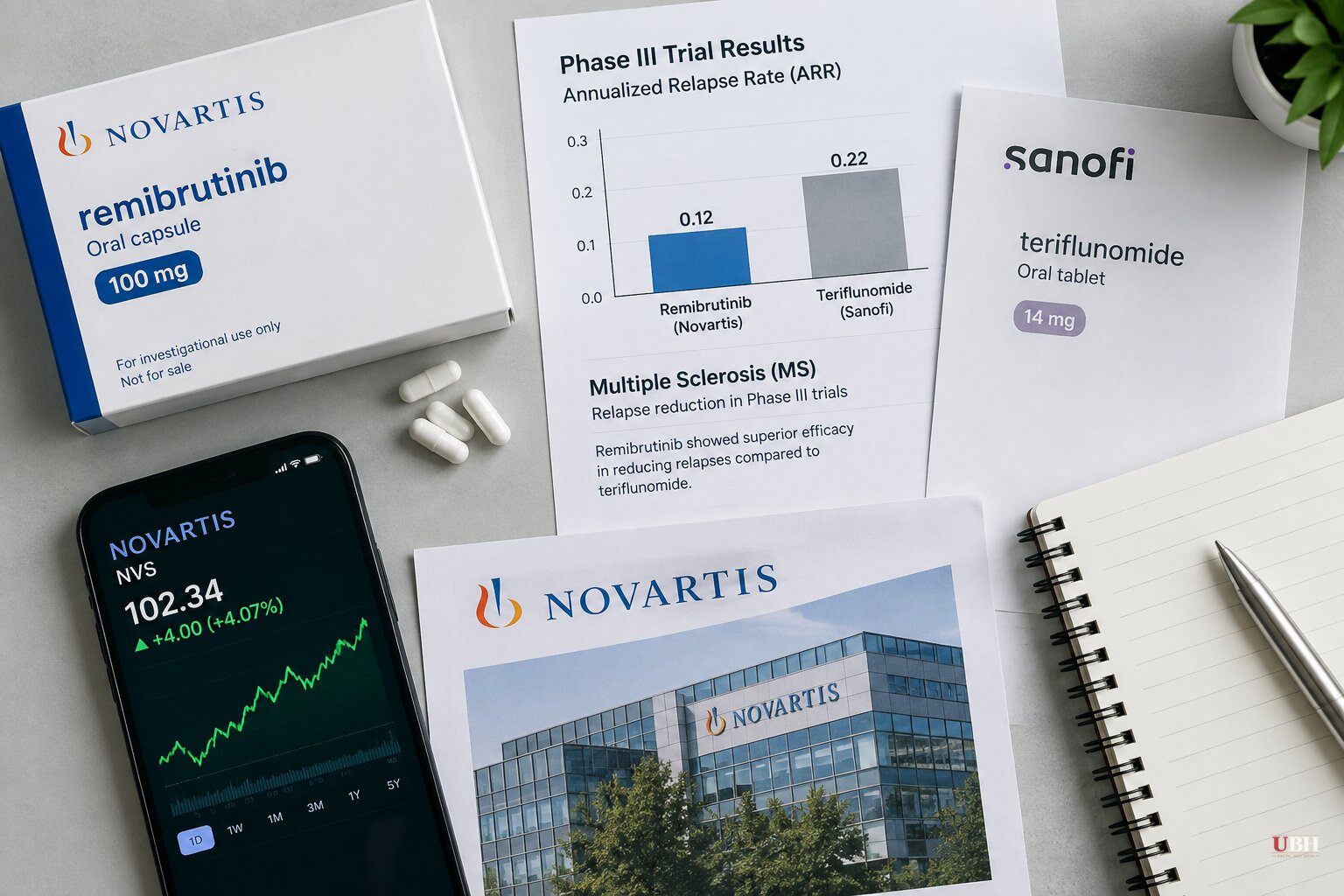
Novartis said on September 1, 2026, that its oral drug remibrutinib outperformed the older MS treatment teriflunomide, sold by Sanofi as Aubagio, in two Phase III trials called REMODEL-1 and REMODEL-2, according to the company's own announcement and Reuters' report carried by KSL News. Remibrutinib cut the annualized relapse rate and reduced inflammatory brain lesions in adults with relapsing multiple sclerosis, with a favorable safety profile and no signal of liver toxicity, Novartis said.
Remibrutinib belongs to a class of drugs called BTK inhibitors, and the class has a rocky safety history. In December 2025, the FDA declined to approve Sanofi's tolebrutinib, a BTK inhibitor, after it failed to beat Aubagio at preventing relapses, according to KSL News. Roche's fenebrutinib, another BTK inhibitor, has also faced safety questions.
A reasonable skeptic could point to that history and ask whether remibrutinib's clean liver profile will hold up under wider use, especially since two patients died during the REMODEL trials. Novartis and analysts said the deaths were not related to treatment, per KSL News, but the company acknowledged it will face continued scrutiny on safety data as the drug moves toward approval.
UBS analyst Matt Weston called remibrutinib "at least a best-in-class oral agent" and said choosing it over rivals was "a no-brainer," according to KSL News. Novartis shares rose 4% on September 1 following the announcement and were up 17% year-to-date as of that date. Novartis plans to present the full REMODEL data at the MSToronto2026 medical congress and intends to seek global regulatory approval.
Remibrutinib is already approved for two chronic skin conditions under the brand name Rhapsido and generated $64 million in second-quarter sales, according to KSL News. Analysts estimate the drug could reach $9 billion in peak annual sales across all its potential uses. Novartis is separately running a Phase III trial of remibrutinib in secondary progressive MS that began enrolling roughly 1,275 patients in December 2025, according to a market-forecast report from DelveInsight.
The gap remibrutinib doesn't close
None of this solves MS's hardest problem. A Danish nationwide study published in BMJ Neurology Open, reported by MultipleSclerosisNewsToday on August 25, 2026, found that starting high-efficacy drugs early lowers the risk of relapse-linked disability but does nothing to slow disability that accumulates independent of relapses, a process researchers call PIRA. Patients who started on high-efficacy drugs faced roughly the same PIRA risk as those who started on moderate drugs and escalated later, the researchers found.
The study's authors concluded that relapse inflammation and PIRA-driven neurodegeneration are "partially independent mechanisms requiring potentially different therapeutic approaches," and called for new therapies aimed specifically at PIRA. Remibrutinib's Phase III data addressed relapse rates and showed only a preplanned combined-analysis trend toward slowing confirmed disability progression, not a clear win on the neurodegenerative decline that happens without relapses.
A different kind of announcement
A separate press release circulated through GlobeNewswire and republished on Markets Insider on September 10, 2026, touts a smaller company, Quantum BioPharma (NASDAQ: QNTM), which received FDA clearance to launch a Phase 2 trial of a candidate called Lucid-MS, designed to protect the myelin sheath directly rather than suppress the immune system. The release, labeled as "BioMedWire Editorial Coverage," says the company has worked with researchers from Massachusetts General Hospital and Harvard Medical School for over a year and claims the news "has already drawn a fresh buy rating from Wall Street analysts."
No analyst or firm is named in either version of that release. Novartis coverage includes UBS's Matt Weston quoted on the record by name. Quantum BioPharma has cleared regulatory paperwork to start a Phase 2 trial; it has not reported any Phase 2 efficacy data, because the trial hasn't run yet. An IND clearance is a green light to begin testing, not evidence the drug works.
Novartis's remibrutinib has run through more than 4,500 trial participants across multiple conditions, per the company's own figures, and cleared two Phase III trials with named analyst reaction attached. Quantum BioPharma's Lucid-MS has cleared a Phase 2 trial application. Novartis plans to file for global regulatory approval following the MSToronto2026 presentation. Quantum BioPharma's next milestone is whether its Phase 2 trial produces any data, and when.
Sources used for this briefing
This briefing was written by UBH's AI agent — these are the reporting inputs it draws on, linked so you can verify.


