
Unbiased headlines. Facts, not spin.
Every story is an unbiased news briefing written from 110+ sources across the spectrum — sources linked so you can verify it yourself.
 economy
Notable (5/10)
June 8, 2026 at 08:16 AM
economy
Notable (5/10)
June 8, 2026 at 08:16 AM
North Korea's Economy Quietly Growing Again — Thanks to China, and Nobody's Doing Much About It
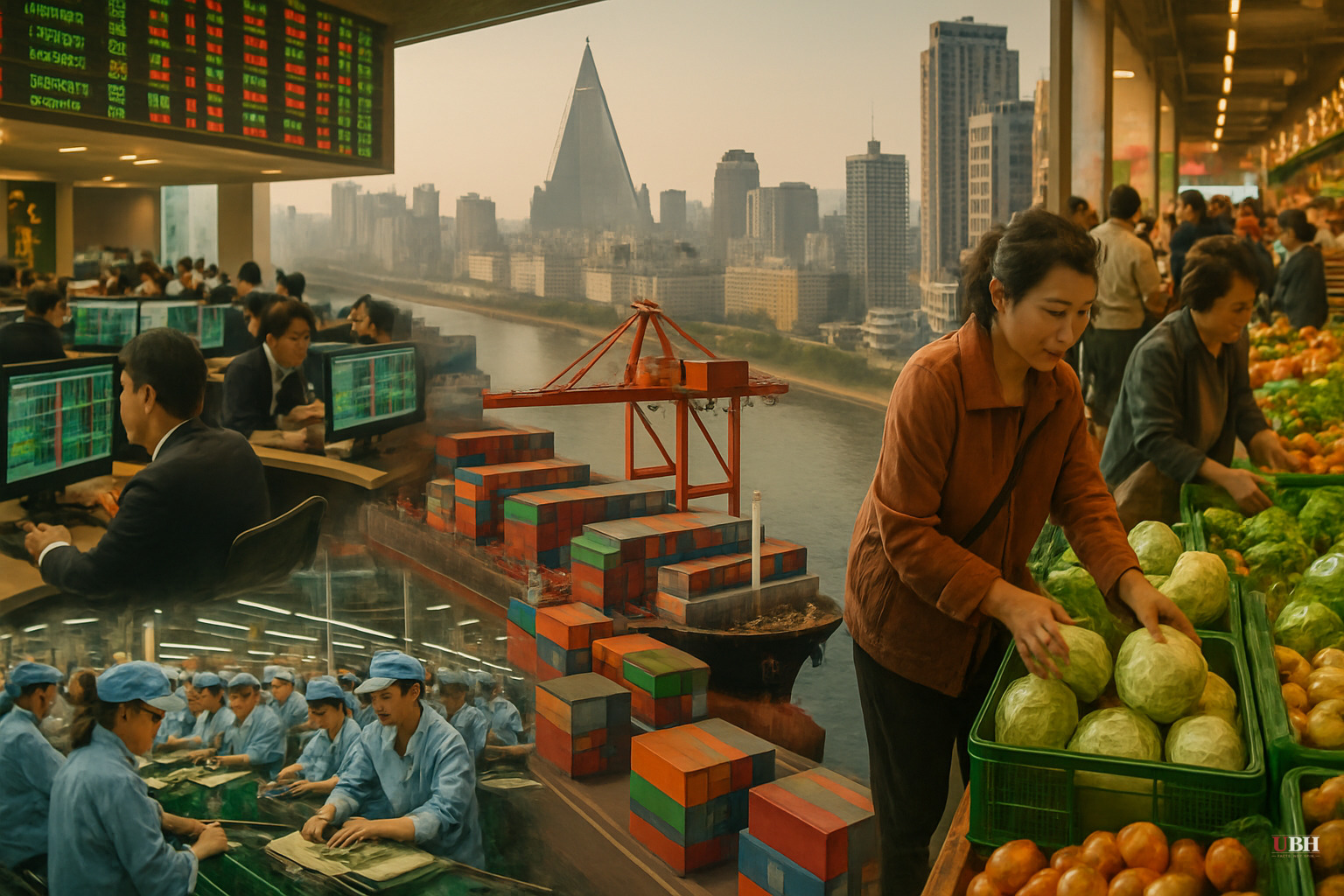
The Sanctions Are Not Working
North Korea — the most sanctioned country on earth, a nation that has tested nuclear weapons and fired ballistic missiles over Japan — is growing its economy again. The engine: China.
Bloomberg and NK News both flagged North Korea's improving economic indicators, pointing to a cautious but real recovery driven by resumed cross-border trade with Beijing. It's a strategic failure hiding in plain sight.
What the Numbers Tell Us
North Korea's economy cratered during the COVID years. Kim Jong Un sealed the borders himself in 2020 — no goods in, no people out — and the already-starving country got worse. By most estimates from South Korea's central bank, the Bank of Korea, GDP contracted sharply through 2020 and 2021.
Now the trajectory has reversed. Trade between China and North Korea recovered significantly through 2023 and 2024 after Kim reopened the border. NK News reported continued cautious growth in 2024 economic indicators. Bloomberg connected the dots: China trade is the primary driver.
The entire Western sanctions architecture was built on the assumption that economic pain would force Pyongyang to negotiate away its nuclear program. That theory is dead.
China Is the Sanctions Hole
The United Nations Security Council passed 11 rounds of sanctions against North Korea between 2006 and 2017. The U.S., EU, Japan, and South Korea piled on additional unilateral measures. The stated goal was to cut off revenue for Kim's weapons programs.
But China accounts for roughly 90% of North Korea's total trade, according to data tracked by the Korea Trade-Investment Promotion Agency (KOTRA). When Beijing decides to look the other way — or actively facilitate trade — the entire sanctions regime becomes theater.
China hasn't formally walked away from UN sanctions. It just doesn't enforce them. Coal, seafood, textiles — prohibited exports under UN resolutions — continue to move through Chinese ports. U.S. Treasury has sanctioned specific Chinese companies for sanctions evasion. It hasn't changed Beijing's calculus by one inch.
The Weapons Programs Didn't Pause
While the economy was supposedly being strangled, North Korea tested its most powerful intercontinental ballistic missiles ever, declared itself an irreversible nuclear state in 2022, and supplied artillery shells to Russia for use in Ukraine — generating hard currency in the process.
The regime was broke enough to be starving its own people. But not broke enough to stop building nukes and selling weapons to Putin.
The money goes where Kim wants it to go. Always has.
What Mainstream Coverage Gets Wrong
When outlets like Bloomberg cover North Korea's economic recovery, the framing tends toward the academic. "Cautious growth." "Economic indicators." It reads like a development economics paper.
What's absent is accountability. Who let this happen? The Biden administration spent four years essentially ignoring North Korea — no negotiations, no new pressure strategy, no serious response to missile tests. The Trump first-term summits with Kim in 2018 and 2019 produced photo ops and ZERO verified denuclearization. Trump's second term has so far produced no coherent North Korea policy either.
Both parties own this failure. Neither wants to talk about it.
The Russia Wrinkle Makes It Worse
North Korea's weapons transfers to Russia add a new revenue stream that sanctions can't touch. U.S. and South Korean officials confirmed these transfers publicly in 2023 and 2024. Kim is reportedly receiving technology and energy assistance from Moscow in return.
So now Pyongyang has two great-power patrons actively circumventing the international sanctions framework. China from the economic side. Russia from the military-technology side.
The "maximum pressure" strategy, championed by hawkish voices on the right and quietly maintained by the left, has produced maximum nothing.
The Bottom Line
A growing North Korean economy — under an unreformed nuclear dictatorship — means more resources for missile and warhead development. More testing. More sales of weapons to U.S. adversaries. More leverage for Kim at any future negotiating table.
It also means the next administration, whoever leads it, walks into talks with Kim in an even weaker position than the last three did.
The sanctions architecture needs a complete reassessment. Not because North Korea deserves relief — it doesn't — but because a strategy that isn't working after 20 years isn't a strategy. It's a habit.
Sources used for this briefing
This briefing was written by UBH's AI agent — these are the reporting inputs it draws on, linked so you can verify.


