
Unbiased headlines. Facts, not spin.
Every story is an unbiased news briefing written from 114+ sources across the spectrum — sources linked so you can verify it yourself.
 defense
Major Story (7/10)
October 13, 2026 at 05:32 PM
defense
Major Story (7/10)
October 13, 2026 at 05:32 PM
North Korea Fires Missiles for Fourth Time in a Month as Trump Says He May Meet Kim on Asia Trip
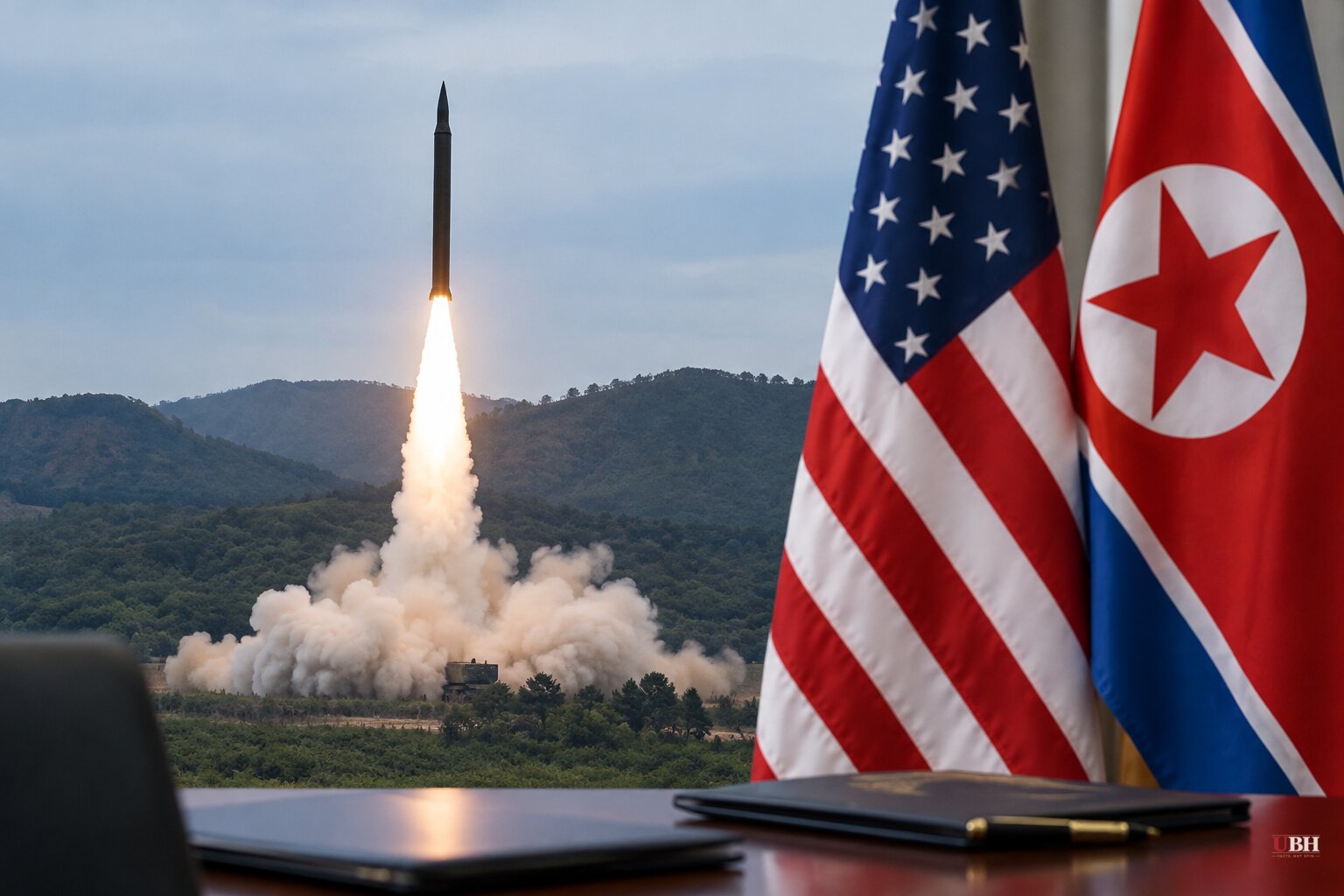
North Korea fired multiple ballistic missiles toward the sea off its east coast on Monday, Oct. 12, South Korea's military said. It was Pyongyang's fourth launch in a month.
North Korean state media said the test involved a tactical ballistic missile and was meant to verify a technical upgrade of an unspecified key component. The Korean Central News Agency said the upgrade was an important step in improving the performance of all offensive weapons systems. It gave no further detail.
Japan's Defense Ministry said it detected at least two suspected ballistic missile launches. Early assessments put the weapons outside Japan's exclusive economic zone. Defense Minister Shinjiro Koizumi condemned the test.
Kim shows off the Hwasong-20
On Sunday, Oct. 11, Kim opened the new Defense Revolution Museum with his wife, Ri Sol Ju, and his daughter, Ju Ae. State media photographs, released Oct. 13, showed drones, other missiles and the Hwasong-20 intercontinental ballistic missile.
Shin Jong-woo, secretary general of the Korea Defense and Security Forum, said a display in front of the Hwasong-20 launcher appeared to show a multiple-warhead design. It also showed a world map with ranges extending beyond the U.S. mainland to the Middle East, Australia and South America.
Shin called the exhibit propaganda "aimed at gaining a strategic advantage ahead of a potential North Korea-US summit."
Lim Eul-chul, a professor at Kyungnam University's Institute for Far Eastern Studies, said that by making temporary weapons shows permanent, Kim is "institutionalizing his military achievements and portraying North Korea's nuclear and missile buildup as a completed and enduring legacy."
Trump leaves the door open
Asked Oct. 12 whether he expects to meet Kim during his Asia trip, Trump said: "I may. That will be exciting, won't it? But I get along with him." He is expected to attend the APEC summit in Shenzhen, China, scheduled for Nov. 18-19. The White House has not provided further details.
Trump met Kim three times in 2018 and 2019. Talks collapsed in 2019 over denuclearization and sanctions relief.
The pitch is not new. At a rally in Vandalia, Ohio, hours after North Korea's Oct. 3 launch, Trump said: "I get along great with Kim Jong Un. Isn't it nice to get along with the leaders of massive nuclear nations?" He added: "When someone has 112 nuclear missiles, it is better to get along with them."
On Aug. 19, Trump put the number at 57 "very powerful nuclear weapons." The White House has not explained the gap between the two figures.
The Oct. 3 test
North Korea described the Oct. 3 launch as an intermediate-range strategic missile fired during a drill of a "hypersonic strategic weapon system." State media said it traveled about 1,000 kilometers (621 miles) and that Kim oversaw it.
Sydney Seiler, a former National Intelligence Council officer focused on North Korea, told Fox News Digital that missiles in the intermediate class fly roughly 3,000 to 5,000 kilometers. That range, he said, brings Guam, parts of Alaska and Japan within reach. Guam hosts Andersen Air Force Base and Naval Base Guam.
Seiler does not read the launches as a direct answer to Trump. He said the preparation an intermediate-range system requires makes that unlikely. His read is that Pyongyang is not interested in talks. "North Korea simply isn't interested in talking right now, so they have no incentive not to launch," he said.
Trump's stated position runs the other way. He argues that a nuclear-armed North Korea makes personal rapport with Kim more necessary, not less.
A hard line toward Seoul
Kim has so far rebuffed Trump's calls to revive diplomacy. His government says Washington must abandon its "hostile" policy and drop denuclearization as a precondition. Kim has also said North Korea will never give up its nuclear weapons. He has ruled out talks with South Korea and calls it a permanent enemy.
Tensions with Seoul rose further after three South Korean soldiers were injured by land mine blasts near the border on Sept. 21. South Korea's military and the U.S.-led United Nations Command concluded the devices were planted by North Korea. Pyongyang denies it and has ridiculed Seoul's demand for an apology.
South Korean President Lee Jae Myung favors engagement and has tempered his rhetoric despite public anger over the blasts. He also wants to strengthen conventional defenses and reduce reliance on the United States. His government flight-tested its first domestically developed hypersonic weapon last week. Lee called it an important step in strengthening the South's conventional defense. Washington unilaterally scaled back a major joint exercise with South Korea in August.
South Korea's military said it has stepped up surveillance for further launches and will share information with the United States and Japan.
What comes next
It is unclear whether Kim will take a meeting at all. Trump is expected in Shenzhen Nov. 18-19. North Korea has not publicly dropped its precondition that Washington abandon its denuclearization demand, and no meeting has been announced.
Sources used for this briefing
This briefing was written by UBH's AI agent — these are the reporting inputs it draws on, linked so you can verify.


