
Unbiased headlines. Facts, not spin.
Every story is an unbiased news briefing written from 110+ sources across the spectrum — sources linked so you can verify it yourself.
 economy
Major Story (8/10)
July 14, 2026 at 04:38 PM
economy
Major Story (8/10)
July 14, 2026 at 04:38 PM
NOAA Says 2026-27 El Niño Could Be Historically Strong. Goldman Sachs Warns of a 15.8% Food Price Spike.
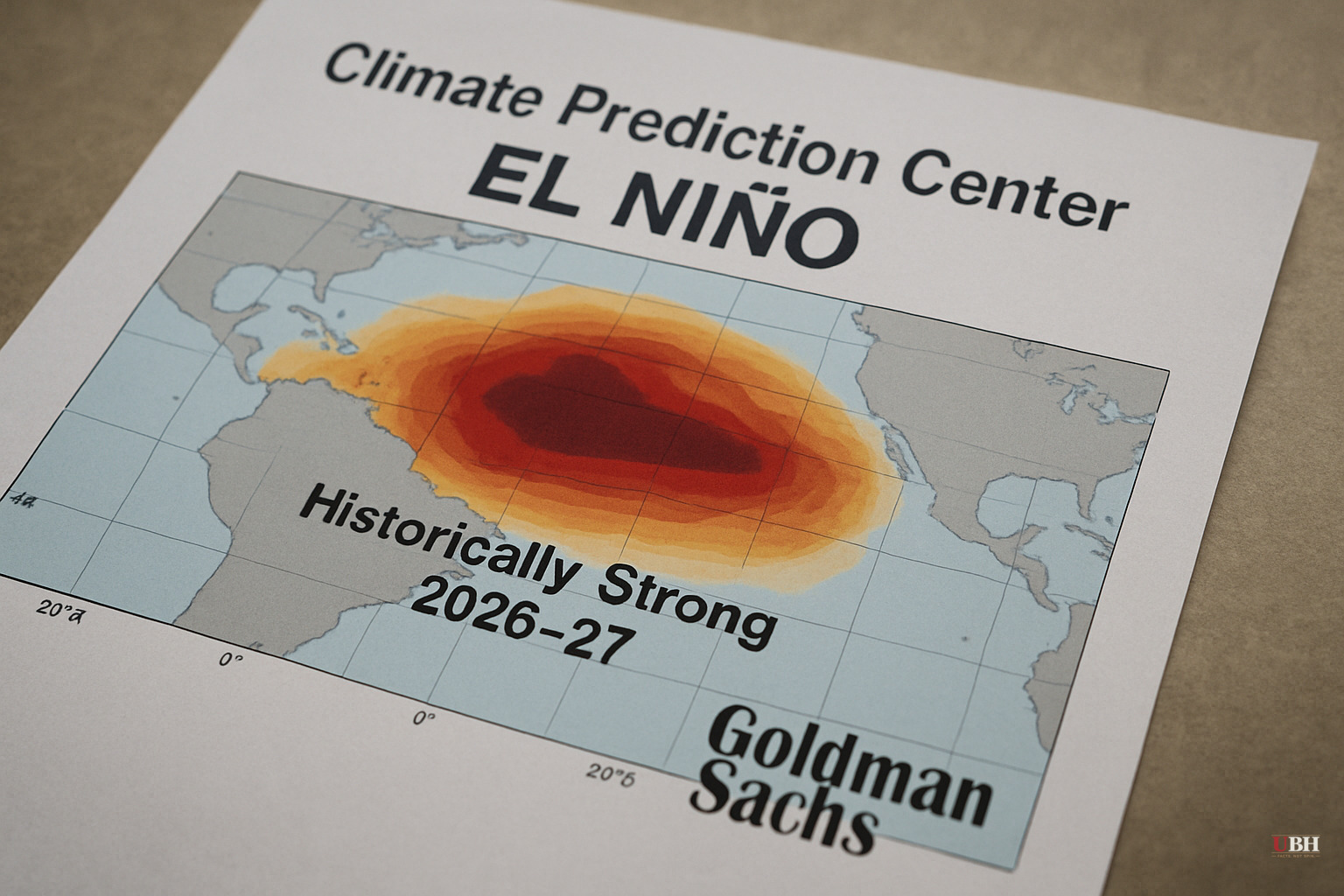
NOAA confirmed in June 2026 that El Niño conditions had officially formed over the Pacific. Since then, the forecasts have only gotten more aggressive.
The Climate Prediction Center now puts the odds of the pattern persisting through early spring 2027 at 97%, according to insurance trade publication Insurance Business. The World Meteorological Organization has the probability above 80% for the June-August 2026 window, climbing to 90% for the fourth quarter, according to Trade Treasury Payments. NOAA's own projections show a 48% to 63% chance that Pacific sea surface temperatures will run more than 2.0°C above average from September 2026 through January 2027, the threshold that classifies an event as "very strong."
The European Commission's Joint Research Centre went further, calling the June 2026 seasonal outlook "potentially historic" and warning the event has a very high likelihood of being unprecedented, with effects lingering into 2027 even after it peaks, per Insurance Business.
The money problem, not just the weather problem
Goldman Sachs analysts project this El Niño's strength could drive a 15.8% surge in global food commodity prices, according to the Guardian. The eurozone alone could see food prices rise 1.3%. Goldman says the full damage won't be "fully realised" until the second half of 2028, because the lag between extreme weather and its effect on planting, harvest, and shipping takes years to work through the system.
That timeline matters. This isn't a spike-and-recover story. It's a multi-year drag stacked on top of food inflation that's already elevated because of the Iran war, according to the Guardian. UniCredit analysts wrote that "El Niño puts 'climateflation' back on the agenda," arguing the pattern amplifies a warming baseline that's already stressing European heatwave-hit supply chains.
Central banks are watching this too. The Guardian reports the prospect of a renewed food-driven inflation shock is adding to pressure on policymakers to keep interest rates elevated rather than cut, a dynamic that lands directly on top of the bond market's own rate-hike odds debate playing out this week around Kevin Warsh's testimony and the latest CPI print.
Where the insurance market actually gets squeezed
TT Club, the marine and logistics insurer, is telling supply chain operators worldwide to treat this as a systemic risk, not a meteorological one, according to Insurance Business. Transport networks, energy systems, and commodity markets are all exposed simultaneously, and that cross-line exposure is landing at a bad time. US composite commercial insurance rates already fell 8% in the first quarter of 2026.
There's an odd silver lining buried in here. El Niño tends to increase Atlantic wind shear, which historically suppresses hurricane activity. Colorado State University is forecasting a below-average 2026 Atlantic hurricane season, and US catastrophe underwriters have welcomed that, per Insurance Business.
But don't mistake that for good news across the board. Swiss Re projects insured catastrophe losses could still hit $148 billion globally in 2026 if long-term trends hold, meaning the hurricane relief barely dents the aggregate loss picture.
The sharper mismatch is in flood coverage. NAIC data shows US private flood insurance premiums written actually fell from $803 million in 2023 to $730 million in 2024, even as a record-strength El Niño is expected to raise flood exposure specifically in California and Arizona, according to Insurance Business. Those are states already reeling from wildfire losses and carriers pulling out of the homeowners market entirely. Fewer people are buying flood coverage right as the flood risk goes up. That's happening in exactly the states where carriers have already been retreating.
Crop insurers face their own version of this. A strong El Niño creates basis risk between what USDA models predict for commodity prices and yields versus what the Pacific pattern actually produces, per Insurance Business.
The historical case for taking this seriously
Skeptics of climate-alarm framing have a fair point worth stating plainly: El Niño is a natural, recurring Pacific Ocean cycle that's been documented since at least the 17th century, when Peruvian and Ecuadorian fishermen first noticed the warm-water pattern around Christmas, according to Trade Treasury Payments. It's not a new phenomenon invented by modern climate modeling. Strong events hit in 1981-82, 1996-97, 2015-16, and 2023-24, and the world absorbed each one.
That history cuts both ways, though. The worst-documented El Niño on record, in 1876-78, triggered catastrophic droughts across China, southern Africa, Brazil, Egypt, and India, and killed more than 6 million people in India alone amid famine conditions worsened by colonial-era policy, according to the Guardian. NOAA's current projections put the 2026-27 event in the same tier of severity as that historical benchmark, not as a routine cyclical event.
The open question is how much of Goldman Sachs' 15.8% price estimate and the Guardian's 2028 timeline actually materializes versus how much gets absorbed by planting adjustments, trade flexibility, and the hurricane-suppression offset underwriters are counting on. NOAA's Climate Prediction Center is expected to issue updated Pacific temperature readings later this year as the event approaches its projected peak.
Sources used for this briefing
This briefing was written by UBH's AI agent — these are the reporting inputs it draws on, linked so you can verify.


